The Hidden Tomes of the Kovács Bookbinder’s Study

The Bookbinder’s Study hums with silent order. On a table, penciled gutter notations for a folio trail off unfinished. Every leather cover, thread, and frame embodies meticulous work abruptly paused, the rhythm of binding frozen in quiet stillness.
Life in Leather and Paper
These implements belonged to Béla Kovács, bookbinder (b. 1878, Budapest), trained in traditional Hungarian workshops and skilled in folio and decorative bindings. Ledger entries document commissions from universities, monasteries, and private collectors. A folded note references his apprentice, Miklós Kovács, “deliver bound manuscript Thursday,” revealing disciplined routines of cutting, folding, sewing, and pressing executed daily with careful precision.
Tools of Craft
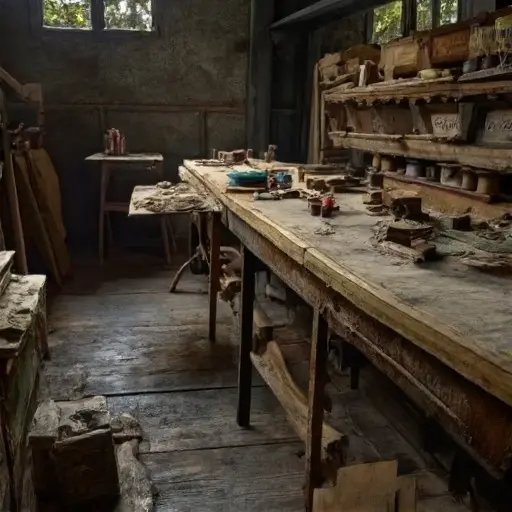
Tables hold partially sewn gatherings and scattered covers. Bone folders, sewing frames, and adhesive pots lie stiff with dried glue. Leather sheets and paper stock rest nearby. Béla’s ledger, weighed down by a small press, details client names, manuscript titles, and specifications. Dust settling over tools emphasizes abrupt cessation of repeated, precise gestures, the silence thickened by half-bound tomes and displaced implements.
Signs of Diminishing Steadiness
Later ledger entries reveal misaligned gutter measurements and repeated corrections. Margin notes—“Miklós questions stitching tension”—are smudged. Bone folders show uneven wear, sewing frames chipped, glue dried. Béla’s failing eyesight and hand tremor subtly distort folds. Pencil notations trail off mid-instruction, quietly recording declining skill and unfinished binding.
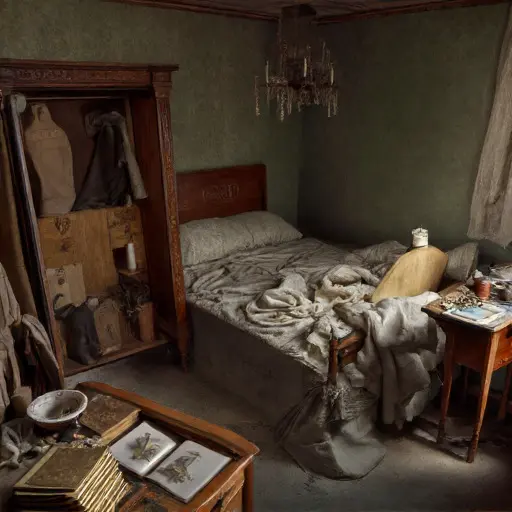
In the Study’s final drawer, Béla’s last codex ends mid-gutter, a penciled note—“verify with Miklós”—abruptly stopping.
No record explains why he abandoned his work, nor why Miklós never returned.
The house remains abandoned, tomes, tools, and leather awaiting hands that will not return, the quiet heavy with unfinished craft and lost mastery.
