The Hidden Tether of Cincture-Rivet House
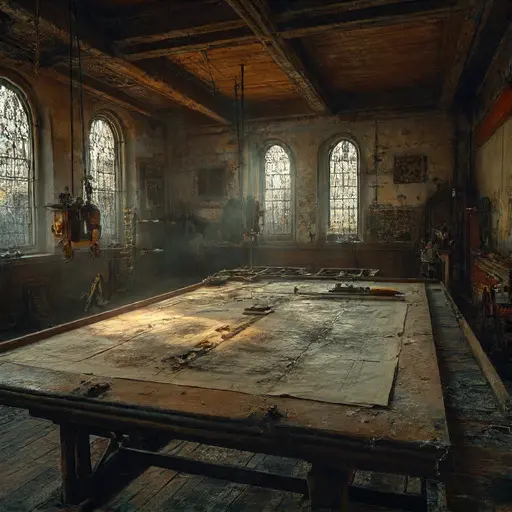
Cincture-Rivet House was an architectural study in forced unity: a massive, sprawling structure of dark, heavily reinforced brick, characterized by numerous external metal straps and internal iron columns that suggested it was being held together by external force. Its name suggested a blend of restrictive belt and binding metal fastener. The house sat low on a remote, exposed coastal flat, making it perpetually battered by wind and salt spray. Upon entering the main engineering studio, the air was immediately cold, thin, and carried a potent, mineral scent of aged iron, machine grease, and a sharp, metallic tang. The floors were rough, uneven concrete, amplifying every faint sound into an unsettling echo. The silence here was not merely quiet; it was an intense, structural stillness, the profound hush that follows the failure of a massive, complex machine. This abandoned Victorian house was a giant, sealed engine, designed to achieve and hold a state of absolute, unchangeable physical cohesion.
The Engineer’s Absolute Connection
Cincture-Rivet House was the fortified residence and elaborate workshop of Master Engineer Alistair Thorne, a brilliant but pathologically obsessive civil and mechanical engineer of the late 19th century. His professional life demanded the precise calculation of structural loads, the flawless execution of complex metal joins, and the pursuit of absolute, unyielding physical connection. Personally, Master Thorne was tormented by a crippling fear of separation and a profound paranoia that all relationships, objects, and structures were doomed to inevitably fracture and drift apart. He saw the House as his ultimate project: a structure where every component was intentionally riveted, strapped, and bolted to every other component, convinced that he could create a single, unshakeable physical entity that would never break apart.
The Stress-Testing Vault
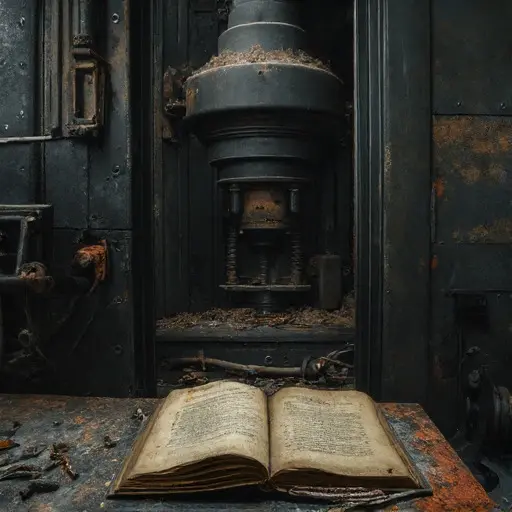
Master Thorne’s Stress-Testing Vault was the inner sanctum of his mechanical paranoia. Here, he tested the limits of cohesion, driving materials to the point of catastrophic failure. We found his final, detailed Cohesion Log, bound in thick, scarred metal plates. His entries chronicled his escalating desperation to find the “Zero-Stress Rivet”—a fastener so strong it could never fail. His notes revealed that he had begun to view his own body and mind as the last unriveted, unfastened system, the most dangerous point of failure. His final project, detailed meticulously, was the creation of a massive, unique, internal “Master Fastener”—a final, absolute rivet designed to permanently join the core of the house to the bedrock beneath it, ensuring the entire structure could never shift.
The Final Connection
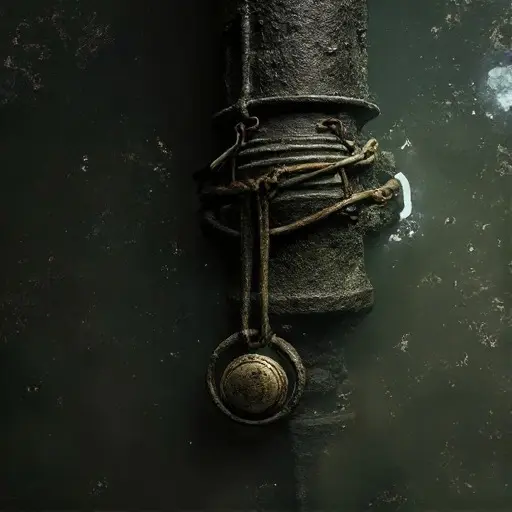
The most chilling discovery was made deep beneath the house, in a flooded sub-level accessible only through a heavy, bolted hatch in the testing vault. The water was shallow, but the air was dense and cold. Here, embedded deep in the bedrock, was the Master Fastener—a massive, custom-forged iron rivet, its head fully seated against the base of the central foundation pillar. Attached to the head of the rivet was a single, small, tarnished locket, fixed to the iron by a thin, strong brass wire. Tucked inside the locket was Master Thorne’s final note. It revealed the tragic climax: he had successfully engineered and driven his Master Fastener, achieving the permanent, unshakeable connection he craved between the house and the earth. He realized, however, that in permanently anchoring the physical structure, he had only highlighted the fragility of the human heart. The locket contained a faded photograph of his estranged wife, Elara. His final note read: “The structure is sound. The connection is eternal. I am the final, unriveted piece.” His body was never found. The hidden tether of Cincture-Rivet House is the enduring, cold, and utterly massive rivet, a terrifying testament to an engineer who achieved structural cohesion only to find the ultimate, unfastened flaw was the solitary nature of his own unanchored existence, preserved within the bolted silence of the abandoned Victorian house.}