The Hidden Takahashi Mounting Table and the Print Left Askew
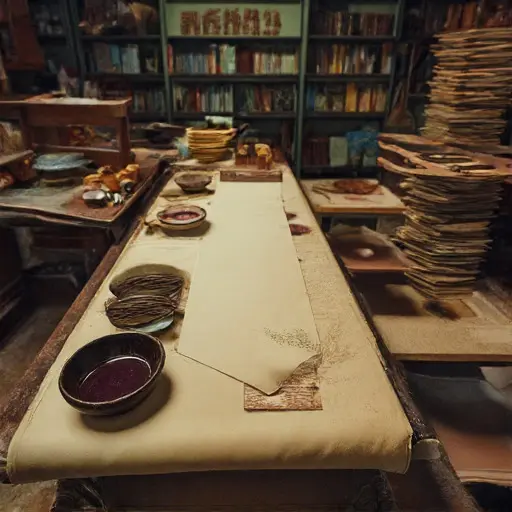
The Printmaking Studio wears a thin veil of ink-sweet stillness. The mounting table’s surface, polished by years of brushing prints into place, holds one sheet misaligned by barely a breath. A brush rests bristle-down, its lacquered handle bearing a fresh smudge.
Nearby, a dish of paste-water has cooled, forming a dull ring around its rim. Nothing is shattered or spilled; instead, the quiet feels weighted by an interrupted thought—something reconsidered in silence and left floating between tools and paper fibers.
The Patient Craft of Hiroshi Kenji Takahashi, Woodblock Artist
Traces within these rooms recall Hiroshi Kenji Takahashi, born 1876 in Edo (now Tokyo), trained under modest ukiyo-e ateliers before traveling abroad. In the Carving Corner, cherry blocks inscribed with Japanese titles lean beside micro-chisels wrapped in silk cloth, each tool marked with the delicate geometry of practiced carving. Bowls of mineral pigments—vermilion, indigo, pine soot—line a shelf above a hand-worn baren.
Hiroshi’s working rhythm pulses through the arrangement: mornings spent preparing pigments, afternoons pulling proofs, evenings mounting finished sheets onto backing papers. In the Reading Niche, a small folding screen painted with cranes and pines stands near a kettle and cup; steam stains rise faintly on the wall above it, remnants of quiet breaks taken between layers of ink. His temperament surfaces in the gentle order, the unhurried placement of objects, the soft tether between discipline and contemplation.
Where Tension Took Root in Gentle Materials
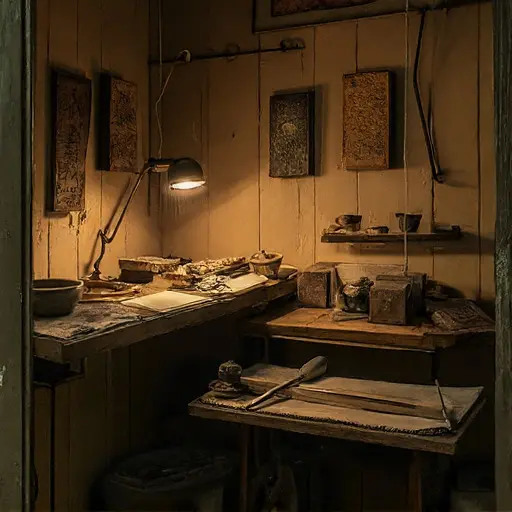
Signs of strain gather in muted spaces. In the Upper Washstand Room, a cracked inkstone rests beside a cloth stained with sumi that has spread irregularly—suggesting a slip in hand or focus. A letter from Yokohama, edges softened by moisture, lies unopened on the sill. On the Guest Cot, a travel wrap embroidered with a wave motif folds around empty pigment jars and a single dull chisel, as though a departure was considered but abandoned midway.
A bundle of washi backing sheets in the Side Cabinet has warped along one edge, reacting to moisture he would normally guard against. Even the kettle in the reading niche shows mineral deposits along its spout, hinting that evening pauses once steady may have grown distracted, uneven.
The Crease That Bent the Final Decision
Returning to the Printmaking Studio, all unease circles back to the faint crease across the misaligned print. Its bend is slight yet unmistakable, the kind of flaw Hiroshi would never allow to stand. The mounting brush nearby bears dry, clumped bristles—forgotten mid-cleaning. A cherry block sits face-down, its carved waves partly inked, as though the final print run halted mid-process.
The rinse basin has collected a thin film of pigment, its surface undisturbed. A baren lies on its side, not in its usual nesting cloth. Dust outlines where a second brush once rested, its absence troubling in a room so carefully maintained.
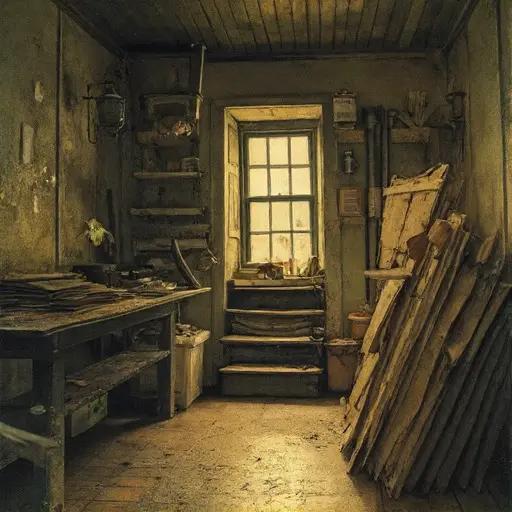
Behind the mounting table, tucked near a crate of rolled washi, rests his final attempt: a near-finished print whose horizon line wavers. The paper’s tension faltered, the pigment edges softened as though uncertainty reached the brush before he could steady it. No annotation clarifies the interruption—only a gentle crease holding a moment he could not resolve.
The house guards its silence, and it remains abandoned still.
