The Hidden Rousseau Upholstery Hall Where the Patterns Slipped Away
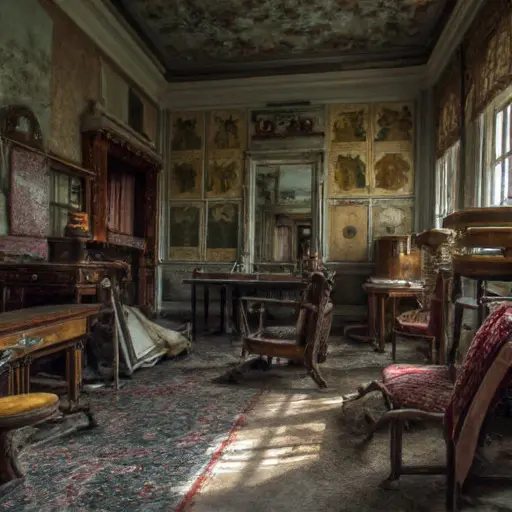
The hall smells faintly of old fabric, glue, and cedar polish. Dust mottles the gilt edges of a once-fine chaise. A coil of linen piping droops over the arm of a chair, one end frayed.
The silence is heavy, as if the room once thrummed with the rhythm of tack hammer and tautened webbing but lost its pulse in a single moment. Anyone stepping here senses a disruption—quiet, abrupt, and unresolved.
A Tradesman’s Life Stitched Into Every Surface
This upholstery hall retains the careful artistry of Aimé Laurent Rousseau, upholsterer and furniture restorer, born 1871 in Lyon. Raised among modest artisans, he brought the discipline of guild work into this residence. His tools show it: shears sharpened to a whiskering shine; upholstery needles bound in ribbons; tack hammers arranged by weight. A lavender sachet from his sister, Marie-Claire Rousseau, rests atop a chest of trims, its fabric yellowing at the corners.
Aimé worked by daylight rhythms—morning sketching, afternoon webbing and padding, evening stitching under lamplight. He revitalized threadbare divans for traveling families, rebuilt fauteuils for those with a taste for Parisian fashion, and matched imported patterns with precision. Every project bore his hallmark: seam tightness measured by fingertip feel alone.
Mastery in Bloom, Then Frayed Edges
During prosperous years, fine fabrics arrived wrapped in paper stamped from Marseille merchants. Upholstery springs gleam in a bin beside a crate of florid passementerie. A catalog of Rococo patterns lies open on a settled ottoman, its pages dog-eared from frequent consultation. A faint scent of anise from his evening tea lingers near the worktable.
Yet disturbances whisper through subtle signs. A webbing strap is tacked unevenly along one chair frame; Aimé never tolerated such asymmetry. A needle snapped inside a half-stitched cushion, its broken eye glinting from the seam. Two brocade panels, meant to mirror each other, sit misaligned. In his ledger, a prestigious commission is circled in red, then crossed out, then scribbled back—confusion unraveling where clarity once lived.
The TURNING POINT That Unseated His Composure
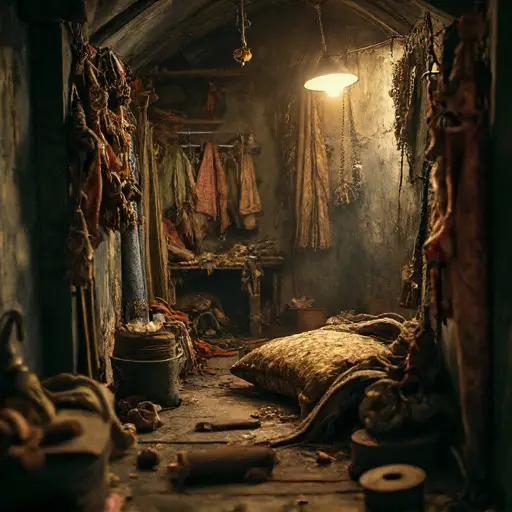
One evening marked an unmistakable shift. An ornate chaise, its under-webbing newly cased, displays a corner ripped as though tugged too sharply. The tack hammer’s handle is split, fibers splaying outward. Nearby, a brocade panel is slash-torn—not from anger, perhaps, but from a desperate miscut he tried to correct too late. His handwriting, usually calm, stutters across a pinned note: “Patron claims imitation… my design was honest.”
Rumors flickered: a noble household accused Aimé of copying an exclusive pattern reserved for their salon; another claimed he substituted cheaper fabric. He insisted his swatches had matched the order, but doubt settled on him like fine dust. One page in his ledger ends abruptly after a single line: “They won’t hear me.”
Feathers spill from a cushion left open at the seam. A bolt of toile slumps against the wall, its pastoral scenes marred by a dark water stain. Even the lavender sachet from Marie-Claire lies overturned, scent faded as if its purpose were forgotten.
A Secret in the Chair’s Hollow
At the back of the hall, a wingback armchair stripped to its frame reveals a loosened panel. Behind it, in the hollow between springs and webbing, lies a linen-wrapped parcel. Inside rests a delicate sample cushion, flawlessly stitched in a now out-of-fashion pattern—one Aimé may have designed himself. Beneath it, folded twice, is a single note: “For Marie-Claire—my design, not theirs.” The ink thins near the edges, as though the brush of his hand shook.
Beside the cushion sits a spool of gold thread, its end pulled taut, frayed in a way that suggests both beginning and breaking. No conclusion is offered—only suggestion, lingering like the room’s muted scent.
The Last Soft Clue
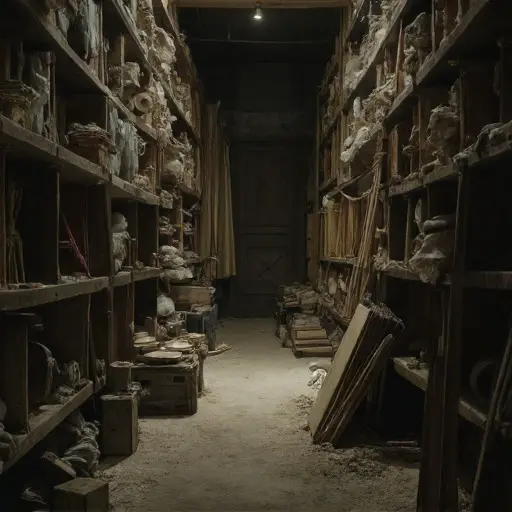
Inside the empty settee frame rests a thin sketchbook page slipped between two slack straps. A faint charcoal drawing outlines a new chair design—curved arms, high back, unusual symmetry. But the final strokes falter before completion. Beneath the drawing, Aimé wrote only: “They won’t trust the hand that made it.” Nothing more.
The upholstery hall settles into its waiting hush, threads curled like questions.
And the house, holding this abandoned upholsterer’s room, remains abandoned.
