The Hidden Prism of the Rossi Glassblower’s Workshop
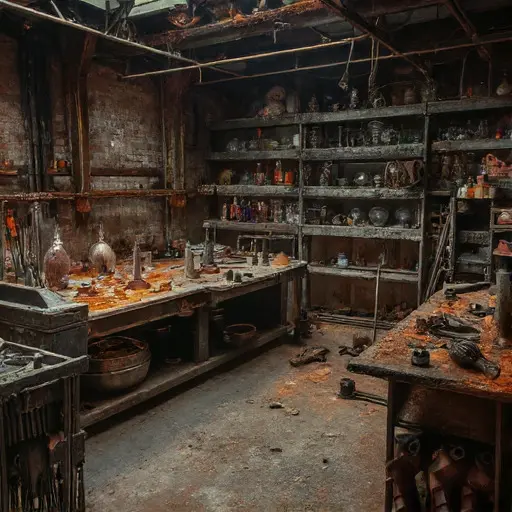
A pervasive stillness fills the Glassblower’s Workshop, where penciled fuse notes on a design sheet stop abruptly, hinting at interrupted craft and suspended experimentation.
Form and Fire
These implements belonged to Marco Rossi, glassblower (b. 1884, Venice), trained in a family atelier specializing in Venetian glass.
His Italian notes record furnace temperatures, glass thickness, and color blending. A folded slip references his apprentice, Luca Rossi, “complete prism assembly Thursday,” revealing a daily schedule of heating, shaping, and cooling, alongside a temperament of patient attention, careful rhythm, and meticulous control.
Furnaces and Vessels
On the main bench, metal tongs, molds, and glass rods lie in careful alignment. Partially blown glass vessels rest under blotters. A ledger beneath a folded cloth details glass thickness, color gradation, and cooling duration, each carefully dated. A half-finished prism remains on a stand, evidence of work abruptly halted mid-shape, leaving precision frozen mid-process.
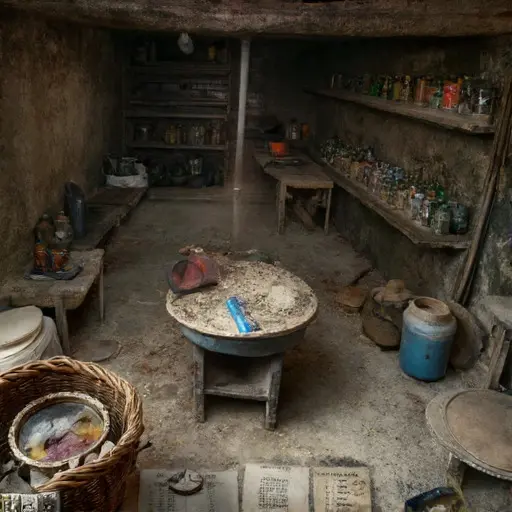
Precision Interrupted
Later ledger pages reveal repeated corrections to color layering and shape symmetry. Several glass vessels show uneven curves or air bubbles. A margin note—“client rejects tone”—is smudged, indicating rising stress. Tools lie abandoned across benches. Persistent tremors in Marco’s hands, compounded by heat-induced exhaustion, forced his careful craft to falter, leaving glassware permanently unfinished and routines disrupted.
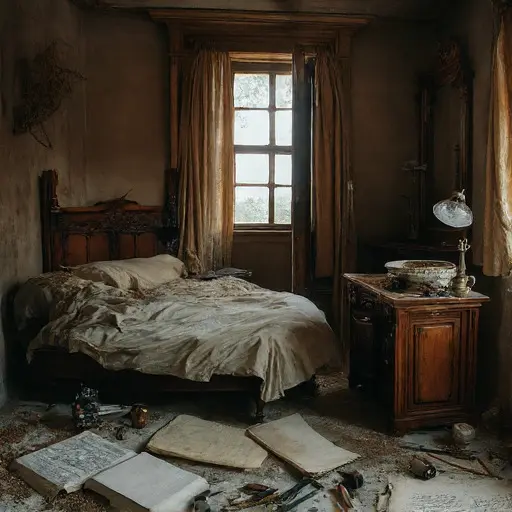
In the Workshop’s final drawer, Marco’s last fuse note ends mid-instruction, lines trailing into blank space. A penciled reminder—“verify with Luca”—stops abruptly.
No record explains why he abandoned his work, nor why Luca never returned to finish the glass pieces.
The house remains abandoned, tools and glass frozen mid-creation, preserving the quiet persistence of glassblowing interrupted, unresolved, and suspended in delicate neglect, a testament to meticulous artistry left unfinished.