The Hidden Moreau Attic Where the Gears Stopped Turning
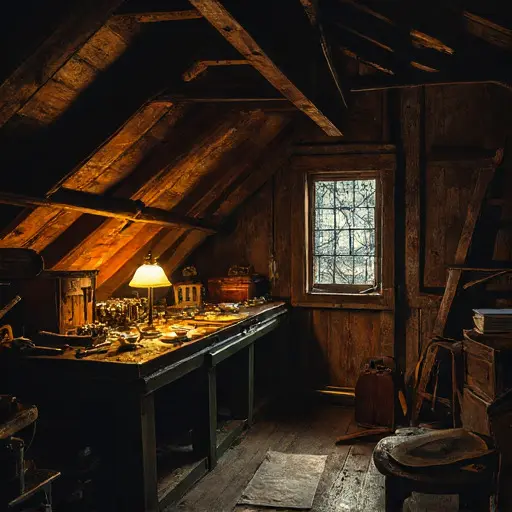
The air inside the attic feels taut with the kind of hush that settles after something has shifted yet refuses to name itself. The sloping roof groans faintly, and the scattered cogs click softly when the boards breathe. Here, once, time was shaped rather than measured.
Now an odd resonance clings to the cramped beams, as if all the unfinished mechanisms murmur at the edges of perception. Dust rests evenly except where a hand—long vanished—brushed it aside in a hurry.
Crafting Time in a Space of His Own
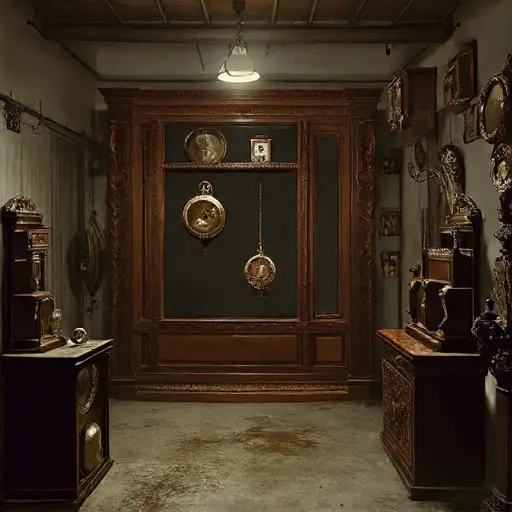
The life of Étienne Marcel Moreau, clockmaker and precision instrument artisan, born 1874 in Lyon, unfurls across this attic workshop. His craft lingered in every corner: French carriage clocks lined along a crooked shelf, a delicate Geneva movement pinned open on felt, and a tray of enamel numeral plates arranged with near-reverence. A book on mechanical harmonics—its spine cracked—lies beside a small box labeled with his sister’s name, Colette Moreau, containing a locket and a child-sized chain.
Étienne’s upbringing was modest, but his apprenticeship cultivated a meticulous temperament. The adjacent niche beneath the eaves evidences his routines: a cushion flattened where he sat to test chimes, the dust-flecked scent of metal polish, and a cup marked by the ring of countless cooled coffees. At the height of his ambition, his pieces were commissioned by merchants seeking fashionable imports from France. His clocks sang with precise tones, subtle flourishes, and movements polished to near-mirror sheen.
Seasons of Mastery and Quiet Revisions
As he matured in craft, he modified the attic to suit evolving techniques. A pulley rig—improvised from curtain cords—hangs above the bench to suspend heavy cases. Sketches of unusual escapements are pinned to a corkboard, though several have been violently torn away, leaving only jagged corners. A lacquered chest holds chime rods sorted by pitch, arranged neatly at first, then increasingly jumbled in later trays.
His successes were real, yet the traces of pressure appear in small misalignments: a cracked crystal cover left unrepaired, a gear blank filed unevenly, a metronome jammed at an impossible tempo. Étienne had begun receiving commissions demanding rapid turnaround, and the attic bears the tension of those late-night hours—lamps burned to stubs, oil cans overturned, fine shavings swept only halfway under the bench.
Signs of Undoing After the TURNING POINT
Another winter night must have ruptured his self-control. A splintered bracket on the main beam indicates something heavy fell—perhaps the ornate wall clock now wrapped under linen. Beside the workbench lies a broken mainspring that seemed forced beyond tolerance, its coil warped in a way no careful clockmaker would permit. Étienne’s hand must have slipped or trembled, the accident marking the start of his decline.
Later clues deepen the mystery: a set of tuning forks arranged to spell nothing meaningful, a screw-topped jar containing fragments of enamel numbered “VII” and “XII,” and a small ledger of orders with entire pages excised. Rumors whispered of a patron accusing him of installing defective escapements, a scandal that might have threatened his livelihood. But here, nothing is certain. One chipped chime rod bears a faint inscription—“Colette”—suggesting perhaps a private grief or family entanglement folded beneath his professional troubles.
A narrow drawer under the bench holds a chain with a snapped clasp, next to a sealed envelope addressed in wavering script. It was never posted. The wax is unbroken.
What Remained in the Quiet Suspended Above
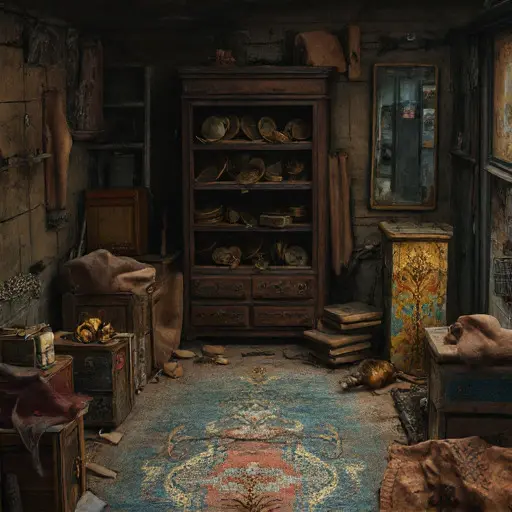
Behind the armoire, a section of paneling has shifted, revealing a recess no larger than a shoebox. Inside rests an incomplete movement mounted to a test frame, its balance wheel missing. A slip of paper, tied to one gear tooth, reads in Étienne’s frail lettering: “Not aligned… forgive the drift.” No date, no signature.
Whether the “drift” referred to a mechanism, a failed commission, or a personal rupture is left unspoken. The unfinished movement ticks faintly when touched, though it lacks the parts required for true operation—nothing more than a ghost of intention.
The stillness climbs the rafters again, folding over gears, sketches, and quiet regrets. And the house, like the stalled clocks within, remains abandoned.
