The Hidden Mancini Stonecarver’s Niche Where the Figures Turned Away
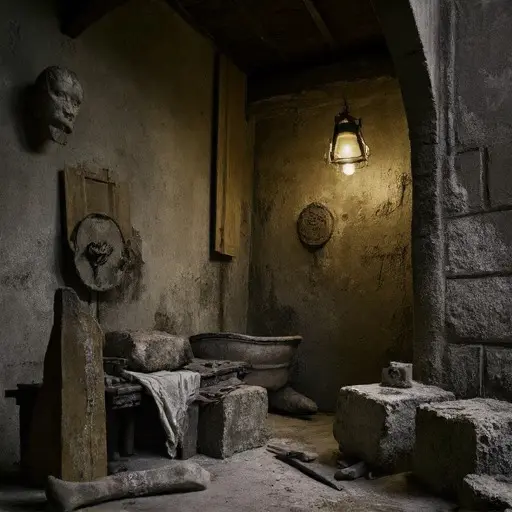
The niche is saturated with the dry whisper of marble, as if every scrape once heard still lingers in its corners. Powder lies thick along the floor in drifting swirls. A long rasp rests across a slab, its teeth clogged mid-stroke.
The bust at the center, an unpolished face turned slightly aside, seems to resist both finishing and forgetting. The space feels interrupted—caught in the breath between one hammer strike and the next.
A Sculptor’s Work Bound to Dust and Discipline
This stonecarver’s niche holds the life of Lorenzo Vittorio Mancini, sculptor and monument artisan, born 1872 in Florence. Trained in modest studios under artisans who carved grave markers and saintly figures, he developed a temperament both meticulous and inward. His tools show it: Italian chisels arranged by fineness, files sorted in linen rolls, and a clay bowl of olive oil kept for softening carved details.
A small cameo of his sister, Giulia Mancini, is tucked beneath a travertine block, its frame subtly bent. Lorenzo’s days followed a rhythm of dust and decision—roughing stone at dawn, defining form through long afternoons, finishing edges by lamp when shadows revealed flaws daylight hid. His commissions ranged from household statues to chapel ornaments, each piece bearing his quiet exactitude.
Peak Craft Shadowed by Unease
At his high point, Lorenzo kept this niche tidy despite its crumbling walls. Marble chips swept into neat piles showed the angles of work completed. A terracotta jug of water sat beside reference sketches of Renaissance figures, imported via traveling art merchants from Rome. Wooden crates held chisels from Carrara, each etched with careful measurements.
Yet subtle disturbances crept into the orderly surfaces. One chisel’s edge is ground to an awkward bevel. A block of alabaster displays a gouge inconsistent with purposeful shaping. His sketch pinned closest to the lantern—a kneeling figure—ends in erratic lines, the proportions unraveling. A ledger of commissions lies open to a page where a patron’s name is crossed out, rewritten, then smudged away entirely.
Rumors later hinted at misinterpretation of a memorial carving, or an accusation that Lorenzo altered iconography after contract. Others whispered of financial strain following a rejected chapel piece. Nothing in the niche clarifies—only the accumulating signs of disrupted concentration.
The TURNING POINT That Disturbed the Chisel’s Path
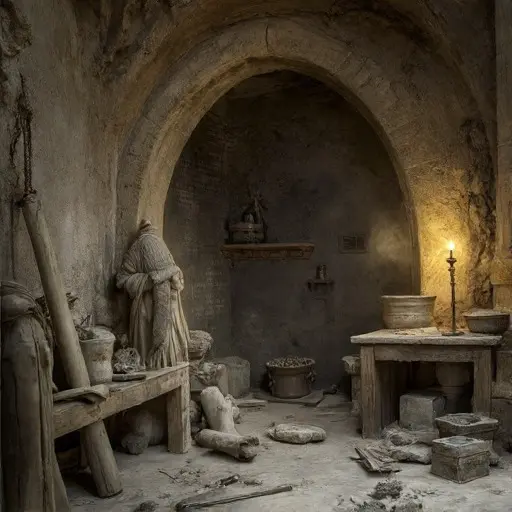
One spring night left unmistakable disruptions: a hammer lies on its side, its handle split; the travertine bust shows a fresh chip across its brow, as though Lorenzo struck too hard or too suddenly. A sketchbook beneath the mallet reveals torn pages where he once planned a monument—now only stray charcoal stubs remain.
A whispered argument with a patron reached the district: an accusation that Lorenzo delivered the wrong expression in a funerary bas-relief, or perhaps carved an unauthorized likeness. Some spoke of legal threats; others claimed he was asked to modify a sacred symbol and refused. In the ledger’s margin, a note reads in wavering Italian: “Not my error—they insisted.”
The finishing cloth, usually folded, lies crumpled on the floor. Several chisels are arranged backwards in the rack. One riffling file shows signs of grinding metal against stone too forcefully, as if in frustration. A shallow bowl of olive oil has spilled onto a blueprint, blurring the design lines beyond recognition.
Secrets Hid Within the Stone’s Shadow
Behind the largest travertine block, a narrow cavity in the wall reveals itself when tapped. Inside rests a small marble fragment carved into the beginning of a serene face—delicate, precise, then abruptly marred by a diagonal crack. Wrapped around it is a slip of parchment bearing five cramped words: “Giulia asked me—unfinished forever.”
No date, no context. Whether this was a private commission, a memorial he feared was beyond his skill, or a symbol caught in dispute remains uncertain. The fissure across the fragment might come from stress or from a calculated break.
The Last Quiet Shaping
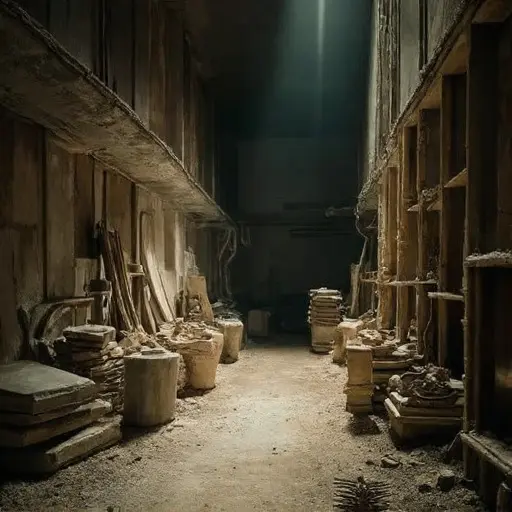
Inside a hollowed molding template near the corridor’s end lies one final remnant: a charcoal study of an angelic figure, its wings sketched with trembling strokes. A note at the bottom reads: “Could not change what they demanded.” The charcoal ends in a broken line.
Stone dust settles again, blanketing tools that once followed his will.
And the house, wrapped around its abandoned stonecarver’s niche, remains abandoned.
