The Hidden Library of the Valerian-Peak
The Valerian-Peak, a severe and imposing structure of grey granite built in 1870, dominates a rocky outcrop, offering panoramic views that were once the envy of the region. Its style is muscular Gothic Revival, relying on heavy masonry and high, narrow windows. To enter is to immediately encounter a house that is beginning to physically fail under the weight of its own stone and the unchecked forces of water and neglect.
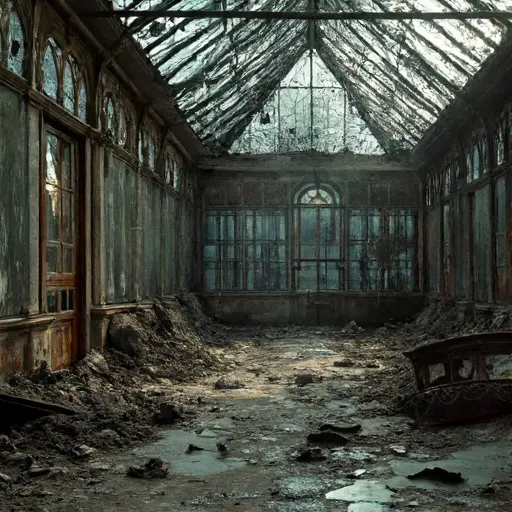
The Winter Garden, a small, delicate glass and iron structure appended to the main house, is a recent casualty. Its destruction is a stark, raw record of the hidden vulnerability underlying the mansion’s imposing façade. The house did not just become abandoned; it slowly consumed itself, starting from the outside in.
The Disciplined Scholar, Professor Elias Croft
The mansion was built for Professor Elias Croft (1830–1895), a figure defined by his dedication to academia. His profession was classical philology and ancient history, a world of exacting rules and precise translations. Socially, he was a severe, respected intellectual, utterly lacking in flexibility or humor.
Elias married Juliet Hawthorne in 1855, a kind but frail woman who lived perpetually in the shadow of his vast intellect. They had two children: Edgar and Helen. Elias’s personality was one of supreme, suffocating discipline; his daily routine consisted of rigid hours spent researching and writing in his immense, custom-built, second-floor Hidden Library. His ambition was to complete a definitive, multi-volume translation of the Roman historian Tacitus, a work he believed would guarantee his immortality. His greatest fear was distraction and intellectual failure.
The Hidden Library was the architectural heart of the house—a vast, windowless space whose entrance was entirely concealed behind a moving, seven-foot-tall bookcase in the main study. This detail perfectly encapsulated his need for intellectual isolation and security.
The Breach in the Hidden Library
The family’s failure was an intellectual and emotional disaster. Edgar, the son, was utterly incapable of meeting his father’s academic standards, suffering constant belittlement. He developed a deep resentment for the mansion and the books it contained. Helen, the daughter, was secretly a gifted musician, a pursuit her father deemed frivolous and trivial.
The final rupture occurred in 1895. Professor Croft, agonizing over a difficult passage in his translation, discovered that his son, Edgar, had fled the country for America, leaving behind a brief note of profound rejection, declaring his intent to work as a common laborer. Hours later, the Professor suffered a massive stroke in his Hidden Library. He lay there for a day before being found by his wife, paralyzed and unable to speak, his work incomplete.
Juliet, heartbroken by the loss of her son and the breakdown of her husband, made a single, desperate, and hidden decision. Knowing her husband’s translation was nearly done, she attempted to finish the final pages herself, finding the correct classical reference. She failed, and in her grief, she deliberately removed and destroyed the few final pages of his manuscript, ensuring his life’s work would remain permanently unfinished.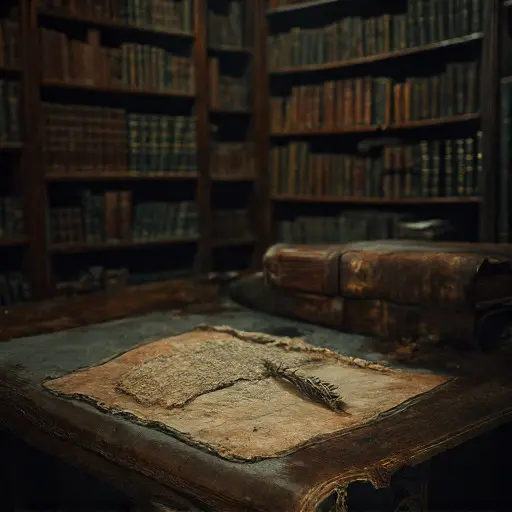
The Unused Music Box in the Master Chamber
Professor Croft died a month later. Juliet, left alone with the knowledge of her secret act of sabotage and the shame of her son’s flight, could not bear to stay. She had only one surviving child, Helen, who immediately accepted a position as a touring pianist in Europe, leaving her mother entirely alone.
Juliet sold nothing, leaving the house full of the Professor’s books and papers. She paid the property taxes for three years, just enough time to ensure the house was not immediately sold and re-occupied, and then she quietly took her own life in 1898, leaving no note, only a small, elegant silver music box open on her bedside table.
The Valerian-Peak was quickly seized by the bank but, due to its remote location and the intense academic clutter left inside, it proved entirely unsaleable for decades. It slipped into a long, permanent limbo.
In the Master Chamber, the Professor’s massive, severe furniture remains untouched. On the nightstand, beside the heavy, four-poster bed, the small, ornate music box sits open, entirely covered in dust, its inner mechanism rusted solid and permanently silent.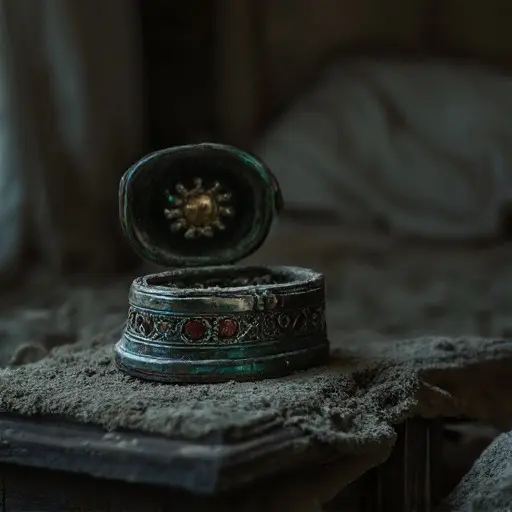
The Valerian-Peak remains today, a massive granite tomb overlooking the gorge. The Hidden Library still holds its secrets, its walls protecting the remnants of a destroyed manuscript and the evidence of an emotional failure that broke both the family and the house itself.
