The Hidden Ash-Limestone Courtyard House
Abandoned Victorian house, pale ash-limestone rendered walls with uneven limewash absorption patterns that reveal decades of rain streaking and mineral leaching, deep bottle-black timber beams softened into charcoal-brown through prolonged weather exposure, and hand-forged ironwork in muted iron-oxide tones with visible hammer marks and slight irregularities in curvature. A compact Victorian courtyard-internal residence is concealed deep within a dense urban block, accessible only through a narrow arched passageway that opens suddenly into a private internal garden courtyard. The entire building is inward-facing, designed as a protected enclosure rather than a street-facing façade, forming a quiet architectural world centered around open air and controlled light.
The structure wraps around the courtyard in a near-rectangular arrangement, with three sides containing living quarters and one side formed by a covered arcade supported by aged timber columns. The roof is steep slate, heavily varied in tone due to layered repairs over time—some tiles deep graphite-gray, others softened to bluish slate, with occasional mismatched replacements that subtly disrupt uniformity while preserving structural continuity.
Chimneys rise unevenly along the roofline, each constructed from different brick batches and mortar compositions, revealing a long, pragmatic history of maintenance rather than a single construction event.
The façade is fully exterior and materially truthful in its aging behavior. Ash-limestone surfaces show vertical runoff staining, with softened erosion along corners and protruding edges where water has repeatedly flowed over decades. Timber beams display stratified weathering: original dark coatings thinned by time, exposing warmer brown wood beneath in irregular patches that follow exposure patterns rather than decorative intent. Iron brackets, balcony rails, and structural fasteners exhibit natural oxidation gradients—heavier in shaded, moisture-retaining zones and lighter where rain has periodically cleaned exposed surfaces.
The central courtyard defines the entire architectural experience. It is a rectangular open-air garden enclosed on all sides, where stone paving and reclaimed soil intermingle as vegetation slowly reclaims structural geometry. Moss spreads along joints in organic, non-uniform patterns, while grass emerges in irregular clusters where paving has shifted or subsided. The original garden layout remains legible only through subtle differences in texture, elevation, and material wear rather than intact design lines.
Vegetation develops in restrained, ecologically plausible layers. Ivy climbs selectively along damp masonry, following mortar cracks and water pathways rather than uniformly covering surfaces. Small trees establish themselves at courtyard corners, their root systems subtly displacing older stone foundations. Wildflowers appear sparingly and realistically: pale white blossoms in shaded recesses, muted violet flowers along drainage channels, and occasional soft yellow blooms in narrow sunlit openings where light reaches the courtyard floor.
A circular stone well sits slightly off-center within the courtyard, its rim worn smooth from long-term contact and use. It is dry, but interior mineral staining suggests historical water presence and evaporation cycles. Nearby, a collapsed wrought-iron pergola leans into the space, its structural geometry still readable but softened by corrosion and plant entanglement. On the upper level, wooden shutters remain partially open, warped slightly by humidity, revealing dim interior rooms with faded plaster surfaces and empty fireplace recesses.
Lighting is realistic courtyard illumination filtered through surrounding buildings—soft, indirect daylight with limited sky visibility and strong ambient bounce from pale stone surfaces. Shadows are subtle, layered, and spatially coherent, avoiding harsh contrast or stylized glow. The air is still, slightly cool, and acoustically muted, as if the courtyard maintains its own enclosed microclimate separate from the surrounding city.
Interior Image Descriptions (for flux dev generation):
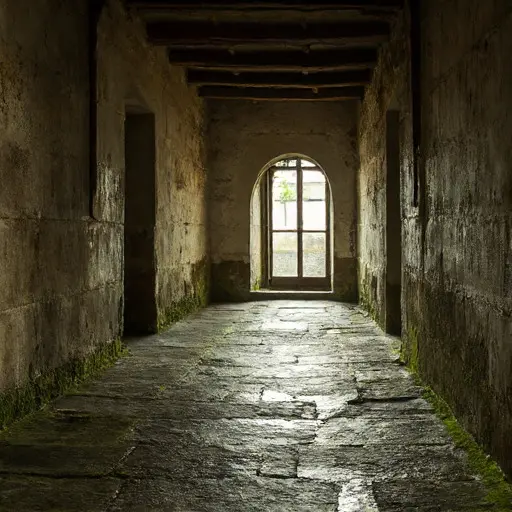
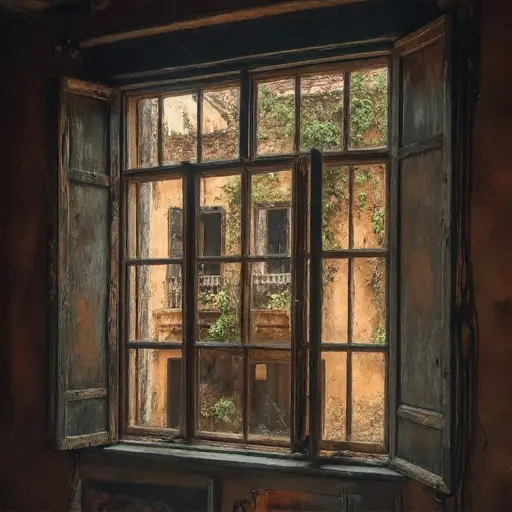
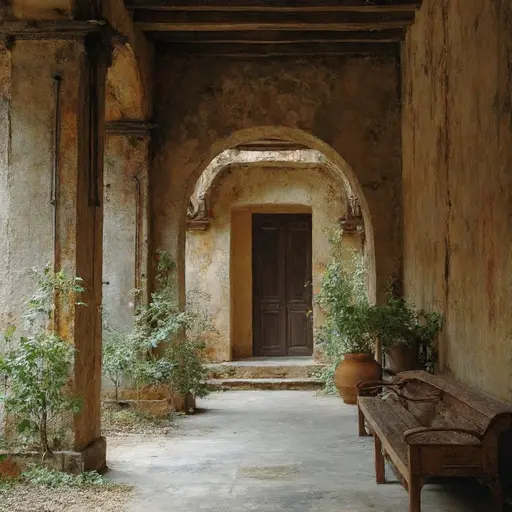
The entire scene reads like a high-resolution architectural survey photograph of a hidden Victorian courtyard residence—documentary, physically grounded, and materially precise. A place defined by enclosure, slow weathering, and protected stillness rather than exposure or decay drama.