The Hidden Alvarez Ore-Sorting Cellar Where the Veins Drifted Off-Pattern
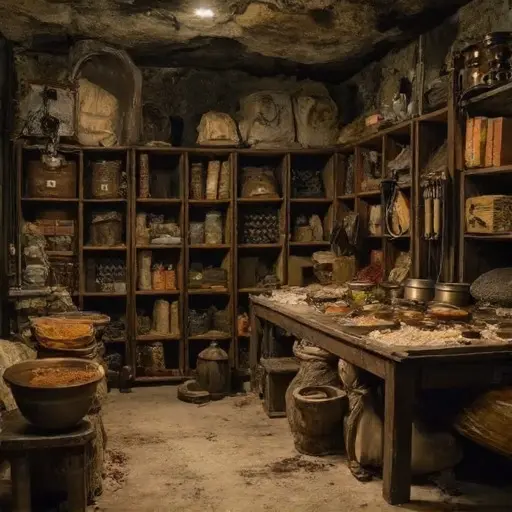
A chalk-dry stillness hangs in the cellar, heavy with mineral smell. The central sorting table holds a half-completed classification tray: upper compartments neatly ridged and separated, lower sections muddied, mixtures slumped together as though the distinction between grades had blurred. A brass pan hangs slightly off level.
Several assay tags lie curled, their ink faded and smudged by handling that ended long ago. Nothing here ruptures the atmosphere; only the sense that once-reliable judgment fell into quiet error.
A Metalworker Defined by Layers, Weight, and Vein
This ore-sorting cellar belonged to an assay worker trained in Spanish metallurgical tradition, indicated only through the artifacts he left behind. Handwritten tags in Castilian script label drawers of sulfides; a leather-bound assay ledger bears arithmetic entries rendered in old Iberian numerals. A copper crucible mold etched with regional motifs rests near a stack of ingot patterns, each bearing the stamp of a small provincial workshop by the Guadalquivir.
The rigor of his craft is implied by the precision of his tools: sieves nested by mesh size, tongs laid at exact intervals, reference stones arranged according to hardness scale. Even the chalkboard on the wall—its upper figures crisp, lower ones slanted—suggests a life once shaped by measured comparison, attentive sampling, and confidence in what the rock revealed.
Evidence of Faltering Classification
Subtle irregularities mark the transition from consistency to drift. A drawer labeled “galena–high grade” contains mixed fragments, some unmistakably low yield. An assay scoop has a bend in its handle, likely from a dropped weight misjudged. Two weighing stones are out of sequence—an error surprising in such a methodical workspace.
Pinned beneath a cluster of ore sacks lies a torn scrap of Spanish script: “report disputed… sample boundaries unclear.” Another note, partly obliterated by mineral dust, references “return demanded,” though the context is unreachable. Along the far wall, a large gradient chart depicting mineral veins has a lower quadrant misdrawn—its veins skewed, their branching angles unnatural compared to the precise patterns in the upper half. Whether the distortion reflects misinterpretation, outside pressure, or an abandoned correction is unknowable.
The TURNING POINT Pressed into Altered Readings
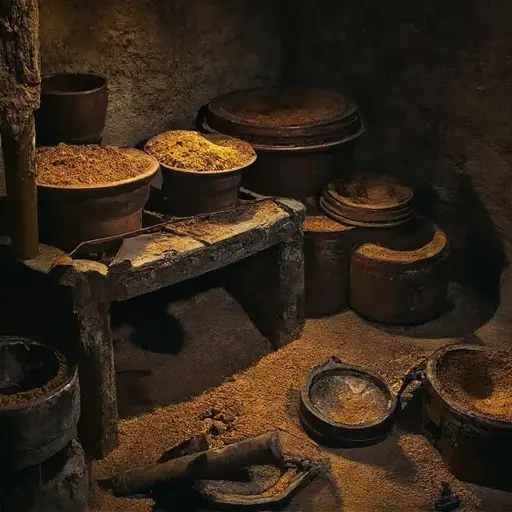
On the main assay bench lies a large evaluation sheet affixed to a worn board. Its first columns list yields and densities in tidy increments; the latter columns wander with inconsistent figures, corrections overwritten, then struck through again. A crucible containing partially smelted ore has cooled into a dark, glassy slump, its form inconsistent with the refined bead expected of practiced work.
Beneath a cracked ingot mold, a fragment of a report survives in thinning graphite: “grade challenged… revision refused.” The writing degrades into faint scratches, spacing erratic. Two reference ore samples—once stored side by side for verification—now lie in reversed positions, labels fluttering loose. A pan of sorted fragments stands half-filled, the dividing line tilted as though the judgment of where one grade ended and another began could no longer be trusted.
A notebook cover, warped by moisture, contains pages where chemical testing values begin confidently then dissolve into crossed-out attempts and unanchored numbers.
A Narrow Gap Behind the Ore Cubbies
Behind a tall bank of labeled cubbies, one rear panel tilts slightly. In the space behind lies a wrapped parcel of untested ore, its cloth unmarked except for a faint penciled outline of branching veins. Beneath it rests a small wooden plaque, half-sanded, meant perhaps for cataloguing. On its underside, barely visible, are graphite words: “resume when the vein clarifies.” No addressee, no signature—only the fragment of an abandoned intention.
Beside it sits a pristine assay dish lined with chalk, unused, awaiting measurements he did not begin.
The Final Misread Sample
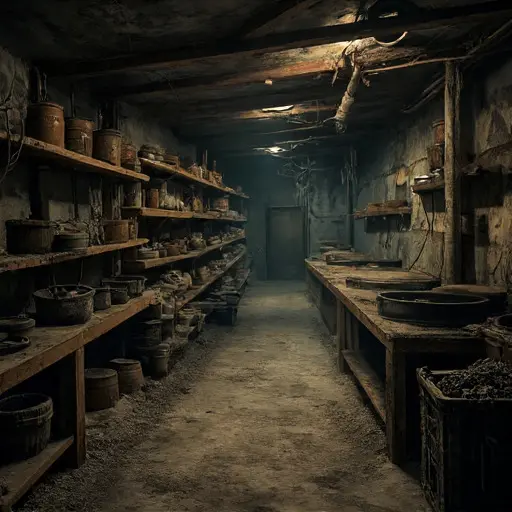
In a shallow drawer beneath the smelting bench lies a test classification tray: its upper compartments sorted in precise gradients, its lower compartments muddled by overlap where categories blurred. A faint note, pressed lightly enough to embed in the woodgrain, reads: “Even the earth misguides when resolve strays from its vein.”
The cellar rests in mineral quiet, its trays and scales gathering slow dust.
And the house, holding its abandoned assay room, remains abandoned.
