The Hidden Almeida Printmaker’s Atelier Where the Plates Fell Silent
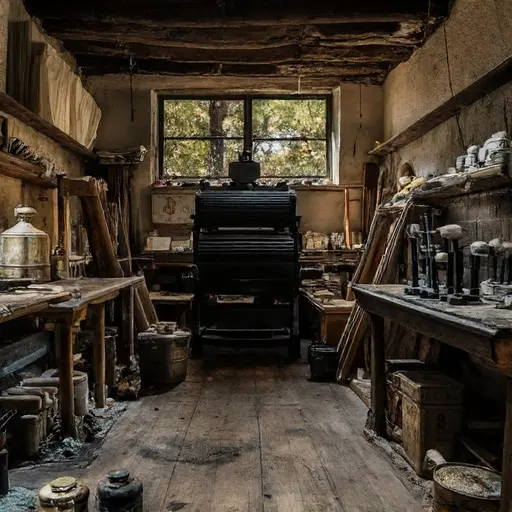
A hush clings to every surface. The roller’s handle sits at an odd angle, as if released mid-turn. A proof sheet hangs crooked on the drying rack, half-tones blurred by uneven pressure.
A loupe on the table reflects a dim, fractured glint of lamplight. Nothing is dramatically overturned—only a constellation of small interruptions that speak of halted intention.
A Maker of Impressions and Measured Calm
This printmaker’s atelier reflects the life of Rafael Luís Almeida, copper-plate etcher and relief printer, born 1878 in Salvador. Raised among modest artisans, he learned his craft from itinerant engravers who valued patience over flourish. His sister, Isadora Almeida, lingers in a pressed hibiscus tucked inside a drawer of papers.
Rafael’s days unfolded in steady sequence: preparing plates at dawn, mixing inks at midday, pulling proofs as lamp shadows lengthened. His tools rest where discipline left them—needles tucked in linen, burins wrapped in chamois, pigment tins aligned by tone. Merchants once prized his botanical prints, which captured coastal flora with unassuming precision.
Lines Once Certain, Now Subtly Disturbed
The atelier once thrummed with quiet focus. Boxes from Lisbon merchants delivered fine rag paper; a shelf displays bottles of linseed oil and spirits of turpentine. Copper offcuts glint in a jar by the window shutter. His pattern folios brim with sketches of mangroves, orchids, and curling vines.
Yet faint contradictions appear. A plate shows a vine motif cutting oddly across itself. A proof bears an unintended dark patch where ink pooled. One dauber lies stiff with dried pigment. His ledger of commissions lists a wealthy patron’s order rewritten three times, then blotted out. A slip of Portuguese notes reads: “They say the edition varies,” the words fracturing toward the edge.
Rumor whispered that a collector accused him of inconsistencies between prints—darkening where there should be delicacy, lines misaligned, details allegedly “lost.” Some insisted he was pressured to create impressions faster than plate preparation allowed.
The TURNING POINT Imprinted in Metal and Hesitation
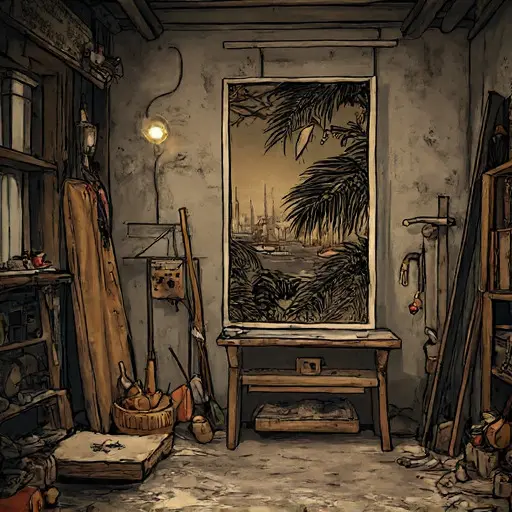
One late evening left its trace. A copper plate for a large botanical piece—almost complete—sits beneath the press, its lines abruptly halted, an entire corner over-bitten. A proof on the table shows splotches where acid might have touched the plate at the wrong moment. An inking brush lies snapped at the ferrule.
Pinned under a spool of twine is a note: “I did not alter their edition.” Another folded scrap mutters, “They demand uniformity impossible with this plate.” His tone unravels in the graphite strokes. The press bed bears streaks of ink as though he ran a sheet through, stopped, and pulled it back prematurely.
Even the solvent bottle stands uncapped, vapors thinning into the room. A wadded rag near the corner radiates a spiral of failed cleaning strokes.
A Narrow Hideaway Behind the Press Cabinet
Behind the tall cabinet of pigments and rags, a loose panel nudges free. Inside rests a wrapped copper plate—small, finely etched with a study of a climbing flower. All lines remain immaculate until the last segment, where the curl stops short, unconnected.
A note bound around it reads: “For Isadora—when the pressure steadies again.” The script softens near the end, thinning as though the stylus dragged in hesitation. The plate bears no traces of inking; it is a pure intention, untested, set aside with solemn care.
Beside it lies a soft cloth used only for final printing—spotless, as if awaiting a moment that never arrived.
The Last Quiet Impression
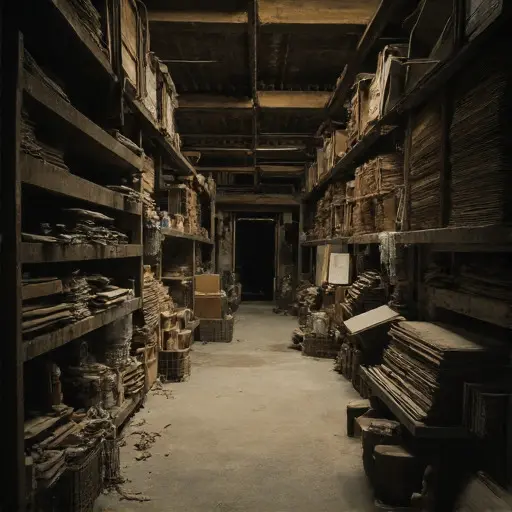
Inside a drawer beneath the empty stand rests a proof fragment: a single botanical line, crisp at first, fading into a trembling ghost of ink. Beneath it Rafael wrote: “Pressure falters under doubt.”
The printmaker’s atelier folds back into its subdued calm, copper plates cooling in their long pause.
And the house, holding its abandoned pressworker’s loft, remains abandoned.
