The Haunting Vasiliev Locksmith Antechamber Where the Hinges Would Not Align
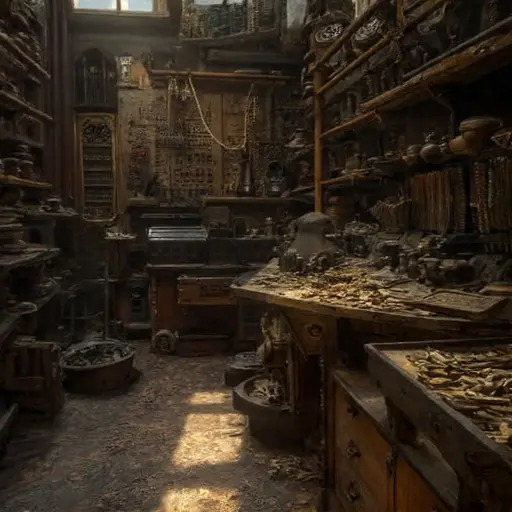
A still, metallic hush holds the antechamber, thick with the scent of oil and iron. On the center table sits a heavy door lock, half-mastered: one side shows crisp geometry in its wards, the other seems uncertain, as if the craftsman’s hand faltered before completing its final rotations. A file rests crooked against a steel blank.
A vice jaw hangs slightly open, as though left mid-task. No rupture, only a soft unraveling of the precision that once lived here.
A Craftsman Moved by Torque, Patience, and the Hinge of Intent
This locksmith’s antechamber belonged to Pavel Aleksandr Vasiliev, locksmith and safebox fabricator, born 1873 in Novgorod. Raised in a modest line of metalworkers, he apprenticed under a wandering mechanic who taught him how torque settles into steel, how a lock’s confidence depends on millimetric tolerances, and how a hinge must move truer than any oath. A faded blue cord from his sister, Larisa Vasilieva, ties a bundle of replacement wards above the back shelf.
Pavel’s rhythm was measured: dawn cutting of key blanks, midday testing of lock cores, dusk filing of tumblers beneath the steady lantern. His tools remain fastidiously arranged—files laid by grit, blanks by gauge, springs coiled in glass jars. Patrons once praised his mechanisms for their reliability and discreet elegance.
When Mechanisms Declined into Uneven Motion
During his strongest years, the antechamber clinked with a purposeful music: tumblers snapping true, springs catching lightly, hinges responding with balanced grace. Safeboxes from Moscow merchants arrived with difficult commissions, each solved with loyal discipline.
Then irregularities crept in. A hinge squeaks where it should glide. A key blank burrs at the edge. A ward line bows too shallowly. His commission ledger shows a merchant’s request written, crossed out, rewritten, then smudged by machine oil. A clipped Russian note reads: “Он говорит, что я испортил замок”—he says I ruined the lock.
A murmur spread among tradesmen: the merchant claimed his new safebox jammed during an inspection, trapping documents the city council needed urgently. Fault, he insisted, must lie in Pavel’s cutting. Others whispered Pavel refused the merchant’s quiet request to engineer a “convenient flaw,” ensuring easy entry for trusted hands—resentment quietly curdled.
The TURNING POINT Etched Into Steel and Suspicion
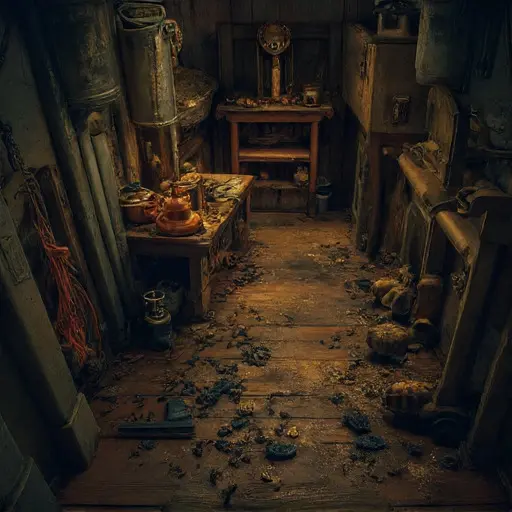
One muted evening left its quiet indictment. A high-security lock—meant for a civic archive—rests on a felt pad. Its upper wards form an elegant matrix of interlocking channels, but its lower wards drift outward, leaving a treacherous slackness. A screwdriver lies snapped near its ferrule. A pot of oil has settled into an uneven ring across the workcloth.
Pinned beneath a half-shaped key blank is a torn slip: “Требуют возмещения за позор.” They demand compensation for disgrace. Another fragment, blurred where oil smeared it, reads: “Я сохранил честность… они отвергают её.” I kept honesty… they reject it. His handwriting slouches and shortens, as if torque left his fingers even before will did. Even the rows of keys—once arranged like quiet promises—tilt awkwardly, a few dropped between cracks in the floorboards.
A jammed lock cylinder sits nearby, bearing shallow miscuts that speak of a moment’s shaken hand.
A Hollow Behind the Safebox Stack
Behind stacked safebox shells and iron drawers, one warped panel shifts inward. Inside rests a small keepsake lock Pavel meant for Larisa: its outer casing decorated in delicate chasing, its internal mechanism only partially assembled. A folded note in his trembling script reads: “Для Ларисы—когда мои петли снова выровняются.” For Larisa—when my hinges align again. The last word fades to pale graphite.
Beside it lies a flawless brass blank, pristine and awaiting the cut he could not trust himself to begin.
The Last Unsteady Mechanism
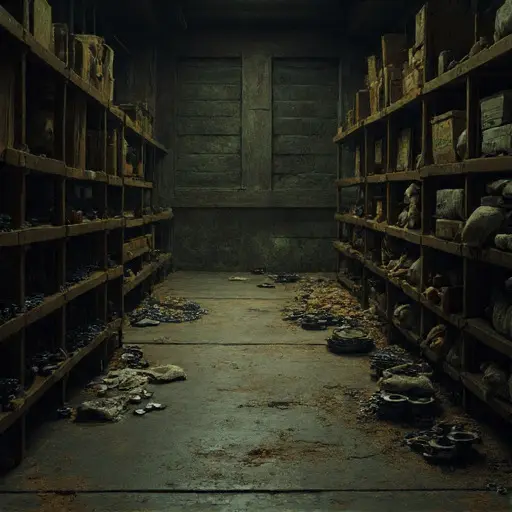
In a shallow drawer beneath the mounting frame lies a test latch: its first rotation smooth and assured before the movement snags, scraping into hesitant half-turns. Beneath it Pavel wrote: “Even trust breaks when resolve slips its hinge.”
The locksmith’s antechamber exhales into metal-scented quiet, unfinished mechanisms resting in unresolved pause.
And the house, holding its abandoned craftsman’s chamber, remains abandoned.
