The Haunting Silence of Corvuswood Manor
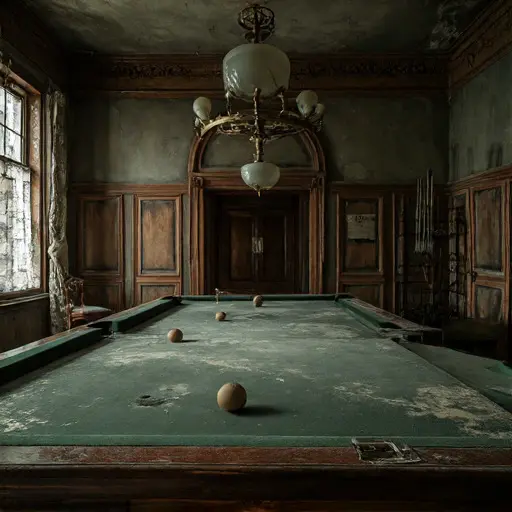
The stillness within Corvuswood Manor was not merely the absence of sound, but the audible pressure of time stopped short. Every breath drawn inside the dilapidated Main Foyer was heavy with the mineral scent of old plaster and the sweet decay of perished floral arrangements. The entrance hall, once a brilliant display of wealth, was now a tomb of opulence.
The ornate, mahogany Coat Closet stood ajar, revealing the remnants of wool coats and top hats, their fabrics dissolving into the gloom. The entire atmosphere suggested a world that had not slowly faded, but had been instantly, tragically, and forgottenly sealed.
Malcolm Eads: The Obsessive Collector
The life that permeated Corvuswood Manor was that of Malcolm Eads, a prosperous but reclusive importer of exotic goods and textiles from the East Indies. Malcolm was a man of fastidious routines and pathological collecting habits. He viewed the house not as a home for his wife, Clara, and their three children, but as a vault for his acquisitions. His Office, a sprawling ground-floor room that looked less like a workplace and more like a museum storeroom, serves as the central document of his temperament. Every square inch is crammed with lacquered boxes, stacked bolts of rare silk, and artifacts from half the world. His profession allowed him to amass fortune, but his social role was that of a guarded outsider. He was terrified of loss, a fear rooted in the early, sudden death of his own parents, which led him to believe that if he could only possess enough things, he could anchor his reality.
A Hidden Drawer in the China Closet
Clara Eads, his wife, was a woman of quiet, intellectual pursuits, who spent her life overshadowed by her husband’s possessions. Her resistance to his suffocating control is found not in protest, but in retreat. Her most frequented space was the Main China Closet, a small, cool room off the Dining Room, where she stored her finest porcelain. It was here she conducted her true passion: meticulous, astronomical observation. In a small, hidden drawer beneath the linen shelf, behind a row of empty brandy snifters, we found her journals. These are not diaries of domestic woe, but logbooks charting the movement of comets and distant nebulae, filled with precise calculations and hand-drawn star charts. This was her escape. The house was her prison, but the universe was her turning point of freedom.
The family’s turning point came during the smallpox epidemic of 1903. Malcolm, in a desperate attempt to protect his precious inventory, refused to allow a doctor into the house until it was too late. His youngest daughter, Eleanor, contracted the disease. She died in the house, in the upper Small Sitting Room that faced the overgrown garden. The tragedy shattered Clara, who left the house the very day after the burial, taking nothing but her star journals.
The End of Inventory in the Attic
Malcolm never recovered. His fear of loss was realized, and his elaborate collection became meaningless. He did not sell or redistribute the contents of Corvuswood Manor. Instead, his obsessive cataloging turned into a frantic, meaningless inventory of his own impending death. The final evidence is found in the claustrophobic Service Attic, a vast, uninsulated space choked with crates and trunks. Here, amidst piles of moth-eaten drapery and dismantled furniture, lies his last great obsession: a massive, hand-written inventory of every single object in the house. The final, tragically brief entry, scrawled shakily in thin ink on the very last page of the ledger, simply reads: “E. not on list.” He had meticulously cataloged his possessions but failed, in his final moments, to list the one thing that mattered—his daughter, Eleanor.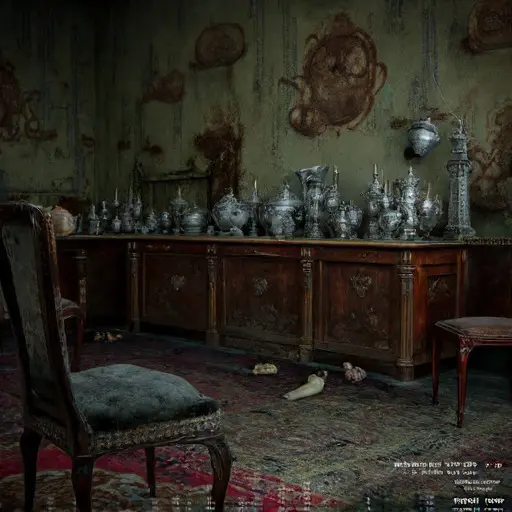
Malcolm Eads passed away three years later in 1906, alone in the silent, inventory-choked mansion. With Clara long gone and their surviving children refusing to return to the site of their sister’s death, the house was abandoned, its contents left as a monument to a lifetime of collecting that ended in emotional bankruptcy. Corvuswood Manor stands today, utterly full, yet profoundly empty—a silent monument to the things a man kept, and the lives he let slip away.
