The Haunting Secret of Kavanagh Spire
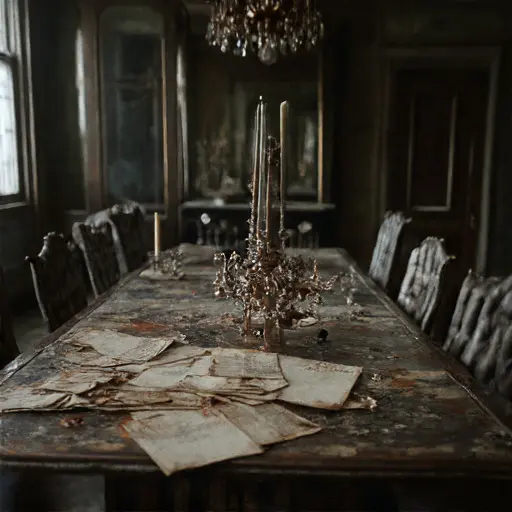
The atmosphere inside the Kavanagh Spire is cold, heavy, and intensely still, saturated with the faint, persistent scent of old leather and damp paper. The Main Entrance Hall is a grand, yet oppressive space, its patterned tiled floor entirely obscured by a century-long, undisturbed carpet of fine, gray dust. A large, ornate hall clock stands against the wall, its hands frozen at the moment of abandonment.
A pair of small, brightly polished children’s riding boots rests neatly beneath the hall bench, an immediate, poignant record of the life that was abruptly withdrawn. The entire house holds the silent, unresolved tragedy of Bernard Kavanagh, a man whose life was defined by his unyielding expectations and his final, devastating confrontation with his own son.
Bernard Kavanagh’s Unyielding Expectations
The proprietor who sealed the house’s fate was Bernard Kavanagh (1860–1918), a wealthy, retired horse breeder and stable owner. His profession was the management of pedigree lines; his personality was defined by intense rigor, an obsession with quality, and an unshakeable belief in the superiority of his lineage. His social role was the demanding patriarch, living with his wife, Helena, and their only son, Edward. Bernard’s central, all-consuming fear was the loss of his dynasty—that his son would fail to meet the impossibly high standards set for him, thereby squandering the family name.
The house, completed in 1907, was built as a statement of enduring quality. The Library was filled with volumes on equine pedigree and business management, while the Formal Study served as his command center. The house’s ultimate descent began with the quiet rebellion of his son, Edward. Edward, a sensitive, academically inclined young man, had no interest in horses or finance, preferring literature and poetry—a profound disappointment to his father. The mounting tension was physically embodied in the Second Floor Trophy Room, a space dedicated to Bernard’s myriad equestrian awards. After a particularly harsh confrontation, Edward moved his few personal books into a small, disused Servant’s Quarters room, effectively isolating himself from his father’s expectations.
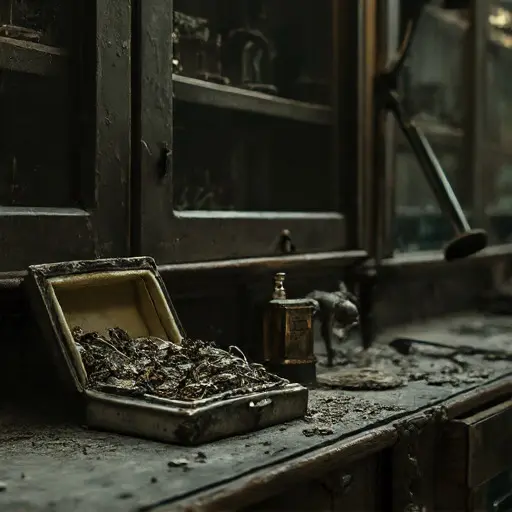
The Open Ledger in the Study
The financial evidence of Bernard’s mounting crisis—fueled by his single-minded obsession with Edward’s future—is found in the Formal Study. On the immense, dark oak desk, a leather-bound financial ledger lies open. The final, hastily written entry, dated late 1918, details a massive, disastrous expenditure on a single, expensive breeding stallion intended for Edward—a final, desperate attempt to bind his son to the family business. The total expenditure far exceeded his available capital, rendering the estate insolvent. The page is marked with a dried, dark ink stain where the pen fell.
Edward’s Final Note in the Servant’s Quarters
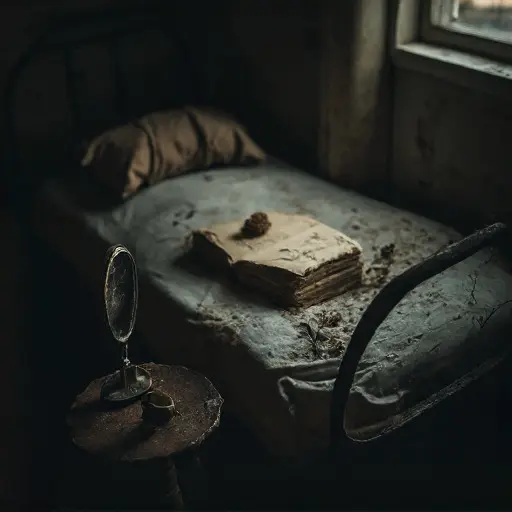
The ultimate tragedy is quietly preserved in the disused Servant’s Quarters room, where Edward had retreated. On a small, bare wooden table rests a single, neatly folded envelope, heavily dusted. It is a final note addressed to his mother, Helena, detailing his decision to leave the house permanently, giving up his birthright to pursue his own life in the city, but expressing profound love for her. Bernard Kavanagh, reading the note found on his son’s empty bed, suffered a massive, fatal stroke in his Study hours later in December 1918.
Helena Kavanagh, devastated by the loss of both her husband and her son—and faced with the immediate seizure of the house by creditors due to Bernard’s insolvency—left the Kavanagh Spire the very next day. She took only her most personal belongings and never contacted Edward, unwilling to drag him into the public ruin. The bank secured the property, but due to the complexity of the final, massive debt, the house was left unsold. It stands today, every room holding the material record of a family destroyed by one man’s inflexible, obsessive fear, forever silent and abandoned.
