The Haunting Scrolls of the Ferreira Calligrapher’s Nook
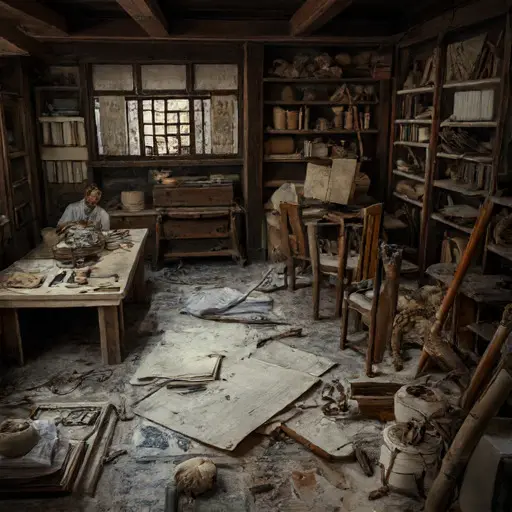
The Calligrapher’s Nook hums with suspended stillness. On a table, penciled stroke notations for a ceremonial scroll trail off unfinished. Each brush, inkstone, and scroll evokes exacting labor suddenly paused, the rhythm of practiced motion frozen indefinitely.
Life in Ink and Parchment
These implements belonged to Isabel Ferreira, calligrapher (b. 1880, Lisbon), trained in Portuguese manuscript workshops and skilled in decorative Latin and Arabic scripts. Ledger entries document commissions from churches and wealthy patrons. A folded note references her assistant, Mateus Ferreira, “deliver illuminated scroll Friday,” revealing a disciplined pattern of daily preparation, brushwork, and composition executed with meticulous care.
Implements of Precision
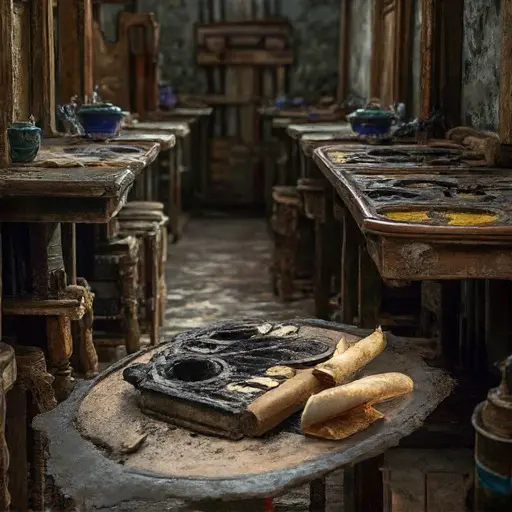
Tables hold partially completed scrolls and scattered brush sets. Ink pots, palettes, and pen rests lie stiff with dried pigment. Parchment sheets are stacked carefully, some curling at the edges. Isabel’s ledger, weighed down by a small inkstone, details client names, letter sequences, and deadlines. Dust settling over brushes and manuscripts emphasizes sudden cessation of repeated, precise gestures, the silence thick with the absence of hand and voice.
Evidence of Fading Control
Later ledger entries reveal inconsistent stroke alignment and repeated corrections. Margin notes—“Mateus questions flourish”—are smudged. Brushes show uneven wear, pen rests chipped. Isabel’s declining eyesight and trembling hands subtly distort lines. Pencil notations trail off mid-character, a quiet record of deteriorating skill and unfinished artistry.
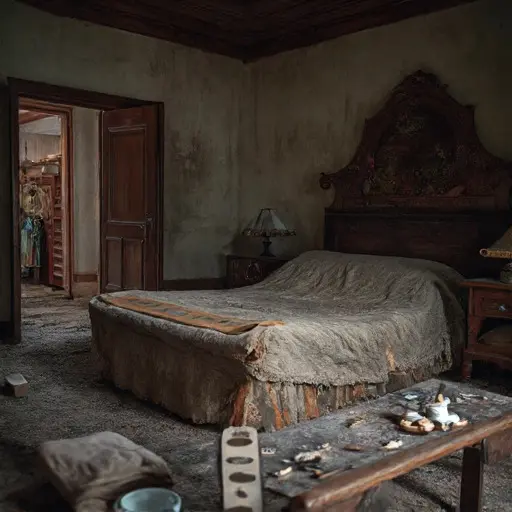
In the Nook’s final drawer, Isabel’s last scroll ends mid-stroke, a penciled note—“verify with Mateus”—abruptly stopping.
No record explains why she abandoned her work, nor why Mateus never returned.
The house remains abandoned, scrolls, tools, and ink awaiting hands that will not return, the quiet heavy with unfinished mastery and lost artistry.
