The Haunting Rousseau Binding Hall Where the Spines Tore Uneven
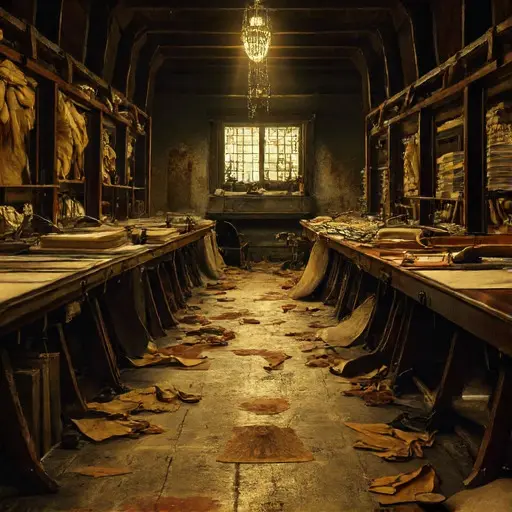
A profound stillness hovers over the benches. A half-bound book sits in the sewing frame, its signatures aligned neatly until a final section skews off by a thread’s width. A bone folder lies discarded, its edge stained darker than usual.
A strip of leather dries curled beside a pot of cooling glue. There is no drama—only the subtle ache of a routine broken mid-motion.
A Binder’s Life Ruled by Quiet Order
This binding hall holds the careful craft of Émile Laurent Rousseau, bookmaker and decorative binder, born 1871 in a district near Lyon. Raised among modest merchants, he studied under a traveling binder who taught him the rhythm of sewing signatures, the softness of properly warmed hide glue, and the delicate art of gold tooling. His sister, Margot Rousseau, endures here in a faded ribbon tied to a gilding stamp handle.
Émile’s days unspooled in calm increments: dawn trimming of page stacks, midday sewing of signatures, dusk pressing bindings under a patient weight. His tools remain faithful in their arrangement—knives wrapped in cloth, gilding rolls stacked by pattern, awls nestled in a padded rack. Patrons once praised his volumes for their measured spine curves and even gilded edges.
Confidence Slipping into Subtle Disarray
In prosperous times, the hall thrummed with quiet precision. Marbled papers arrived from Paris traders, shimmering like chilled wine. Leather hides softened under patient oiling. Finished volumes lined the shelves, each spine straight and dignified.
But small shifts crept in. A spine edge tilts off its intended line. A gilding roll leaves a faint tremor in a decorative border. A sewing thread frays where Émile’s tension once held true. His commission ledger displays a notable client’s name written, crossed out, rewritten, then blotted to obscurity. A terse French note reads: “They say my binding lies.”
Rumors suggested he had been accused of improper restoration—claiming he damaged a rare book’s original stitching. Others whispered he refused to modify a binding to suit a demanding collector with questionable taste.
The TURNING POINT Marked in Thread and Strain
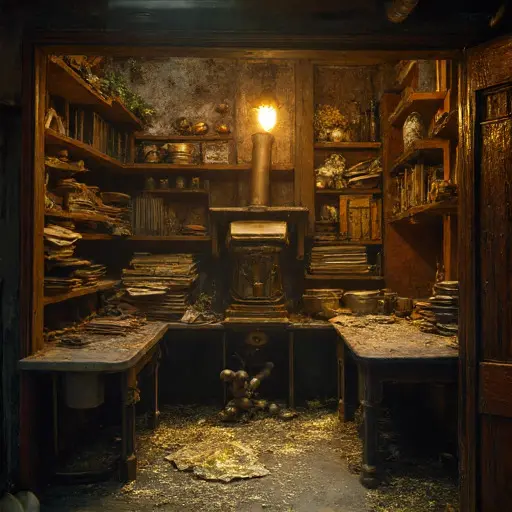
One lamplit evening left unmistakable clues. A prized commission sits in the press, its spine distorted ever so slightly, the leather lifted at a corner where glue should have sealed evenly. A sewing frame holds a half-completed text block, the thread tangled mid-signature. A gold-tooling roll bears a scorched patch near its grip.
Pinned beneath a torn scrap of marbled paper is a note: “They claim I ruined their heirloom.” Another fragment, ink fading unevenly, reads: “Restitution beyond reach.” The lines slope downward as though his hand trembled. Even the trimming knife—normally precise—shows a nick near the tip, a sign of haste or distraction.
Across the bench, an awl stands embedded in a board off-center, left as if he abandoned the motion halfway through.
A Narrow Recess Behind the Leather Cabinet
A loose panel behind the cabinet reveals a small recess. Inside lies a slim volume, beautifully sewn for its first half, then abruptly unfinished. The spine is shaped but not glued; the leather cover cut but not applied. A folded note in Émile’s careful script reads: “For Margot—when steadiness returns.” The last word thins into hesitant ink.
Beside the volume rests a flawless sheet of marbled endpaper, untouched, waiting to embrace a book he never continued binding.

The Last Split Stitch
In a drawer beneath the empty press lies a test signature: sewn straight until the final stitch, which veers sharply out of line. Under it, Émile wrote: “Even tension fails when resolve frays.”
The binding hall exhales its glue-scented quiet, spines half-shaped under fading lamplight.
And the house, holding its abandoned binder’s chamber, remains abandoned.
