The Haunting Requiem of Whispering Fallow
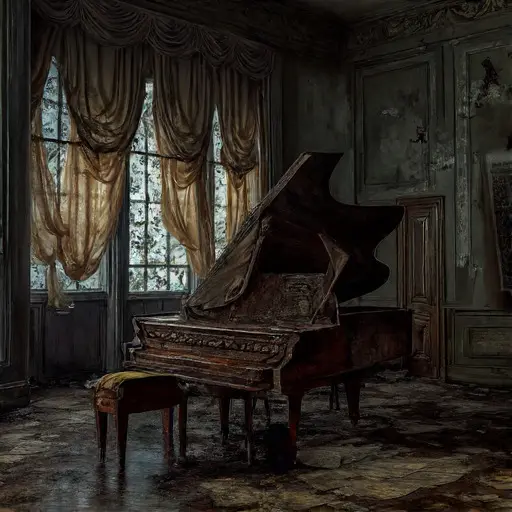
Whispering Fallow is not built on a hill or by the sea, but deep within a silent, forgotten valley—a place where the very air seems dense with moisture and sorrow. This abandoned Victorian house is characterized by its severe, yet beautiful Neo-Gothic architecture, dominated by high, narrow windows and dark, rain-stained brickwork. The moment one steps inside the foyer, the quiet is absolute, broken only by the faint, rhythmic drip-drip-drip of water somewhere deep within the walls. The house smells perpetually of stale wood smoke, damp wool, and an underlying faint sweetness, like dried lavender. This stillness is oppressive, creating an atmosphere of deep, profound suspense, as if the walls are holding a note that was never finished.
Elara Vane: The Composer’s Silence
The last mistress of Whispering Fallow was Elara Vane, a brilliant, but tragically fragile, classical composer who lived only for her music. Elara inherited the house in 1905, transforming its grand, central parlor into a state-of-the-art music room. Her ambition was to compose a requiem so profound, so perfect, that it would capture the essence of silence itself—a score to end all sorrow. She was known to the few servants she kept as intensely focused, often spending days at the piano, chasing a single, elusive progression of notes.
Elara’s end was as mysterious as her music. She was discovered one morning in 1912, sitting motionless at her piano, her fingers resting lightly on the keys. There were no marks of violence, no visible illness, only a complete, sudden cessation of life. The local doctor recorded the cause as “Heart Failure,” but the town whispers that she was simply consumed by the very silence she sought to master. The house, her instrument, remains intact, preserving the ghost of her final, unplayed composition.
The Score Library’s Hidden Note
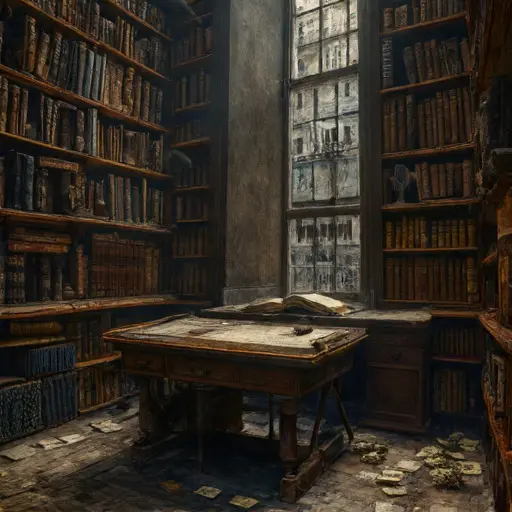
The second-floor library served as Elara’s archive and study. This room is filled with musical history—volumes of Bach, Chopin, and Liszt. The scent here is purely paper and dust. The entire room is cluttered, but in the center, on a massive mahogany table, lies a stack of her own compositions. The earliest scores are fluid and light; the later ones are dark, discordant, filled with complex, often impossible, chromatic progressions.
The top manuscript, bound in black ribbon, is the score for her final piece, titled “The Fallow Requiem.” The notes are dense, yet the piece abruptly stops halfway through the final movement, with a full stave left completely blank. Scrawled in the margin, in an unsteady hand, is the haunting instruction: “The final note is silence itself. It cannot be written, only heard in the absence.”
The Ballroom’s Echo Chamber
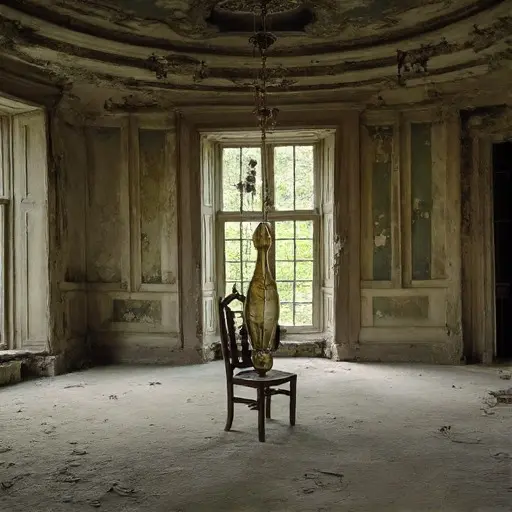
The enormous ballroom, unlike the other rooms, is almost bare. It was acoustically designed with specific paneling to amplify and sustain sound—a feature Elara used to test the resonance of her compositions. Today, it serves as a powerful echo chamber. The floor is warped, and dust motes hang in the air like frozen rain, but the room itself resonates with the potential for sound.
In the precise center of the vast, empty space, there is a single, ornate, high-backed chair. On the seat of the chair lies a solitary object: a tarnished brass tuning fork. It is untouched, but its presence is a forceful statement. Whispering Fallow is the physical embodiment of Elara Vane’s final quest for ultimate silence. The eerie emptiness and the waiting tuning fork preserve the haunting expectation of a note that was never played, leaving the house itself as the requiem for the composer who vanished into her own perfect stillness.
