The Haunting Petrov Iconography Studio Where the Colors Refused to Hold
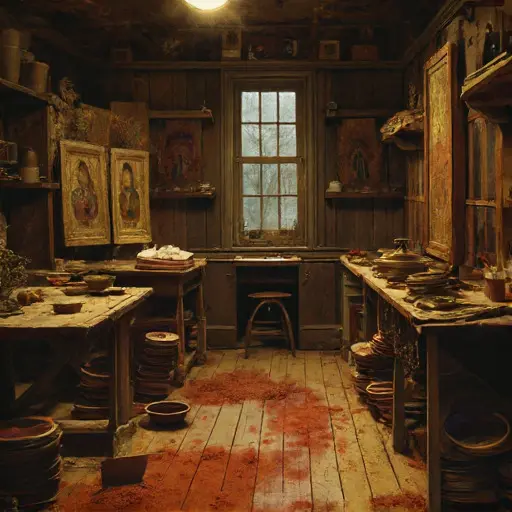
The quiet sits like a folded prayer. A panel on the central table shows a saint’s robe blocked in steady strokes, yet the face remains suspended in bare underdrawing, lines trembling where the brush must have faltered. A sheet of gold leaf clings to the rim of its booklet.
A brush lies crusted in a mix of ochre and egg binder, hardened mid-stroke. Nothing here insists on catastrophe—only a practice interrupted, devotion shaken, color left unanchored.
Trained Hands Shaped by Reverence and Precision
This iconography studio was the working place of Ivan Mikhailovich Petrov, icon painter and gilder, born 1874 in Kazan. Raised among modest woodcarvers, he apprenticed under a traveling monk who taught him silent preparation of gesso, the discipline of layered tempera, and the reverent restraint demanded by holy subjects. A small embroidered kerchief from his sister, Sofiya Petrov, is pinned beneath a palette of drying pigments.
Ivan shaped his days through solemn rituals: dawn sanding of gesso boards, midday laying of undercolors, dusk burnishing gold leaf under a single lamp. His tools remain arranged with patient order—brushes grouped by fineness, pigments kept in ceramic cups, gilding knives wrapped in linen. Patrons once trusted him to render saints with luminous calm and careful proportion.
As Craft Drifted from Its Once-Sure Harmony
In the stronger seasons, the studio glowed with clarity. Boards prepared with immaculate gesso stood in rows along the wall. Pigments from St. Petersburg traders arrived in slim glass vials. Completed icons dried near the stove, halos shimmering under thin layers of bole and leaf.
Yet irregularities crept in. A halo arc flattens where it should rise. A robe’s shading appears blotched, layered too quickly. One gesso panel bears faint cracks across its center. His commission ledger lists a wealthy parish’s order written, crossed out, rewritten, then smeared. A terse Russian note near it reads: “They say my likeness shames them.”
Rumors murmured that Ivan misrepresented a family patron saint—claiming the proportions slighted tradition. Others whispered he refused to alter sacred iconographic rules to please a donor seeking a more fashionable visage.
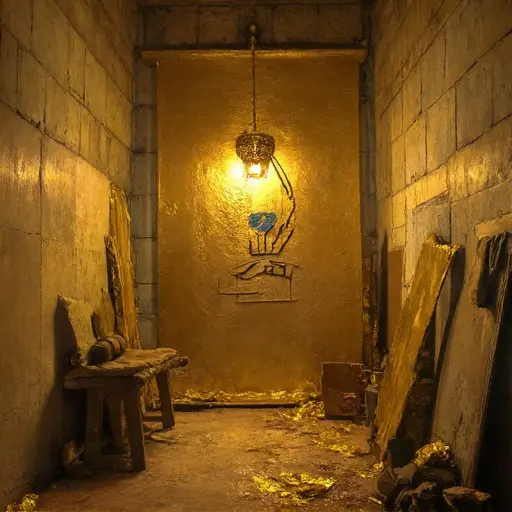
The TURNING POINT Captured in Pigment and Strain
One quiet evening left subtle distress behind. A nearly finished icon leans on its easel, gold leaf clinging irregularly along the halo’s outer ring. A fine brush lies snapped at the ferrule. A bowl of tempera has congealed at its edges, pigment separating like thoughts pulled apart.
Pinned beneath a sheet of tracing vellum is a torn scrap: “They demand restitution for offense.” Another fragment, blurred by red clay, reads: “I painted as taught… they insist otherwise.” The handwriting weakens after each line. Even the palette—normally cleaned with reverent care—shows hardened streaks of ochre and green, as though he lifted his hand mid-blend and never returned.
Across the table, an icon stand sits slightly askew, wedge missing from its base.
A Quiet Recess Behind the Pigment Cabinet
Behind the tall cabinet storing pigments and bole, a panel shifts aside. Inside rests a small icon: the figure’s posture exquisitely drawn, but the face left unpainted, only faint graphite lines marking where sanctity would have blossomed. A folded note in Ivan’s wavering script reads: “For Sofiya—when the light steadies again.” The last word fades into pale strokes, as though the brush hovered too long.
Beside the unfinished icon lies a fresh, unmarred gesso board, perfectly smooth, awaiting a first layer he never applied.
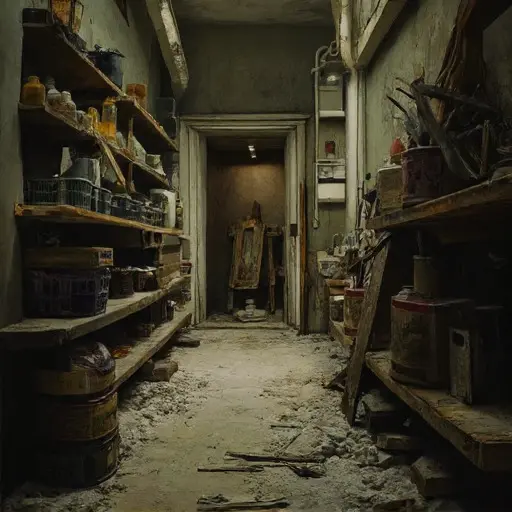
The Last Unfinished Layer
Inside a shallow drawer beneath the easel rests a gesso shard: one edge polished flawlessly, the opposite fractured by a hesitant stroke. Beneath it Ivan wrote: “Even radiance fails when resolve dims.”
The iconography studio exhales into lamplight’s hush, colors resting in half-formed silence.
And the house, holding its abandoned painter’s chamber, remains abandoned.
