The Haunting Papers of Durleighmere House
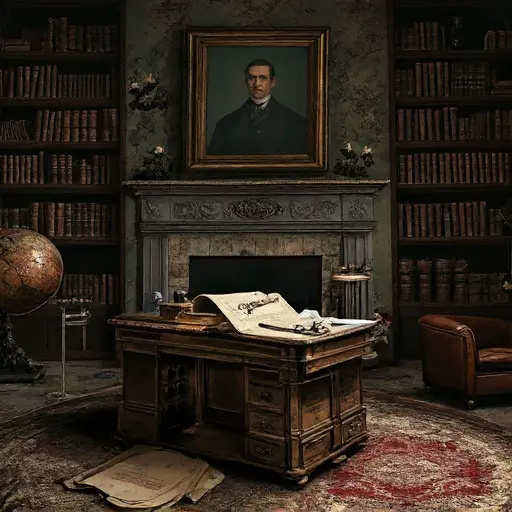
Durleighmere House is not empty — it is paused. The kind of stillness here is not peaceful but restless, as if the house itself is mid-thought. Every room holds the posture of something left mid-sentence.
Chairs turned at angles. Pens uncapped. The embers may have died out long ago, but the gestures of use remain, haunting in their incompletion.
There is no vandalism, no collapse. Only a quiet build-up of things that were never resolved. The haunting quality comes not from fear, but from too many words left unsaid, recorded only in dust-covered letters, ledger entries, and journals never signed.
The Correspondence of Aldric Hensley
Aldric Lionel Hensley, born 1848, was a barrister who built Durleighmere House after a sudden inheritance from a cousin who died at sea. Known for his advocacy of estate law and his obsessive correspondence, Aldric kept copies of every letter he sent and logged every one he received. His wife Marta rarely wrote at all — her journals, preserved in the linen closet drawer, contain mostly lists of medicines, embroidery notes, and recipes in German script.
They had one son, Thomas, whose name appears repeatedly in Aldric’s later letters — always unanswered. A letter dated June 4, 1899, begins: “You do not write. I assume this is your answer.” Another, from September, ends: “If you have chosen absence, then so be it. I remain where I always was.”
Thomas left for Paris in 1897. No return is recorded.
Marta passed away in 1902. Her side of the bed was never stripped. The bedchamber remains exactly as her final servant left it — shoes aligned, nightdress folded, brush still bearing strands of dark hair. The housekeeper’s log ends two weeks later.
Aldric continued writing letters until 1911. None were mailed.

The Paper Trail to Nowhere
In the rear storage room, boxes labeled “T.H.” and “C.H.,” presumably Thomas and cousin Charles, remain sealed. The handwriting grows shakier as the years go on. Some envelopes inside were never addressed — filled with only blank pages or copied passages of legal text.
One note reads: “This house is no longer a place for the living, but for paper.”
The third-floor map room contains pinned travel maps with routes circled in red — all ending in large X’s. Aldric, it seems, continued to track where his son might have gone. Receipts from international shipping agencies clutter the desk.
The Final Letter in the Coal Room
Beneath the stairs, in the coal storage room, wedged behind the last bin, is a letter addressed to “Mr. T. Hensley.” It is unopened, never mailed. The envelope bears no return address, only the scrawl: “Last attempt.”
Aldric Hensley’s death was not recorded. Durleighmere was shuttered in 1913. It has remained untouched.

Durleighmere House still holds its letters.
It remains abandoned.
