The Haunting McBride Pickling Bench and the Brine Unanswered
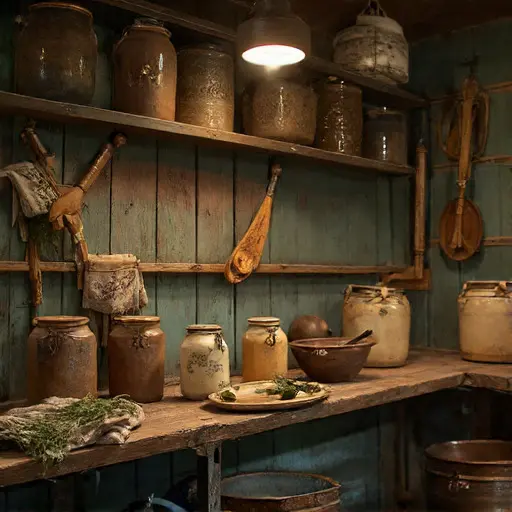
The Preservation Kitchen breathes a warm, resigned stillness. On the pickling bench, the brine bowl remains exactly half-filled, faint rings marking where it cooled. A length of cheesecloth lies in a soft heap, stiffened by traces of salt.
In the corner, a bundle of dill has browned at the edges, shedding fragments like forgotten notes. The copper pot nearest the hearth bears a thin film of residue, suggesting a halted simmer. Nothing appears damaged or hurried—only a patient world that lost its rhythm between one tasting and the next.
The Preserving Touch of Fiona Catriona McBride
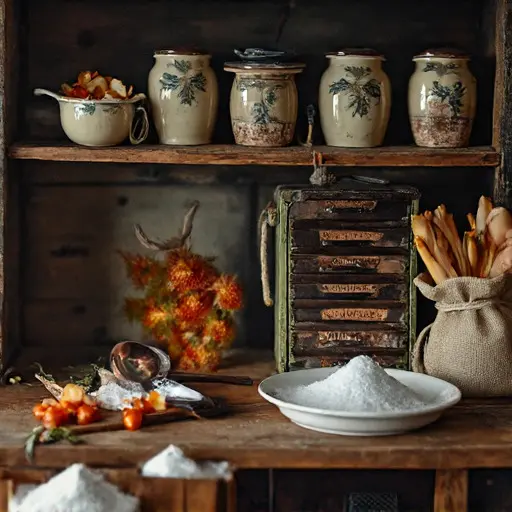
The furnished rooms evoke Fiona Catriona McBride, born 1874 in the Scottish Highlands, raised in households where curing, pickling, and herbal craft formed daily life. Within the Flavoring Nook, bundles of heather and thyme tied with tartan ribbon rest in jars labeled in Scots dialect. A spice chest holds whole peppercorns, clove buds, and mustard seeds arranged in neat compartments, each container stoppered with wax. Her temperament emerges through this measured order: diligent, consistent, gentle in her methods.
Fiona likely rose early, boiling brines with slow, confident stirs. Afternoons passed with blanching vegetables and trimming roots. Evenings, she bottled finished batches while humming under her breath—quietly, purposefully. In the Pantry Side-Room, shelves bear rows of sealed jars: onions, carrots, and small cucumbers suspended in clear amber liquid. The jars stand in symmetrical columns, each marked with hand-cut paper labels in her careful script.
Strains Threading Through Her Quiet Labor
Hints of downturn appear elsewhere. In the Upper Washstand Chamber, a cracked jug of vinegar leaks along the basin’s rim, its spill dried in uneven arcs. A letter from a cousin in Inverness, edges blurred, lies unopened near a soap dish—perhaps bearing unwelcome news. On the Guest Cot, a travel shawl lies half-folded, pockets lined only with spice bundles and no true provisions.
A pair of jars in the Root Cellar Corner show faint clouding in their liquid—an early sign of spoilage Fiona would never ignore. A crate of cucumbers sits untouched, their skins wrinkled, as though she abandoned a batch she normally tended with exact timing. These fragments whisper of creeping doubt: maybe illness, maybe financial anxieties, perhaps grief that slipped into her routine.
A Brine Bowl Tilted from Its Usual Circle
Returning to the Preservation Kitchen, the shallow brine bowl on the pickling bench becomes the room’s quiet heart of unease. Its cloudy surface is undisturbed, as though the last intended stir paused midair. Beside it, a wooden spoon rests with its handle pointed slightly off the bench’s center—uncharacteristic for her tidiness. The copper pot’s lid lies ajar, its hinge casting a bent shadow across the bench’s edge.
Near the hearth, bunches of rosemary droop in uneven clusters, suggesting she lost her balance or her purpose between steps. A linen apron draped over a chair shows a single streak of brine across its hem, the mark drawn in a trembling line.
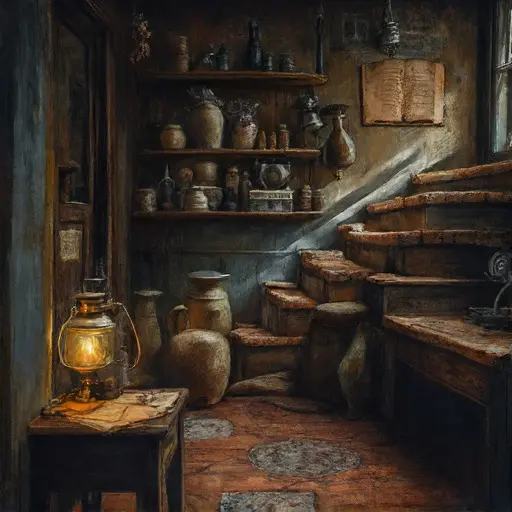
Behind the pickling bench, tucked by a crate of root vegetables, rests her last attempt: a jar sealed unevenly, its lid pressed at a slight angle. The brine inside sways cloudy in one corner, as though the final judgment—taste, stir, or discard—failed to arrive. No note clarifies the moment her certainty faltered.
The house answers nothing further, and it remains abandoned still.
