The Haunting Ledger of Dubois’s Silent Engraver Studio
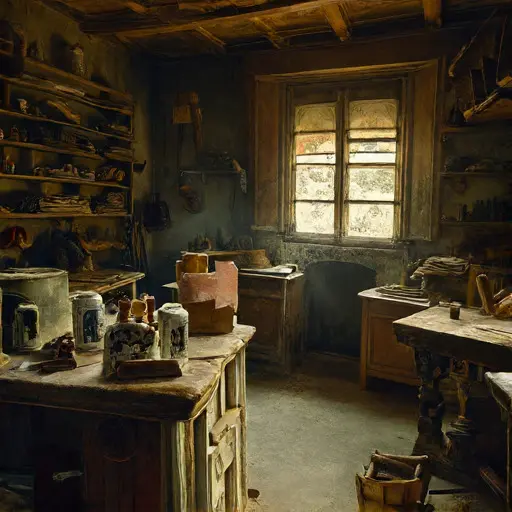
The engraver studio hangs in tense stillness. On a workbench, a partially engraved copper plate rests, its etching lines incomplete. Tools are neatly arranged, burins poised beside unpolished sheets, the room holding the rhythm of absent hands.
Lines Carved with Discipline
The room belonged to Étienne Dubois, professional engraver (b. 1870, Lyon), trained in fine arts academies and commissioned for illustrations and prints. His handwriting appears on sketches and client notes, exacting and restrained. A note references his apprentice, Madeleine Dubois, who cleaned plates and prepared inks. His daily schedule consisted of planning etching layouts, engraving designs, inking plates, and pressing prints meticulously. Temperament precise, ambition quiet, and devotion to detailed craft defined his life.
Plates Left Unfinished
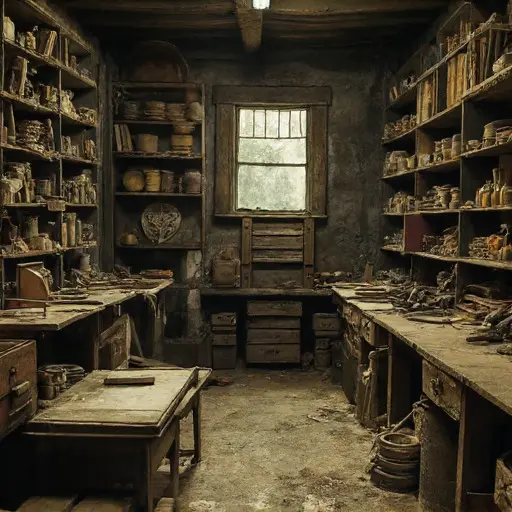
Copper plates lie untouched, ink dried partially in pots. A ledger beneath the main bench lists client commissions and etching steps but ends abruptly. Dust coats engraved surfaces, polishing cloths lie stiff, and stacks of prepared paper await impressions never taken. Burins rest across a leather pad, poised as though waiting for the next stroke, the room caught mid-gesture.
When Technique Fell Out of Favor
Later ledger entries grow sparse. Correspondence from galleries and clients lies unopened. Dubois’s decline was caused by industrial lithography and mechanized printing; handcrafted etching sequences could not compete with rapid reproduction. Daily work slowed, then ceased entirely, leaving the exacting craft suspended.
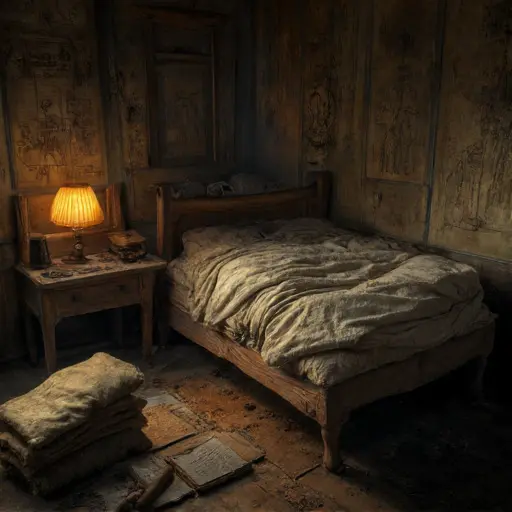
The final ledgers and engraving tools remain untouched. No note explains Dubois’s departure; Madeleine never returned to collect the materials. The house remains abandoned, benches stacked, plates aligned, each etching frozen mid-creation, a testament to precise labor halted permanently, the silent weight of interrupted artistry lingering in every corner.