The Haunting Inventory of Wexford’s Edge
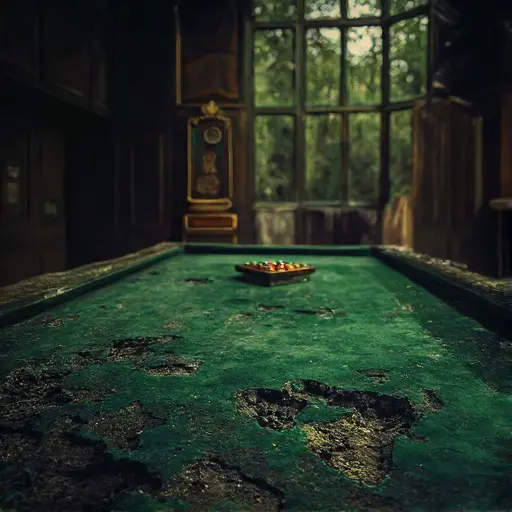
The silence inside Wexford’s Edge was a suffocating pressure, a cold, heavy stillness that seemed to repel all modern sound. Upon crossing the threshold into the Main Entrance, the air was thick with the scent of dry, brittle paper and the metallic tang of pervasive dampness. This mansion’s entire interior was a single, vast turning point, preserving the precise moment when a meticulous life had finally crumbled under its own weight.
Every object was a piece of inventory in a personal ledger that could no longer be balanced.
Edgar Wexford: The Cartographer of Control
The owner of Wexford’s Edge was Edgar Wexford, a highly successful but pathologically meticulous surveyor and cartographer in the late 19th century. His wealth came from accurately mapping the rapidly expanding rail lines. His temperament was defined by an obsessive need for control, precision, and the reduction of all uncertainty into measurable data. His social role was one of unwavering reliability, but his private life was a constant effort to contain the chaos he secretly feared. He married Eleanor, a woman whose gentle nature was slowly eroded by his demands for order. They had two young daughters, Clara and Susannah.
Edgar’s pathology is most evident in his Surveying Office, a dedicated room filled with instruments. On his long, mahogany Drafting Table, numerous topographical maps are still laid out, meticulously detailed. But hidden within a drawer beneath the maps is his Secret Logbook. It contains no business notes, but pages of obsessive daily schedules for his wife and daughters, detailing every minute of their day—meal times, reading times, even precisely allocated leisure minutes—his futile attempt to map and control the unpredictable variables of human life.
The Governess’s Final Lesson in the Schoolroom
Eleanor Wexford found her life consumed by the effort to maintain the impossible order her husband demanded, slowly sacrificing her own identity. Her closest ally in this quiet struggle was the family’s governess, Miss Harriet Finch, an educated woman who subtly resisted Edgar’s tyrannical control. The Schoolroom, a large, top-floor space, became their quiet battleground.
The room is still intact: two small, polished wooden desks remain, along with a large, slate blackboard covered in dust. On the teacher’s desk, beneath a stack of dusty arithmetic primers, lies Miss Finch’s Personal Journal. It records not lessons, but her growing horror at Edgar’s psychological abuse of his daughters, particularly his cruel punishment of Clara for failing to adhere to his rigid schedules. The final entry, dated 1898, documents her decision to leave immediately, stating she could no longer be complicit in the emotional damage being inflicted. This was the silent, final turning point that exposed the core cruelty of the house.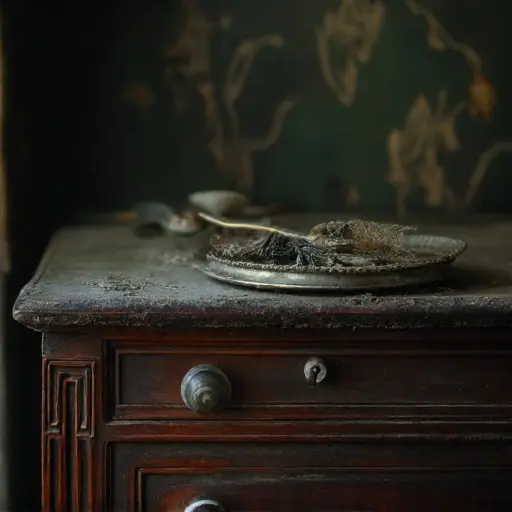
The Unsent Message in the Conservatory
After Miss Finch’s departure, Eleanor finally broke. She confronted Edgar, demanding he release them from his control. He refused, citing his duty to maintain order. Eleanor responded by taking the girls and fleeing the house in 1899, leaving him completely alone.
Edgar Wexford did not pursue them; his paranoia instantly convinced him the world was collapsing. His final, devastating turning point is preserved in the Conservatory, a glass-walled room where Eleanor had once cultivated tropical ferns. Here, amidst the dead, brittle husks of plants and the wreckage of shattered glass, lies a small, water-damaged wooden Writing Slope. Inside, beneath a few dry pen nibs, is Eleanor’s last written communication to him—not a letter of anger, but a meticulously written, single page detailing the coordinates of her sister’s remote cottage, where she was hiding. It was her final, desperate attempt to give him a piece of data—a map—that could lead him to reconciliation.
Edgar Wexford was found dead in the Master Study two weeks later, having succumbed to a massive stroke, surrounded by his instruments. The evidence shows he never touched the writing slope. He had abandoned his entire life, including the map to his family, out of a final, paralyzing inability to deviate from his routine. Wexford’s Edge was left untouched, its interiors a dense, dust-filled monument to a life that valued the precise, forgotten control of a map over the messy, chaotic reality of love.
