The Haunting Gräf Inlay Workshop Where the Grain Shifted Out of True

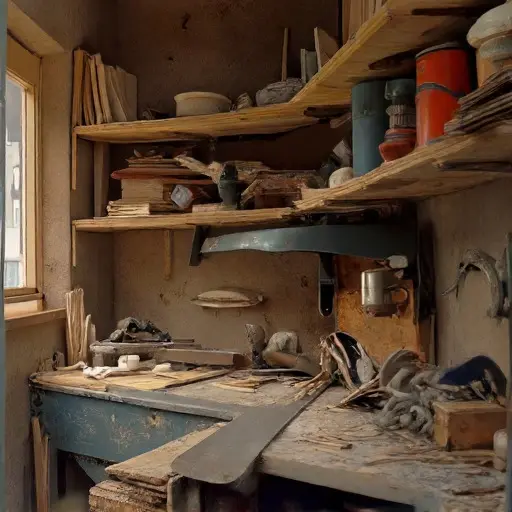
A mellow hush, dry with old wood dust, inhabits the room. At the central bench lies a half-fitted panel for a decorative cabinet: its upper motifs nested in precise geometry, lower segments subtly misaligned, curves wandering from their intended arcs. A fret saw lies skewed atop a warped veneer sheet.
Glue brushes stiffened long ago in mid-stroke. Nothing here shouts disturbance, only the gentle suggestion that routine once steady fell into quiet deviation.
A Cabinetmaker Bound by Pattern, Balance, and Grain
This inlay workshop belonged to an Austrian-trained cabinetmaker, known solely through the artifacts of his method. More than a dozen species of veneer—walnut, pear, maple, birch—are sorted in drawers whose dovetails still meet cleanly. Along a back wall, Viennese-style pattern guides lie weighted by brass bars, their curves crisply cut. Beside them rest turned beech knobs, unused, awaiting attachment to pieces that were never completed.
His habits reveal themselves through ordered surfaces: chisels polished, sawblades oiled, clamps nested by size. Even the marquetry cradle bears shallow indentations where panels once rested under steady hand. It is a workspace shaped by discipline, the kind practiced by those who measure form by tone of tapping, by density of wood, by consistent following of grain.
Subtle Disruptions in the Craft
The decline appears not as chaos but as small departures from precision. Veneer sheets, which should lie flat, ripple faintly at their edges. A tulipwood strip shows a scoring line that overshoots its boundary by several millimeters. The glue pot—once meticulously cleaned—shows hardened residue in uneven ridges.
Pinned beneath a pattern frame lies a torn slip written in German script, its meaning fragmentary: “commission returned… proportions contested.” A second scrap, blurred by glue staining, hints at a disagreement over symmetry. On the drying rack a decorative panel, designed in mirrored halves, reveals mismatched geometry—left side slightly elongated, right compressed by an unnoticed shift. These signs suggest pressure from exacting patrons, or disputes over accuracy, though nothing confirms their cause.
The TURNING POINT Hidden in Warped Veneer
One unfinished cabinet door offers the clearest trace. Its upper quadrant, formed from walnut and pear, exhibits graceful nested spirals. But below, the plumwood inserts drift from alignment, creating a faint skew. The back of the door bears chalk marks smudged into ambiguity—lines that once indicated careful placement now blurred beyond use. A veneer press lies toppled on its side, not violently, but as though nudged without correction.
A penciled notation on a curled scrap reads only: “pattern disputed… correction declined.” The graphite weakens toward the fragment’s edge, strokes inconsistent. Another discarded pattern sheet shows two central motifs of uneven scale, one more refined than the other, though it is unclear whether the discrepancy was error or disputed design. Clamps that once defined straight edges now rest misaligned, two with screws partially backed out.
In a shallow tray, packets of marquetry segments—previously sorted by color—mix across boundaries, as if lifted and returned without certainty.
A Concealed Hollow Behind the Veneer Cabinet
A tall veneer cabinet stands slightly out from the wall. Behind it, a loosened panel reveals a narrow cavity. Inside rests a small decorative medallion—walnut base, pearwood floral inlay—only partially completed. Its outer ring fits tightly; the interior motif remains chalk-drawn but uncut. A note in faint German graphite records: “finish… when the grain settles again.” The sentence trails off before naming a purpose or recipient.
Beside the medallion lies a pristine sheet of maple veneer, unmarked and untouched, reserved for a future design abandoned in concept alone.
The Last Misaligned Panel
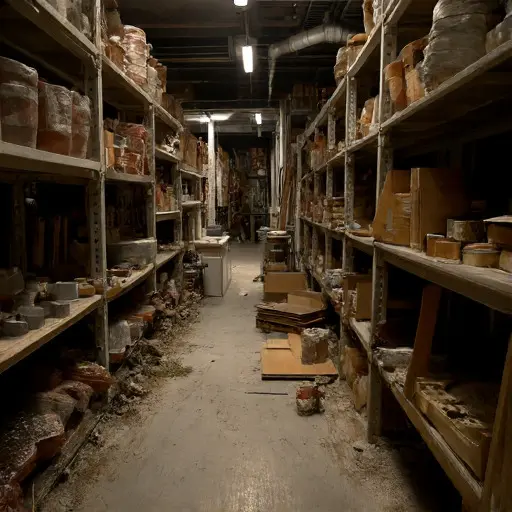
In a shallow drawer beneath the assembly frame lies a test inlay panel. Its upper half, fitted in small geometric tessellations, remains crisp and centered. But its lower half slips outward, forming a faint diagonal unintended by the design. On its back, in nearly vanished pencil pressure, reads: “Even form strays when resolve breaks from its grain.”
The workshop sinks into quiet, the scent of wood dust lingering among tools at rest.
And the house, holding its abandoned cabinetmaker’s room, remains abandoned.
