The Haunting Glow of Hearth-Aurelia
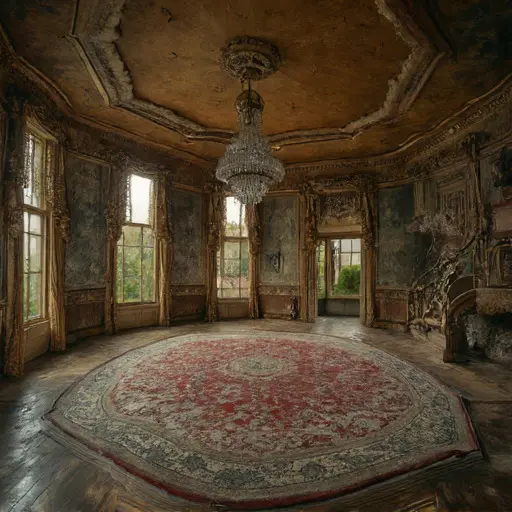
Hearth-Aurelia—a name evoking both warmth and gold—was a dazzling example of architectural hubris. Built entirely of white marble and imported, luminous wood, the mansion was designed to capture and amplify every ray of available sunlight. Perched dramatically on a narrow cliff overlooking a river, the house felt permanently exposed, its light-filled windows staring out like blind eyes. Stepping through the massive, arched entrance, the air was surprisingly dry and cold, carrying the faint, sweet scent of ozone and crystallized dust. Every corner seemed to hold residual brightness, a haunting glow that refused to entirely fade. The silence here was sharp, a brittle quiet that felt like frozen glass, perfectly preserving the moment the light was extinguished. This abandoned Victorian house was a temple to visibility, where secrets had nowhere to hide.
The Photographer’s Perfect Image
Hearth-Aurelia was the creation and studio of Evelyn Dubois, a pioneering but deeply obsessive portrait photographer of the late 19th century. Her professional life was dedicated to the nascent art of photography, focusing intensely on portraiture—capturing the perfect, unblinking image of the human soul. Personally, Evelyn was driven by a profound, artistic anxiety: the fear that all beauty was fleeting and that memory was unreliable. She built Hearth-Aurelia with custom skylights and perfect exposures, seeing the mansion as the ultimate, giant camera, designed to capture the truth of existence in an instant. Her obsession was the moment, the shutter-click that would freeze life forever.
The Darkroom of Final Exposure
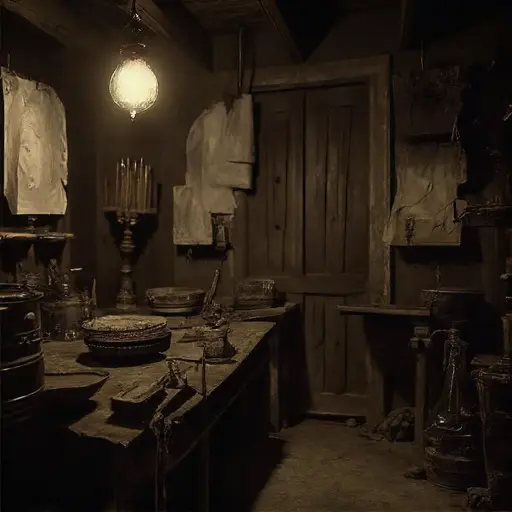
Evelyn’s darkroom was a sealed vault of perpetual night, the only space in the house where light was forbidden. Here, among the dusty chemical stains and shattered glass negatives, we found her final, detailed journal. It revealed her descent into despair after her long-time subject and fiancée, Sebastian, a brilliant engineer, abruptly broke off their engagement. Evelyn became obsessed with capturing Sebastian’s absence—creating a photograph so perfect it would prove his existence despite his departure. Her final entry detailed her ultimate experiment: she was going to use the entire mansion as a pinhole camera to capture the single, brief flash of light from the setting sun, believing the resulting image would contain the memory of everyone who had ever stood within the walls of Hearth-Aurelia.
The Sun Gallery’s Blank Canvas
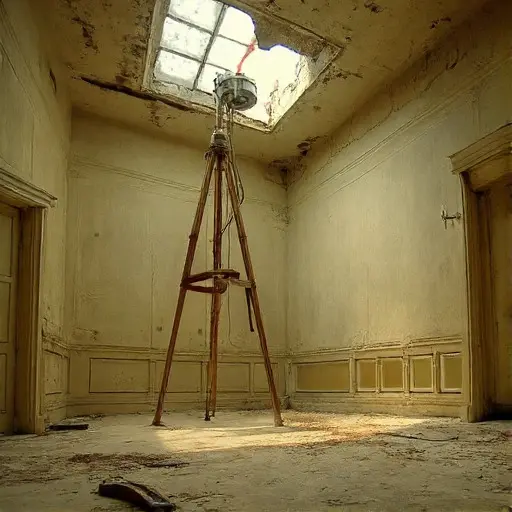
The top floor of the house was Evelyn’s “Sun Gallery”—a massive, bright chamber built with adjustable skylights and massive lens arrays. It was here that she planned her final, grand exposure. The walls were covered in a specialized, photo-sensitive emulsion, now completely faded to a ghostly pale yellow. In the center, we discovered her massive, unique camera apparatus—a custom-built lens mounted on a towering wooden tripod, aimed directly at the largest skylight. On the lens, a small, silver locket was taped, engraved with the initials E.D. & S.B. Taped to the tripod leg was a single, final piece of undeveloped photographic paper, completely blank. Evelyn’s body was never found. The theory is that when she triggered her final, powerful flash—attempting to capture the perfect, all-encompassing image of light and memory—she either destroyed herself in the process or simply became another, invisible layer in the light she sought to control. The haunting glow of Hearth-Aurelia is the residual, perpetual light of a photographer who made herself the final, invisible subject of her own abandoned Victorian house.