The Haunting Demir Cartography Studio Where the Measures Drifted Off-Scale
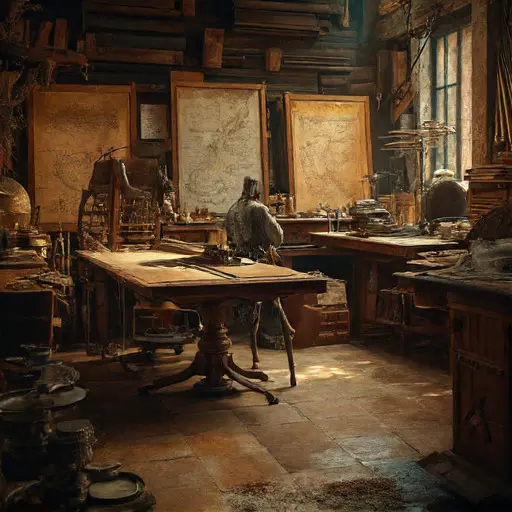
A fragile stillness hums through the room. On the central table lies a half-inked river system—its upper bends crisp, its lower course jittered by uneven spacing. A quill lies crooked near a blot that spreads into unsure branches.
A brass divider stands open at an imprecise radius. Nothing catastrophic, only a practiced hand faltering at the edge of its certainty.
A Life Charted Through Quiet Lines and Grain-Fine Judgement
This cartography studio belonged to Kemal Orhan Demir, mapmaker and survey draftsman, born 1870 in a district near Bursa. Raised in a modest family of textile traders, he learned under a traveling cartographer who taught him to measure distance by shadows, to coax coastlines from scant reports, and to ink contours in patient gradients. A ribbon from his sister, Leyla Demir, clings to a jar of ochre pigment.
Kemal’s days settled into measured routine: dawn sharpening of quills, midday alignment of scale bars, dusk washing in faint tints beneath a steady lamp. His instruments remain sorted with earnest care—compasses nested, rulers stacked, pigments arranged by tone. Patrons once admired his maps for their balance and clarity.
When Precise Boundaries Drifted into Uncertainty
For years, the studio thrived in silent rigor. Reports from surveying crews lay neatly folded. Parchment sheets stretched taut over drawing boards dried with clean, unwavering lines. Completed maps stacked in folios bore the calm authority of careful measurement.
Then distortions crept in. A mountain range tilts against its standard bearing. A bay mouth narrows by a fraction. A border line wavers mid-stroke. His commission ledger lists a provincial official’s order written, crossed out, rewritten, then smeared by water. A curt Ottoman note beside it reads: “He claims I falsified the extent.”
Rumor moved in low voices: the official accused Kemal of delivering a map that misplaced a contested boundary—declaring his draft an affront to administrative pride. Others whispered he refused to adjust the border to satisfy political conceits.
The TURNING POINT Inked in Hesitant Bearings
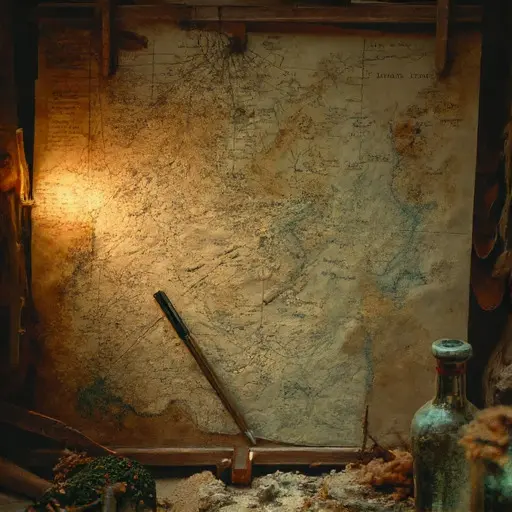
One evening left quiet evidence. A large commission map dominates the table—northwestern contours resolute, southeastern borders smeared beneath an aborted wash. A ruler lies warped along one edge, as though heat buckled it. A quill, snapped at the tip, rests beside a diluted wash that never settled into tone.
Pinned beneath a creased field report is a torn scrap: “They demand restitution for insult.” Another fragment, blurred by dripped wash, reads: “I drew what the measures told—yet they deny it.” His handwriting slips as though each numeral carried weight. Even the folios—normally squared—stand uneven, some leaning in muted disorder.
Across the table, a half-traced caravan route bends sharply where a steady hand once held its course.
A Small Hollow Behind the Rolled Charts Cabinet
Behind the tall cabinet of chart tubes, a panel shifts aside. Within rests an incomplete personal map Kemal intended for Leyla: a simple valley rendered with tender precision in its upper reaches, while the lower folds remain faint pencil arcs. A folded note in his wavering script reads: “For Leyla—when my bearings return.” The last word thins into pale graphite.
Beside it lies a fresh sheet of parchment, perfectly stretched and blank, waiting for the measure he never began.
The Last Faltering Contour
Inside a shallow drawer beneath the drafting frame rests a test sheet: contour lines begin in steady elevation, then flatten into confused strokes where spacing collapses. Beneath it Kemal wrote: “Even truth’s outline fails when resolve ripples out of thread.”
The cartography studio settles into pigment-scented quiet, its measures lingering in half-drawn hesitation.
And the house, holding its abandoned mapmaker’s chamber, remains abandoned.
