The Haunting Decay of the Ashlar-Moorings

The Ashlar-Moorings, a sprawling Second Empire mansion characterized by its mansard roof and iron cresting, was built in 1878 for a price that bankrupted its original builder. It stands today as a ruin of ambition, its stone façade scarred by weather and climbing ivy. To enter is to walk into an immense, echoing space where the cold seems to radiate from the very stone.
The primary library, a room of intimidating height and scale, is the mansion’s inner sanctum, now a stage for magnificent decay. Dust is the reigning occupant, a thick, pervasive layer that softens every line and muffles every footfall. The silence is not peaceful; it is heavy, deep, and haunting, a testament to the sudden and irreversible end of the family that created it.
The Compulsive Collector, Edmund Finch
The house belonged to Edmund Finch (1840–1910), a wealthy, eccentric investor who made his fortune cornering the early market in municipal bonds. His profession required an obsessive eye for detail and a talent for hoarding value. Socially, he was a recluse, known for his vast collections more than for his hospitality.
Edmund was a widower; his wife, Clara, died young, leaving him with two daughters: Adeline and Martha. Edmund’s personality was defined by a compulsive, anxious need to possess and classify everything. He never entertained; his entire life was devoted to filling the house—especially the library—with rare books, taxidermy, and obscure antiquities. His ambition was to create a comprehensive, private museum that would secure his immortality through objects. His greatest fear was loss and disorder.
His house was perpetually under construction as he added rooms to hold new acquisitions. He built a hidden, small gallery off the library, accessible only by a spring-loaded door disguised as a bookcase, to display his most valuable and volatile art pieces, a true reflection of his paranoid nature.
The Loss in the Hidden Gallery
The ruin of the Finch family was a quiet, internal tragedy of alienation and disease. Edmund’s two daughters were stifled by his controlling environment and his obsessive focus on inanimate objects over people. Martha, the younger, artistic daughter, fled the house in 1905, never to communicate with her father again.
Adeline, the elder, remained, attempting to manage her father’s increasingly erratic behavior as his mind began to succumb to syphilitic dementia, a common, though often hidden, affliction of the era. His paranoia escalated; he became convinced that his prized collection in the gallery was being stolen. He would lock himself inside the concealed space for hours, performing agitated, frantic inventory checks, his once meticulous classification system devolving into chaos.
The final, catastrophic event occurred in 1910. One winter morning, Adeline found the secret door to the gallery open, and her father inside, deceased. He had fallen from the rolling ladder while frantically attempting to catalogue a high shelf, striking his head on the plinth of a marble bust. The cause was medical, but the mechanism was the house itself—specifically, his own compulsive fear of loss.
The Decision in the Grand Stairwell
Adeline was left with an overwhelming, unsaleable estate filled with eccentric, heavy, and often bizarre objects. She was exhausted by years of caring for her father and devastated by her sister’s refusal to return or help. Her decision regarding the Ashlar-Moorings was based on pure emotional rejection.
She did not want the house to be saved, sold, or appreciated. In 1911, Adeline held a small, private auction for a few select antique dealers, selling only the high-value art pieces from the hidden gallery (the only items her father truly obsessed over). She used the modest proceeds to buy a small cottage far from the city. She made no effort to empty the rest of the house, which was still crammed with lower-value, heavy collections—books, scientific instruments, and geological samples.
Her final act was to pay a solicitor to set up a trust that would simply maintain the tax payments on the property for twenty years, long enough to ensure no immediate, clean sale could take place. Then, she walked out, locking the main entrance behind her. The house, full of the material evidence of Edmund’s life, was left to rot.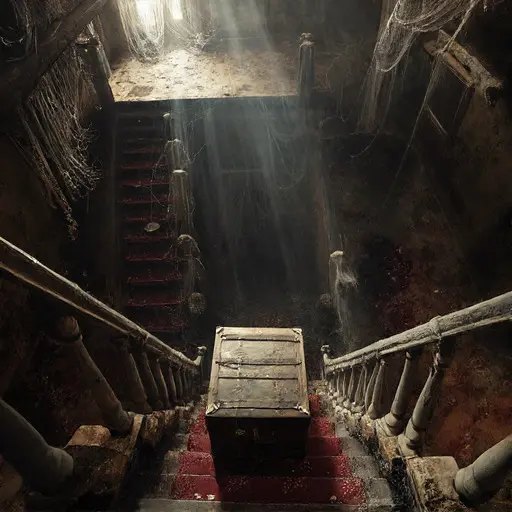
When the trust funds ran out in 1931, the Great Depression had already made the house worthless. It became another piece of abandoned property, too large and complex to liquidate, too remote to vandalize completely. The Ashlar-Moorings remains today, its haunting silence filled with the thousands of heavy, useless objects left behind—the physical manifestation of a collector’s obsession and a daughter’s final, quiet refusal to clean up his mess.
