The Haunting Balance Ledger of the Castaño Cordwainer’s Shop
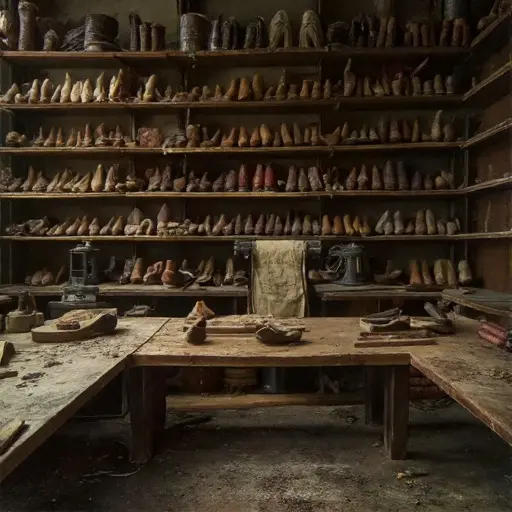
A muted stillness fills the Cordwainer’s Shop, where a folded sheet bears a penciled balance notation—figures broken off just before a crucial subtotal. Nothing feels ransacked, only suspended.
A Maker’s Quiet Course
These tools belonged to Rafael Castaño, cordwainer (b.
1874, Valencia), trained under a master in the city’s artisan quarter. His Spanish annotations—small, slanted—list fittings for merchants and café waiters. A slip referencing his sister, Isabel Castaño, “collect repaired slipper Friday,” outlines a dependable rhythm: tracing patterns, cutting uppers, aligning welt stitches with a measured calm.
Crafting Footwear with Intention
On the main bench, an array of awls sits wrapped in linen. A curved skiving knife rests beside stacked toe boxes. Several templates hang from a nail, edges darkened by repeated handling. Beneath a hinged lid, Rafael’s ledger shows orderly commissions, their margins clean, ratios steady.
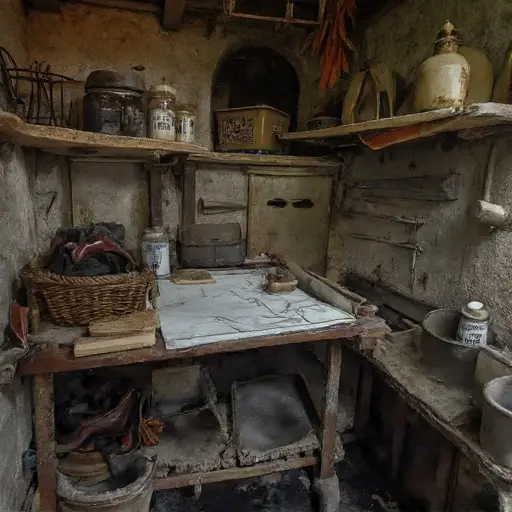
A Subtle Faltering of Method
Later leaves in Rafael’s ledger slant unpredictably. Measurements for matching pairs conflict; heel lifts are recorded twice, then crossed out. A pair of nearly finished shoes sits on a side stool—one welt straight, the other wavering. A margin note—“client disputes comfort”—is smudged into near-inkblot. A mispunched hole on an otherwise immaculate upper suggests a lapse foreign to his usual care.
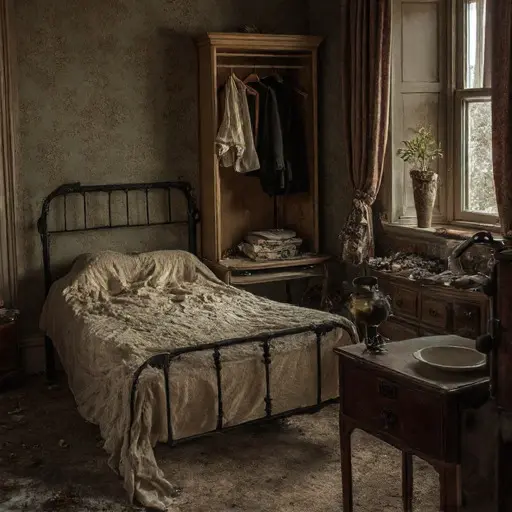
In the Shop’s final drawer, Rafael’s last ledger page ends mid-calculation, balance figures trailing into faint graphite. A penciled reminder—“review with Isabel”—stops abruptly.
No record clarifies why corrections unraveled or why Isabel never returned.
The house settles into abandonment, its tools awaiting hands that will not trace another line.
