The Harbor Manor Left Waiting for Empty Tides
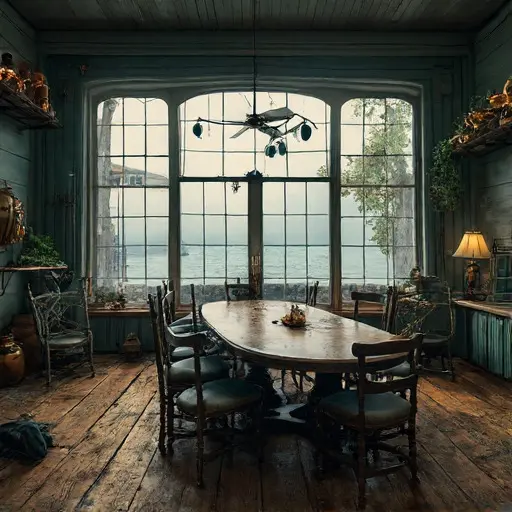
The manor was constructed as a functional extension of the harbor itself, built not beside the quay but into it, as if architecture and maritime infrastructure were never intended to be separate. Its compact rectangular form follows the shoreline precisely, aligning its structural rhythm with the geometry of the stone dock. Unlike inland Victorian estates, this residence was designed for loading, mooring, and seasonal maritime work, its elegance expressed through restraint rather than ornamentation.
For decades, it served as both residence and operational harbor house for a small coastal family involved in trade and boat handling. The dock-facing wing functioned as a transitional space between domestic life and maritime labor, where goods were recorded, ropes managed, and weather observed before voyages. The ember-glass windows were chosen specifically for visibility through fog, and the nocturne-copper fixtures doubled as both structural reinforcement and functional mooring hardware.
The first signs of abandonment came not through damage, but through absence of arrivals. Boats stopped docking at the quay. The capstan base at the edge of the stone platform—once central to daily operations—began to rust unevenly as it remained unused. Rope lines slackened permanently, then were removed altogether. Without maritime activity, the manor’s dock-facing systems lost purpose first, while the interior rooms slowly transitioned from active use to preserved stillness.
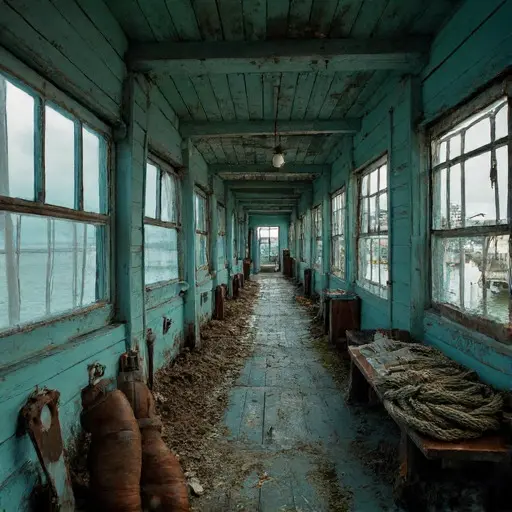
As time passed, the manor’s structural integrity remained intact, but its operational identity dissolved. The shallow slate roof resisted coastal winds as intended, and the copper seam bands oxidized into deeper tones of nocturne-copper, blending visually with the sea palette. Interior spaces remained largely untouched, but no longer maintained for use. Dust accumulated evenly rather than chaotically, suggesting still air rather than disruption. The harbor itself became quieter, with fewer signs of human movement across the quay.
Eventually, the house ceased to function in any practical sense. No vessels returned to the dock, no maintenance crews arrived, and no repairs were initiated. The structure remained precisely as it was designed—resistant to weather, aligned with the harbor, and fully coherent—but no longer part of any living system of use. The broken capstan stayed in place at the waterline, marking the final point of contact between maritime activity and architectural permanence.
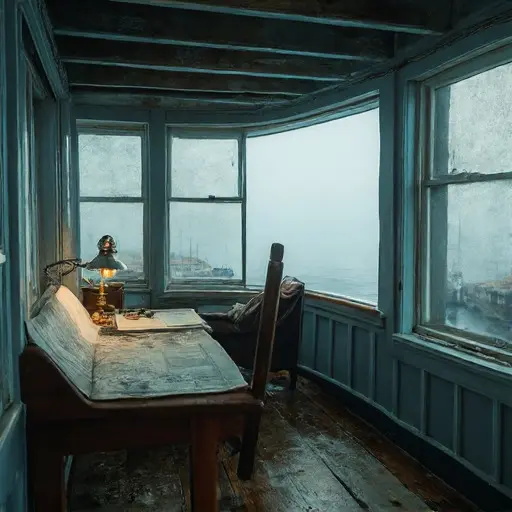
Today, the harbor manor persists as a static coastal artifact. Its walls remain weathered but sound, its dock alignment unchanged, and its interiors preserved in quiet suspension. The tide continues to rise and fall against the stone quay, but no longer interacts with human activity. No restoration has been attempted, no reoccupation recorded, and no maritime function restored. The manor endures as a silent harbor structure, holding its position against the sea while remaining permanently unvisited.