The Hallowmere House Notes and the Abandoned Bone-Map Maker’s Bench
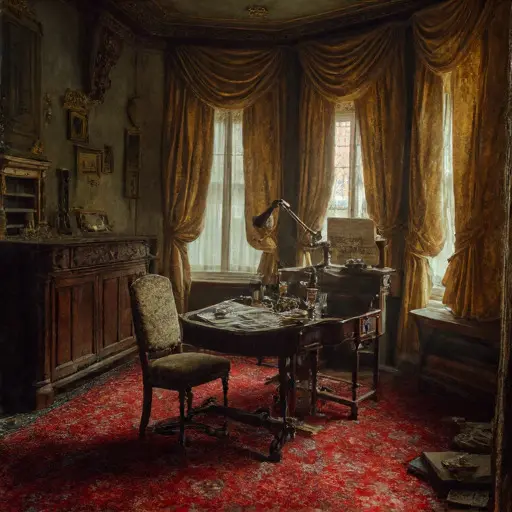
The Measured, Quiet Life of Dorian Crest Hallowmere
Dorian Crest Hallowmere, a Victorian specialist in “osteographic cartography”—engraving maps into bone for scientific demonstration—lived here with his widowed sister Arlisse and her son, Pennor. Dorian’s notebooks brimmed with contour sketches, ridge profiles, bone selection charts, and experiments in how engraved lines responded to differing densities. Soft-spoken, meticulous, and reserved, he spent hours testing how to match the natural grain of bone to the geography it represented.
In the Osteography Chamber, bone blanks sit sorted by curvature, engraving tools lie in neat cloth rolls, vellum sketches are pinned beneath tarnished weights, and reference bones line a shelf in careful gradation. Arlisse’s domestic order remains visible—folded linens, precisely arranged herbs, mending laid out by size. Pennor’s traces linger quietly: a wooden toy knife carved by Dorian, chalk-dusted arithmetic on a slate, and a folded drawing of a “Bone Mountain” labeled in a child’s earnest handwriting.
As Dorian’s reputation grew, his drafts tightened. Margins crowded with corrections. Bone blanks accumulated faster than he could shape them. When Arlisse fell ill, household structure began to loosen. After her death, Pennor was taken to relatives elsewhere. Dorian’s final notes show trembling strokes, unfinished ridge carvings, and contour diagrams ending mid-line. One afternoon, he stepped away from his table and did not return. Hallowmere House has remained unchanged ever since.
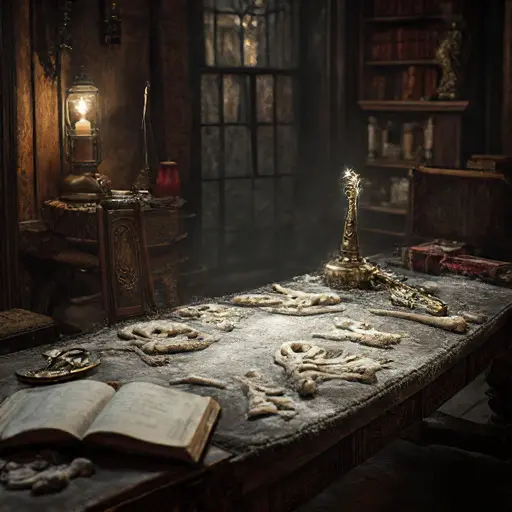
A Corridor Worn by Slow Withdrawal
Upstairs, the corridor’s runner rug sags into dusty folds, its original pattern now faint ghostwork. A hall table holds a cracked spectacles frame, a dulled engraving needle, and a personal note ending mid-sentence. Pale outlines linger where bone-display frames once hung.
A Sewing Room Resting in Its Last Gesture
In the Sewing Room, Arlisse’s tender work remains paused. A child’s collar lies pinned beneath the treadle machine’s presser foot. Thread spools toppled from once-neat rows have faded into chalky pastels. Pincushions hardened by age bristle with rusted needles. Folded muslin stiffened along its edges rests untouched in quiet expectancy.
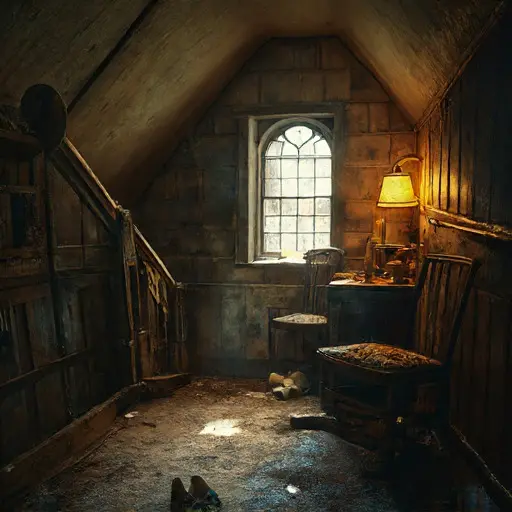
Behind the lowest crate lies a slip in Dorian’s thinning script: “Finish valley carving — tomorrow.” Tomorrow never came to Hallowmere House.
