The Halewick Pavilion Left Vacant After Courtyard Overgrowth Decline
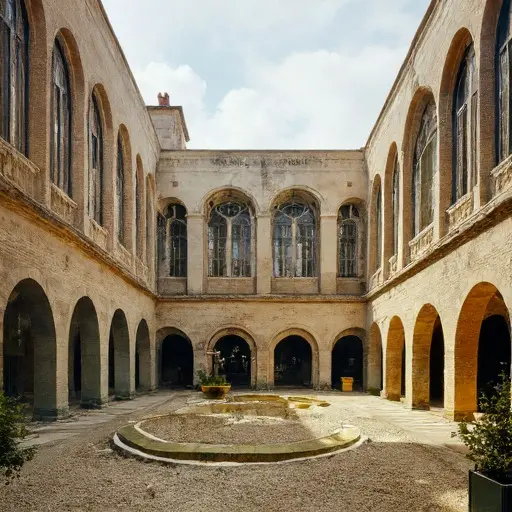
Halewick Pavilion was completed in 1906 within a broad, gently undulating heath forest where low hills rolled beneath heather, pine, and scattered silver birch. Unlike enclosed Victorian estates of the period, the pavilion was designed as a wide, low residence organized around a central open courtyard that remained visually and physically present throughout the building. Rather than isolating nature, the structure framed it, allowing the heathland to occupy the architectural core.
The exterior was composed of pale sandstone, deep glazed brickwork, and segmented timber façades arranged in horizontal layers. Sandstone formed the structural base in warm cream, soft ochre, and light ash-beige tones. Glazed brick introduced saturated accents of emerald, midnight blue, and burnt crimson, arranged in measured bands that caught subdued reflections of shifting light. Timber sections softened the composition further, painted in fog gray, muted saffron, and desaturated pine green, all weathered into subtle tonal gradients.
The pavilion’s layout emphasized openness and circulation around the courtyard. Multiple wings extended outward in a near-rectangular loop broken by open passages, creating a continuous but non-enclosed perimeter. Each wing carried its own shallow pitched roof, resulting in a modular skyline of overlapping forms. From above, the building read as a structured geometric ring embedded in the heath.
Inside, the Halewick estate functioned as both residence and ecological study center. The Langridge family, who commissioned the pavilion, were amateur botanists and land surveyors. Edmund Langridge documented heathland succession patterns, while his sister Clara managed specimen cataloging and correspondence with regional naturalists. The open courtyard served as a living laboratory, where plant growth was observed directly within the architectural loop.
Early financial strain
By the late 1920s, interest in private botanical estates declined as regional environmental surveys became centralized through academic institutions. The Langridge family’s research lost institutional relevance, and external support gradually diminished. Maintenance of the pavilion’s extended perimeter became increasingly difficult, particularly as wind exposure affected timber façades and seasonal moisture accumulated in courtyard pathways. Copper gutters along rooflines developed verdigris patina, and sandstone surfaces began to soften in color under persistent weathering.
Gradual decline in the household
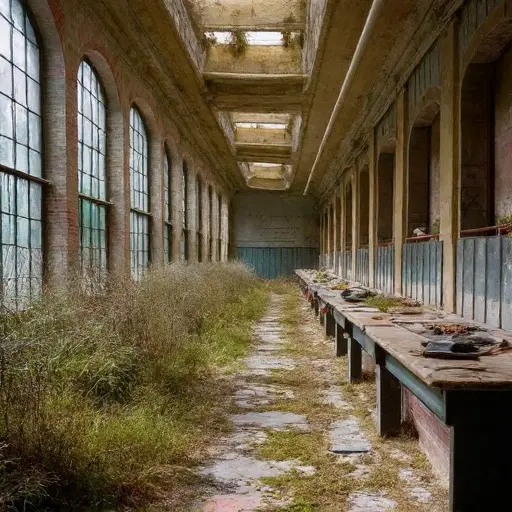
As financial pressure increased, courtyard maintenance was reduced and eventually abandoned. Gravel pathways began to break apart under encroaching vegetation, and the central circular garden transitioned from cultivated study space to semi-wild heath growth. Inner-facing windows were increasingly left unused, while some outer service rooms were closed entirely due to upkeep costs.
Family members gradually left for positions in regional forestry services and academic institutions. By the early 1940s, only intermittent occupancy remained, primarily for record storage and occasional site visits.
Final abandonment phase
By 1946, Halewick Pavilion was no longer fully inhabited. Utility services were reduced and eventually discontinued as access roads and maintenance funding were withdrawn. Without upkeep, wind and heath vegetation accelerated the breakdown of the courtyard’s edges, allowing grasses and shrubs to merge with architectural thresholds. Rooflines remained intact but weather-softened, and timber façades began to lose their structural sharpness.
The pavilion left empty
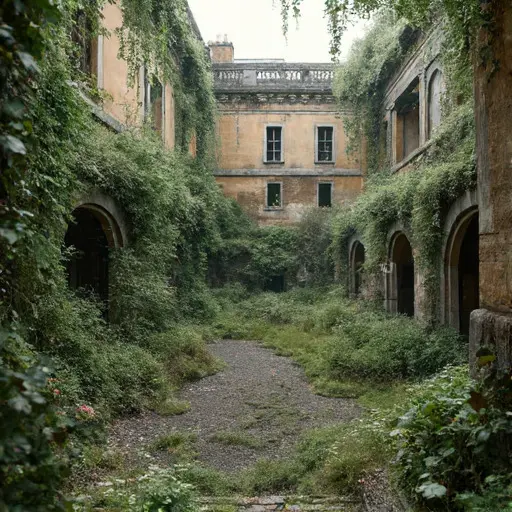
By the late 1940s, no formal ownership or maintenance of Halewick Pavilion remained. Legal responsibility dissolved among distant heirs who never returned to the heath. No restoration was undertaken, and no institutional transfer occurred. The pavilion remained open around its central courtyard, slowly deteriorating as vegetation, wind, and seasonal cycles reclaimed the structure from the inside outward.