The Halcyon Ring Residence Left Sunken in Meadow Silence
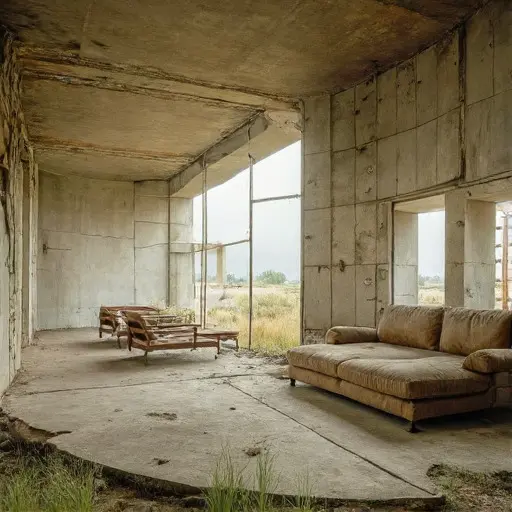
The Halcyon Ring Residence was constructed in 1932 as part of an experimental rural habitation project aimed at integrating continuous-loop architecture into open landscape environments The design, commissioned by a consortium of structural engineers and landscape planners, proposed a single uninterrupted residential form capable of distributing load evenly across a circular concrete system rather than discrete building wings The structure was partially embedded into a gently sloping meadow to stabilize its mass, resulting in a flattened ring geometry that sat half-sunken into the soil Reinforced concrete formed the primary structural body, with exposed rebar beams left intentionally visible as part of a modular maintenance system, while segments of glazed brick and weathered wood siding were inserted to define internal zones of habitation The building was never intended to have a conventional entrance or exit hierarchy; instead, circulation occurred continuously along the ring, with interior rooms arranged along a looping corridor that gradually shifted elevation and orientation as it followed the curve of the structure
Slow Structural Settling and Functional Abandonment
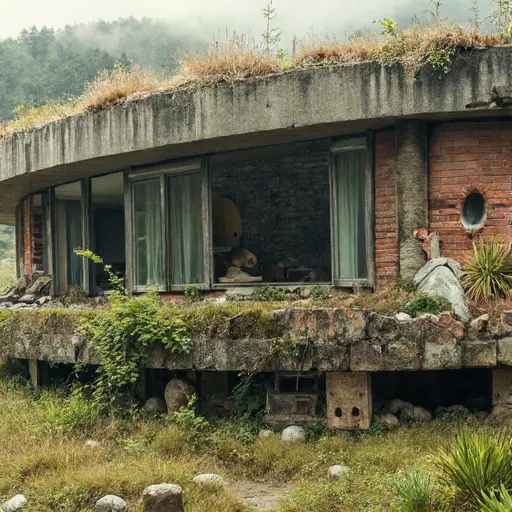
By the early 1940s the Halcyon Ring Residence began to experience gradual structural instability as uneven soil compression beneath the flattened ring caused differential sinking along its circumference Sections of the concrete loop settled at slightly different rates, introducing subtle torsion into the originally uniform circular geometry This resulted in a gentle warping of interior spaces, where floors that were once level began to tilt imperceptibly, altering circulation patterns without fully compromising structural integrity Occupancy declined steadily as residents found the continuous-loop layout increasingly disorienting under conditions of slow deformation Maintenance efforts were complicated by the absence of structural endpoints, making repairs difficult to isolate without affecting adjacent sections of the ring By 1947 most inhabitants had permanently left the residence, with only sporadic inspections conducted afterward to assess safety and material degradation Despite abandonment, the structure remained intact due to the inherent strength of its circular load distribution system, which prevented localized collapse even as environmental forces continued to reshape its form
Final Evacuation and Landscape Reclamation
<img src=”https://beyondvisit.
com/wp-content/imagecontent/uploads/abandoned victorian house 47194675.webp” alt=”” />
By 1952 the Halcyon Ring Residence was officially declared uninhabitable following structural surveys confirming widespread differential settlement and progressive material fatigue across the entire circular foundation No demolition was undertaken due to the complexity of dismantling a continuous ring structure embedded in soft meadow soil, and no restoration was attempted due to the cost of re-leveling the entire looped system Ownership responsibilities were gradually dissolved as administrative bodies concluded that the structure no longer functioned as a conventional building but as a stabilized architectural landscape feature The surrounding meadow slowly reclaimed the lower edges of the ring, with vegetation spreading through cracks and over exposed concrete surfaces while interior spaces remained open to the air through broken glazing
The Halcyon Ring Residence remains in place as a silent flattened loop within the rural meadow Its continuous circular form persists despite partial sinking and weathering, maintaining structural coherence while remaining fully abandoned No occupants have returned, and no reconstruction has ever been attempted The building endures as an integrated architectural landscape object, slowly merging with the grassland while preserving the faint geometry of its original ring form under soft, unchanging overcast light