The Greywold Valley House Left Vacant After Upland Decline
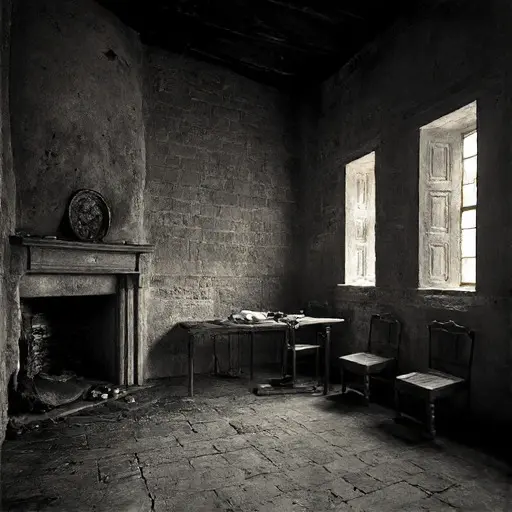
The Greywold Valley House was established in 1902 by the Carrick family, who settled in the upland valley to manage small-scale sheep grazing and seasonal crop rotation across the surrounding hills. Built directly into the geological character of the region, the house was constructed from locally quarried stone, with its lower levels formed from darker fieldstone and its upper floors transitioning into lighter dressed masonry. This gave the structure the appearance of having grown out of the valley floor itself rather than being placed upon it.
The household was modest and practical, shaped by the demands of rural upland life. William Carrick oversaw grazing cycles, livestock movement, and maintenance of dry-stone field boundaries, while his wife Agnes managed household records and correspondence with nearby market towns. The house functioned as both residence and administrative center for small agricultural operations scattered across the valley. For many years, it remained stable, sustained by predictable seasonal rhythms and limited but sufficient income.
Early financial strain
By the late 1920s, agricultural profitability in upland regions began to decline as larger lowland farms expanded production and reduced market prices. Transporting goods from remote valleys became increasingly inefficient, and returns on livestock and crops diminished steadily. The Carrick household responded by reducing operational scope, allowing some field boundaries to fall into disrepair and delaying maintenance on both the house and surrounding agricultural infrastructure.
Inside the residence, daily life remained structured but increasingly constrained. Rooms that had once been used for administrative work were closed off during colder months, and repairs to timber and stonework were postponed. The muted burgundy door at the entrance gradually faded under exposure to wind and seasonal weather, reflecting the broader slow deterioration of the property.
Gradual decline in the household
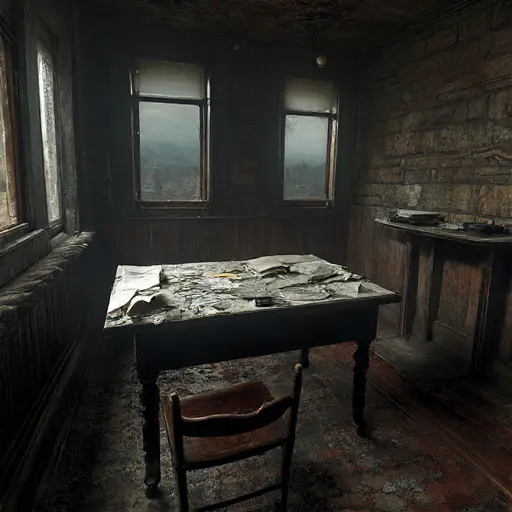
As financial pressure increased, portions of the valley operations were gradually abandoned. Sheep grazing areas were reduced, and previously maintained field boundaries were left unrepaired. Grass and coarse meadow vegetation began to reclaim stone fragments and gravel paths. The narrow gravel approach to the house became less distinct, blending into the natural terrain as maintenance decreased.
The Carrick children left the valley during the 1930s, relocating to towns where industrial and administrative employment offered more reliable income. Their departure significantly reduced the household’s capacity to manage both the residence and surrounding land. The upper floors of the house were increasingly unused, and heating was restricted to a limited number of rooms.
Final abandonment phase
By the early 1940s, the Greywold Valley House was no longer fully inhabited. Utility services were gradually discontinued following prolonged financial arrears. Without maintenance, moisture and wind began to penetrate the thick stone structure more deeply, while interior spaces cooled and darkened over time. Agricultural activity surrounding the house ceased almost entirely, leaving only remnants of former field organization in the landscape.
Final deterioration
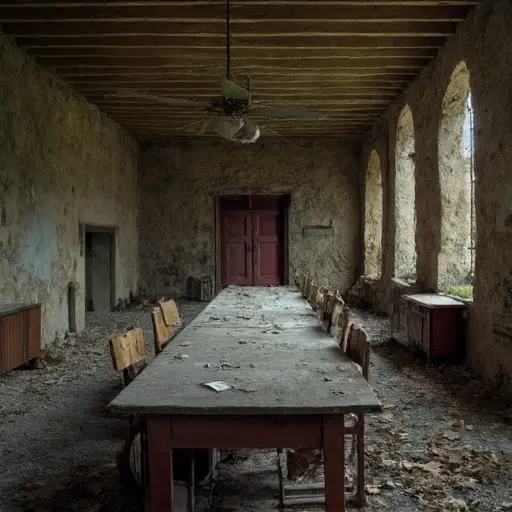
By the mid-1940s, no formal ownership or active maintenance of the Greywold Valley House remained. Legal notices were repeatedly returned undelivered, and no heirs reestablished residence in the valley. The structure persisted as an abandoned rural dwelling, slowly weathering within the stone and grass landscape that surrounded it. No restoration or reoccupation followed. The house remains empty today, anchored in the upland terrain, gradually returning to the quiet rhythm of wind, stone, and open valley space.