The Greyhollow Romanesque Townhouse That Stopped Moving
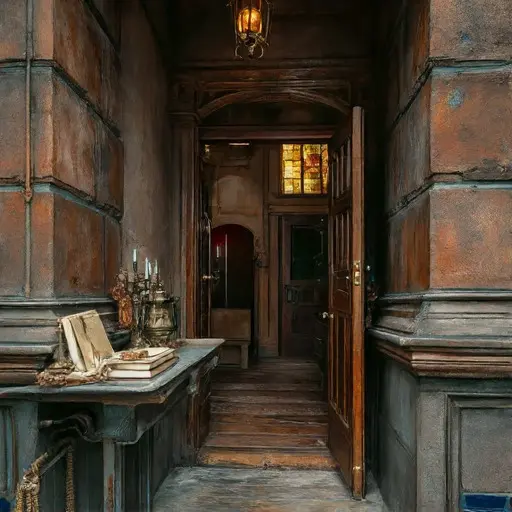
The Greyhollow Townhouse was constructed at the turn of the twentieth century for the Aldridge family, who moved into the growing urban district as industry expanded outward from the city core. Designed in the Victorian Romanesque style, the house emphasized solidity and permanence, with its heavy masonry façade, rounded arch windows, and compact corner turret intended to project stability in an otherwise rapidly changing neighborhood. The family consisted of a merchant father, a schoolteacher mother, and two children, supported intermittently by a live-in housekeeper.
Daily life revolved around structured routines—school schedules, trade correspondence, evening meals in the dining room, and maintenance of the small but carefully tended front yard. The townhouse functioned as both residence and symbol of long-term establishment, its materials chosen for endurance and status rather than ornament alone.
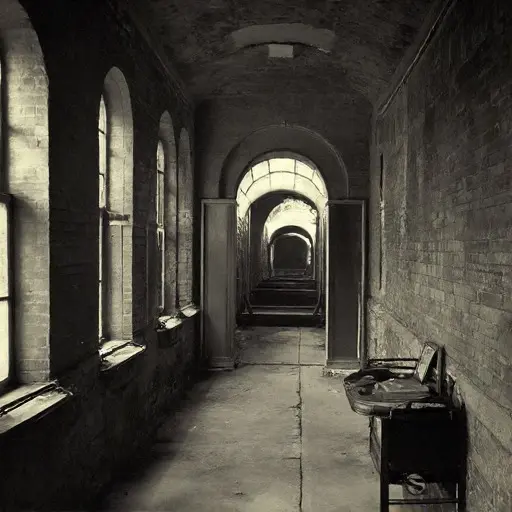
By the early 1920s, the Aldridge family began experiencing steady financial pressure as local trade fluctuations and rising maintenance costs affected household stability. The townhouse, built from dense masonry and intricate ceramic detailing, required consistent upkeep that gradually became difficult to sustain. Repairs to the roofline, turret structure, and front façade were postponed, allowing moisture to penetrate deeper into the stonework. Portions of the upper floors were closed off to conserve heating, while daily life increasingly centered on the ground-floor rooms. The front yard, once carefully arranged, began to lose definition as overgrown grapevines spread across the trellis and the iron gate remained unrepaired. The household did not collapse abruptly; instead, it gradually reduced its footprint within the structure, as maintenance and occupation slowly retreated in parallel.
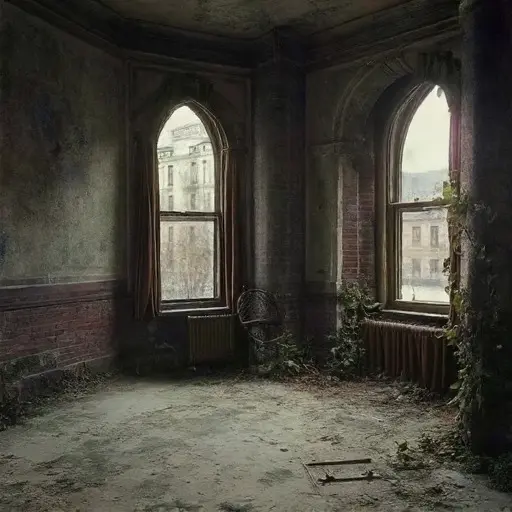
By the mid-1940s, after the final remaining occupants left due to age, debt, and unresolved inheritance complications, the Greyhollow Townhouse was abandoned without formal closure. No restoration was undertaken, and ownership disputes prevented any meaningful redevelopment. The front yard remained partially defined by its rusted gate, leaning bench, and overgrown grape trellis, while the bicycle, ceramic pots, and cracked steps remained exactly where they were left. Inside, furnishings, documents, and personal effects were never removed. The building continues to stand in a quiet state of suspension, its Romanesque mass gradually weathering under constant overcast skies, with no return and no resolution recorded.