The Granite Watchtower Family Manor
Deep within a dense forest clearing where tall trees form a quiet, enclosing ring, the Granite Watchtower Manor stands like a forgotten experiment in domestic architecture. This abandoned Victorian family residence blends Gothic Revival ornamentation with industrial-era structural logic, resulting in a home that feels more engineered than simply built. Though long uninhabited, it remains strikingly intact—its massing and materials still asserting authority over the surrounding woodland.
The building rises as a 2.5-story composition with a strong horizontal emphasis, anchored in pale blue-gray granite blocks layered with bands of dark red brick.
This alternating masonry creates a striped visual rhythm across the façade, reinforcing the manor’s fortress-like presence. Heavy structural buttresses are embedded directly into the exterior walls, not as decoration but as functional supports, giving the entire structure a grounded, almost workshop-like solidity typical of late 19th-century experimental domestic design.
Above, the roofline is steep and complex, formed from weathered slate tiles that shift subtly between graphite black and desaturated teal. Multiple sharp gables intersect across the silhouette, interrupted by iron-framed skylight structures that once illuminated interior workspaces and family rooms. The overall impression is one of controlled complexity—ornamental restraint fused with industrial ambition.
At the center of the façade lies a deeply recessed arched entrance carved from stone. Within it sit heavy double oak doors reinforced with black iron bands and embedded with shattered emerald-tinted glass panels. The doorway opens into absolute darkness, with no visible interior light or reflection, emphasizing the building’s long abandonment.
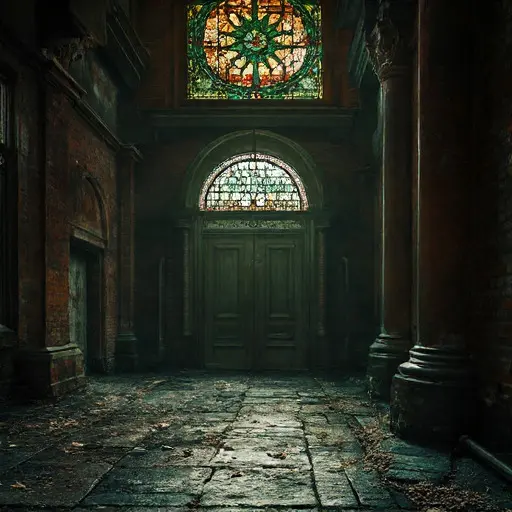
Inside, the manor feels entirely void of life. Natural light filters in only through fractured windows and broken skylights, revealing vast interior spaces once divided between family living quarters and functional industrial-style rooms. Exposed structural beams, iron supports, and stone corridors remain intact, but every room is silent and unlit. Dust hangs in the air like a thin veil over machinery remnants, wooden furnishings, and abandoned architectural details.
The window system reflects the building’s hybrid identity. Lower floors feature tall industrial-style arched windows fitted with iron muntins, while upper levels transition into narrower clerestory openings. Some panes still contain faded stained glass in muted cobalt and amber, while others are completely broken, allowing forest air and ivy to slowly infiltrate the interior structure.
Dominating one corner of the manor is a square watchtower, constructed from alternating layers of granite and brick. Its steep pyramidal roof rises above the treeline, encircled by narrow observation windows that once offered surveillance across the estate grounds. Though weathered, the tower remains structurally sound, reinforcing the manor’s fortress-like silhouette against the forest backdrop.
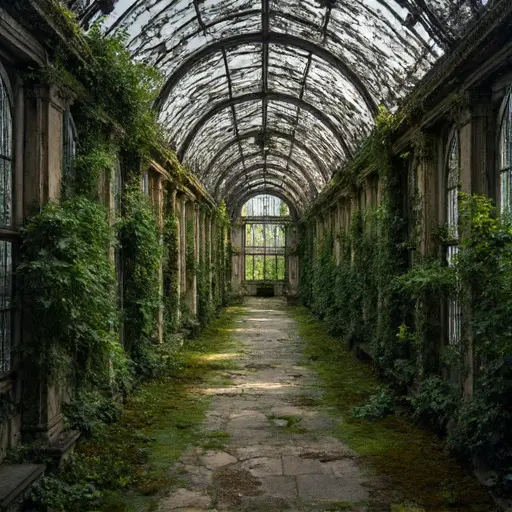
A long glass-roofed corridor extends from one wing of the house, resembling a Victorian workshop conservatory. Its iron framework is bent in places, with several sections collapsed entirely, yet the skeletal geometry remains readable. Broken glass panels hang unevenly in their frames, revealing shadowed interior walkways where nature is slowly beginning to intrude.
The surrounding grounds have fully transitioned from structured estate to reclaimed woodland floor. Old flagstone yards are partially buried under moss and leaf litter, while rusted mechanical garden fixtures hint at former utility systems once integrated into the home’s design. Fragmented drainage channels carved in stone now serve as shallow pathways for rainwater and creeping vegetation.
The forest itself is dense and quiet, forming a natural boundary that respects the manor rather than overwhelming it. Tall deciduous trees surround the clearing evenly, their canopies filtering soft neutral daylight across the structure. There is no fog, mist, or dramatic atmospheric distortion—only clear visibility that emphasizes material textures and architectural detail.
Today, the Granite Watchtower Manor stands as a rare Victorian experiment in merging domestic life with industrial engineering. Its granite-and-brick body, iron reinforcements, and layered Gothic forms remain a testament to a time when architecture sought to balance utility with permanence. Now reclaimed by forest stillness, it endures as a silent monument to ambition, craftsmanship, and the slow return of nature.