The Granite Hollow Manor Hidden Within Split Boulder Field
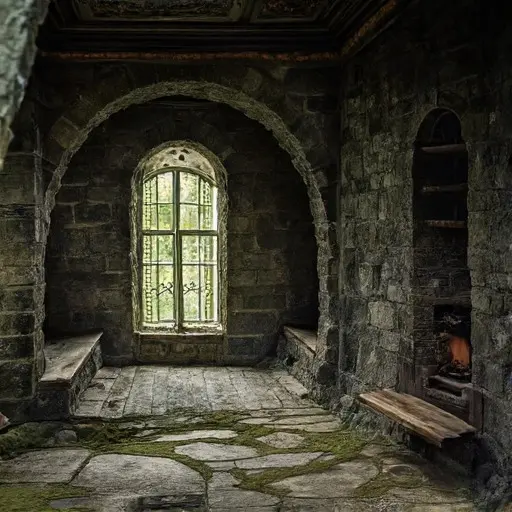
The Granite Hollow Manor was completed in 1904 deep within a remote boulder field at the edge of Northmoor Ridge. Unlike conventional estates of its era, it was not constructed on cleared land but fitted precisely into the existing gaps between massive granite formations, using the natural stone as both foundation and structural boundary.
The original builder, architect Elias Corwen, designed the residence as an experiment in “geological domesticity,” a concept where architecture would conform entirely to natural rock formations rather than reshape them.
The result was a house that never fully revealed itself from a single viewpoint, existing instead as a series of interconnected spaces hidden between stone masses.
The first occupants were the Larrimore family—Henry Larrimore, his wife Agnes, and their son Thomas. Henry worked in mineral surveying, and the house was intended to support extended observation of the surrounding geology while maintaining a permanent domestic residence within the field itself.
For several decades, the manor remained stable and functional. Rooms were warmed by small coal hearths embedded into stone recesses, and light entered only through carefully positioned arched windows that aligned with natural gaps in the boulders.
GRADUAL WITHDRAWAL AND ROCK-BOUND ISOLATION
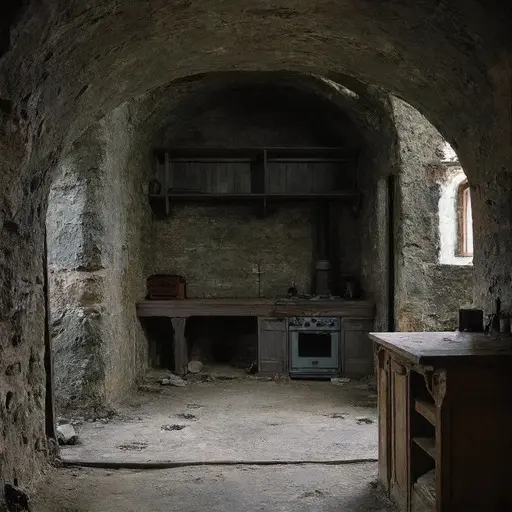
By 1927, Henry Larrimore’s health began to decline following years of field exposure in harsh terrain conditions. His reduced mobility made it increasingly difficult to maintain both surveying work and the upkeep of the manor’s complex, irregular layout.
Agnes attempted to preserve the household by consolidating daily activity into fewer accessible chambers. Several sections of the house—particularly those deeper within the boulder field—were abandoned entirely due to difficulty of access and rising dampness from surrounding stone.
The geological environment, once a defining feature of the home, began to assert itself more strongly. Moisture seeped through granite seams after heavy rain, and moss spread along stone edges that had previously remained dry and stable. The house responded not with collapse, but with gradual absorption into its surroundings.
Thomas Larrimore left for employment in coastal industry work in the early 1930s and never returned to the property. Correspondence from this period suggests increasing difficulty in maintaining heating, repairs, and structural sealing between timber and stone interfaces.
FINAL ABANDONMENT WITHIN THE BOULDER FIELD
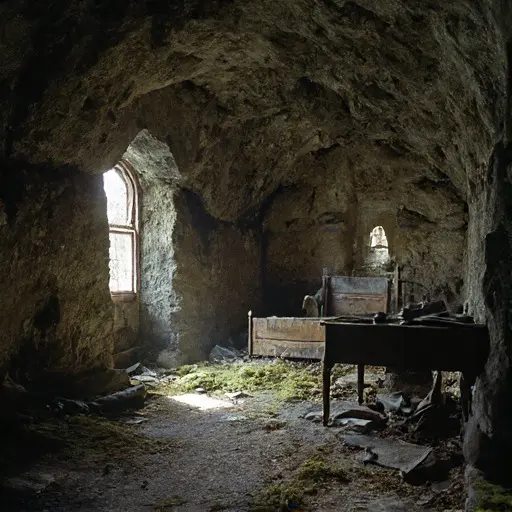
Agnes Larrimore left the Granite Hollow Manor in 1939 after prolonged illness and increasing isolation within the remote stone field. With no practical access routes and no remaining household support, she relocated to a nearby settlement for care.
Ownership of the property became legally ambiguous following her departure. Because the structure was inseparably integrated into natural granite formations, no effort was made to dismantle or relocate it. It was deemed structurally stable but impractical for continued habitation.
Over the following decade, the manor experienced no restoration or human return. Instead, it continued its slow integration with the boulder field. Moss thickened along shaded seams, lichen spread across exposed stone faces, and timber sections weathered under constant moisture and wind exposure.
By the late 1940s, the Granite Hollow Manor was officially recorded as abandoned. It remains hidden within the granite field, its rooms intact but silent, its architecture indistinguishable in places from the natural stone formations that surround and define it.