The Glassterrace Manor Left Vacant After Botanical Trust Collapse
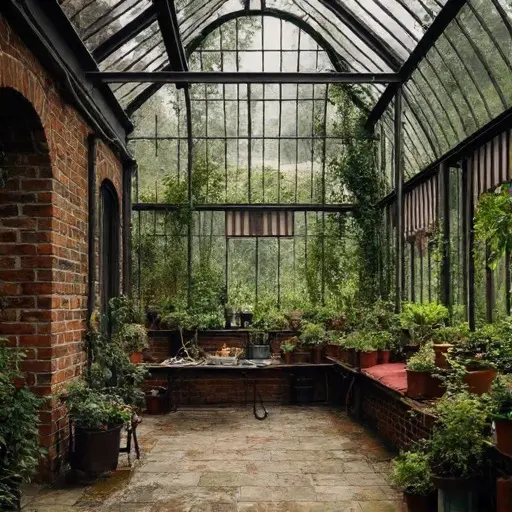
The Glassterrace Manor was completed in 1903 on a gentle agricultural hillside overlooking a river-fed valley. It was commissioned by the Linton family—Dr. Harold Linton, a botanist affiliated with early private horticultural societies, his wife Edith Linton, and their son Charles.
The house was designed not as a conventional residence but as a living greenhouse system integrated into stepped terrain, allowing controlled plant study across multiple climate-exposed terraces.
Each tier of the structure functioned as both domestic space and botanical environment. The lowest brick level housed kitchens and service rooms, while upper timber-and-glass tiers supported experimental plant cultivation and seasonal acclimatization studies. A central glass spine connected all levels, enabling vertical plant growth experiments that were considered innovative for the period.
For the first two decades, the manor was actively maintained as both home and research site. The Lintons hosted visiting botanists and maintained detailed records of plant behavior under controlled hillside microclimates.
EARLY SIGNS OF FINANCIAL AND INSTITUTIONAL WITHDRAWAL
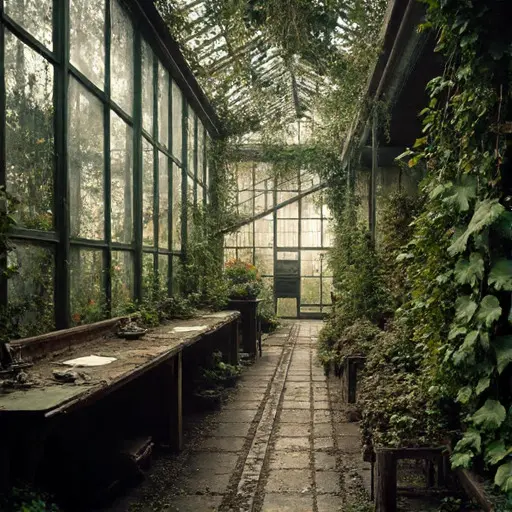
By 1928, the private botanical trust funding the Glassterrace Manor began to dissolve due to economic instability and shifting scientific priorities. Dr. Harold Linton lost primary financial support for his research, forcing a gradual reduction in staffing and experimental activity across the property.
Without institutional backing, maintenance of the complex greenhouse systems became inconsistent. Irrigation channels along the stepped terraces began to fail, causing uneven plant growth and structural moisture accumulation in unintended areas. Some terrace levels were abandoned entirely, while others became overgrown beyond controlled study conditions.
Edith Linton attempted to preserve the residential portions of the manor, but the integration of domestic and botanical spaces made separation impossible. The house itself slowly transformed from curated environment to uncontrolled conservatory.
By the early 1930s, Charles Linton had left to pursue unrelated work in urban industry, and the research component of the household effectively ended.
FINAL OCCUPATION AND BOTANICAL OVERGROWTH
By 1944, the Linton family had fully departed the Glassterrace Manor. Dr. Harold Linton passed away shortly after funding collapse, and Edith relocated to relatives in a nearby town. Charles never returned, and no heirs assumed responsibility for the property or its ongoing maintenance.
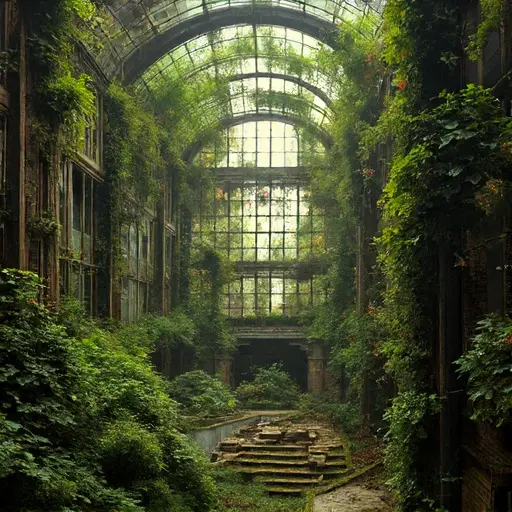
With no institutional oversight and no financial support, the terraced greenhouse system gradually ceased functioning. Water channels dried or overflowed unpredictably, and structural ironwork began to corrode under constant humidity. The stepped walkways became unstable in sections, and several terrace levels were rendered inaccessible.
Despite partial structural integrity, the manor was no longer considered viable for habitation or research. No restoration effort was initiated due to the complexity of its integrated botanical architecture and the difficulty of separating plant growth from structural elements.
By 1949, the Glassterrace Manor was formally recorded as vacant. It was never repurposed or restored. The house remains embedded in the hillside, its glass tiers overgrown, its terraces silent, and its once-controlled botanical system now continuing its uncontrolled reclamation of space without human return.