The Glassbend Stick-Eastlake House Where Work Was Never Finished
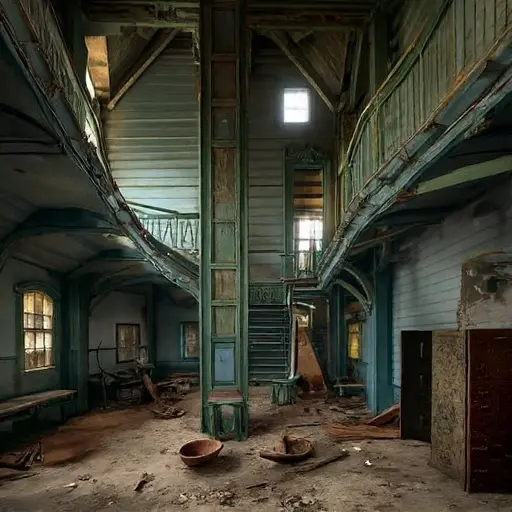
The Glassbend Manor stood on a forest plateau where wind moved steadily through the treeline without obstruction, shaping both the vegetation and the architecture over time. Its Stick-Eastlake design was never fully resolved into symmetry; instead, it expanded through additions that followed necessity, resulting in a fractured but coherent vertical composition that seemed to grow rather than be built.
It belonged to the Halden family, who treated the estate less as a residence and more as an ongoing workshop of life.
Samuel Halden, a horticultural engineer, experimented with hybrid cultivation systems across the greenhouse and terraces, while his partner Miriam documented seasonal plant behavior in detailed field journals that often blurred the line between observation and memory.
Their daily rhythm revolved around unfinished tasks. Tools were rarely put away completely. Seed trays were left partially filled, irrigation channels adjusted but not sealed, and wooden tables carried the residue of repeated, interrupted labor. The house reflected this continuity, with every wing holding evidence of something recently begun rather than completed.
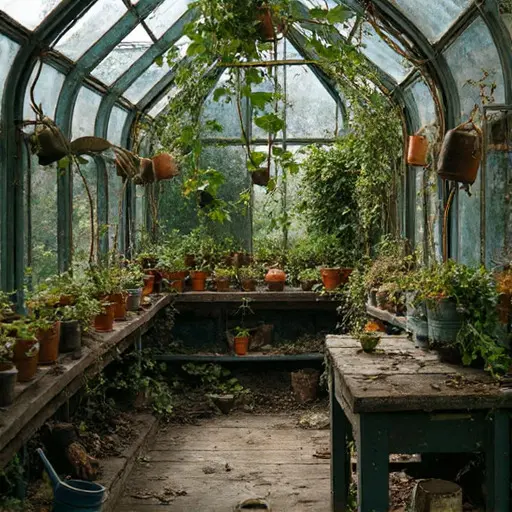
The decline of the Glassbend House occurred gradually, shaped less by catastrophe than by the slow withdrawal of attention. Economic strain reduced Samuel’s experimental work, and maintenance of the complex glass and timber structures became increasingly difficult. Repairs were postponed, then simplified, then eventually ignored as seasons accumulated without resolution.
Miriam continued her documentation longer than anyone expected. Her final entries described not new plantings but the persistence of existing ones, noting how certain vines adapted to broken glass and how wind patterns altered growth along the fractured veranda. Eventually, even her writing ceased, leaving only notebooks scattered across interior tables.
As activity diminished, the estate did not immediately feel abandoned. It simply became less coordinated, as though each part was operating on its own delayed rhythm.
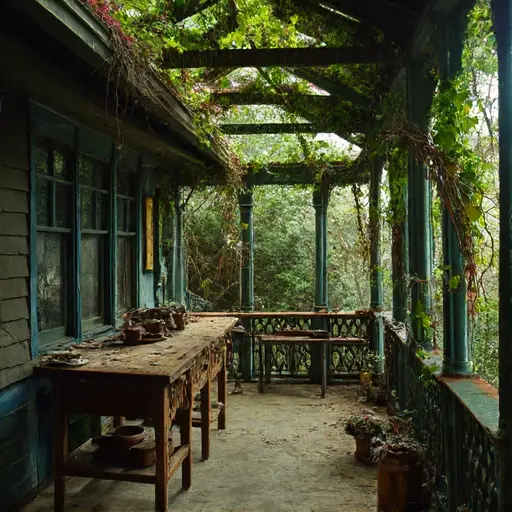
By 1952, Glassbend Manor was fully abandoned. The Halden family had dispersed after a series of personal and financial setbacks, leaving no successor willing or able to continue the work that had defined the estate. Ownership complications and the sheer complexity of the structure discouraged restoration efforts.
No deliberate departure marked the end—only the gradual absence of return. The greenhouse remained standing with vines still growing through its fractures, the worktables stayed scattered with unfinished tasks, and the terraces continued to host the slow spread of wildflowers. The house endures as a paused workshop of life, where labor once defined every room and now only nature continues it without instruction.