The Frozen Tear of Lacrima-Shard House
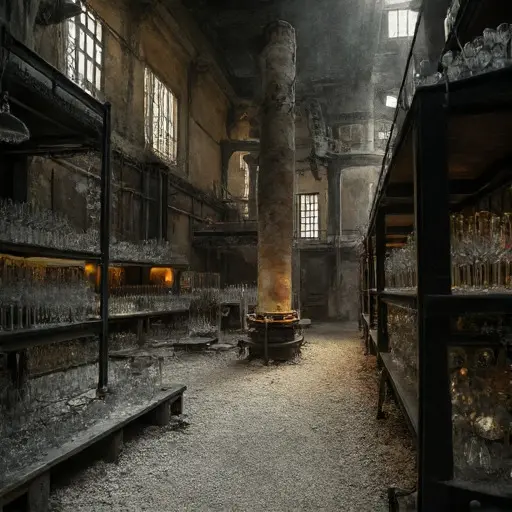
Lacrima-Shard House was an architectural study in fragile elegance: a mansion of pale, almost translucent brick, characterized by numerous, oversized, oddly shaped glass panes embedded in the walls. Its name suggested the combination of tear drops and broken fragments. The house stood on a high, exposed cliff overlooking the sea, making it perpetually vulnerable to wind and spray. Upon entering the main gallery, which was devoted to the display of finished glassworks, the air was immediately cold, thin, and carried a potent, almost dusty scent of dried soda ash, old wax, and a sharp, brittle tang of fine glass dust. The floors were polished stone, now dull and slick, amplifying every faint sound into an unsettling echo. The silence here was not merely quiet; it was the intense, hollow stillness that follows the sound of shattering, suggesting that a profound breakage had occurred and was now perfectly contained. This abandoned Victorian house was a giant, sealed kaleidoscope, designed to capture and display a single, perfect, crystalline emotion.
The Glass Artist’s Final Clarity
Lacrima-Shard House was the fortified residence and elaborate workshop of Master Glassblower Alistair Vance, a brilliant but pathologically obsessive artisan and crystalline chemist of the late 19th century. His professional life demanded the relentless manipulation of extreme heat, the flawless control of molten silica, and the pursuit of absolute optical clarity and structural perfection in glass. Personally, Master Vance was tormented by a crippling fear of emotional vulnerability and a profound desire to make his personal pain tangible, yet beautiful and unbreakable. He saw the House as his ultimate kiln: a space where he could finally distill his own deep sorrow into a single, flawless glass object—a crystallized, permanent tear.
The Annealing Chamber
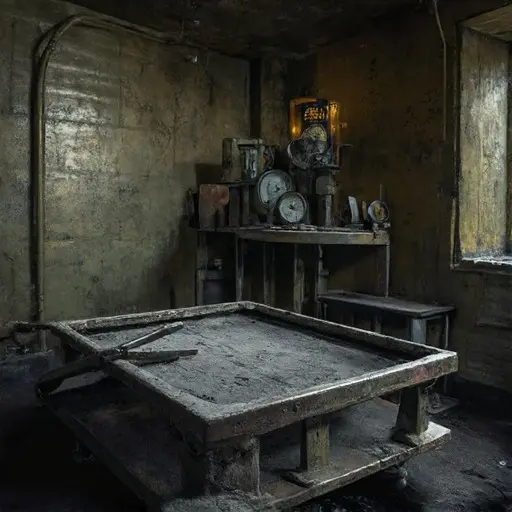
Master Vance’s Annealing Chamber was the final stage of his meticulous process. Here, the internal stresses of the glass were meant to be relieved over days. We found his final, detailed Fusion Log, bound in thick, heat-resistant leather. His entries chronicled his escalating desperation to create a “zero-stress” object—a piece of glass so perfectly cooled that it was theoretically unbreakable. His notes revealed that he had begun to conflate the emotional cooling of his own grief—following the death of his young daughter, Eliza—with the physical annealing process. His final project, detailed meticulously, was the creation of a massive, hollow crystalline teardrop that, when complete, would contain and silence all the pain he felt.
The Crystalline Heart
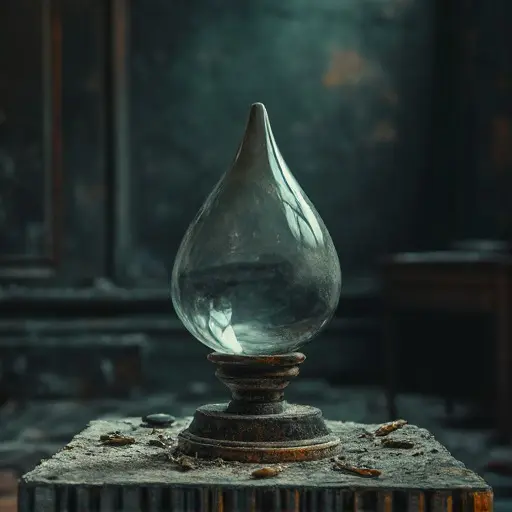
The most chilling discovery was made in the very center of the main display gallery. The room was empty of all objects except for a single, small, velvet-draped pedestal. Resting on the pedestal was a massive, fist-sized, perfectly clear, flawlessly formed hollow glass teardrop. The object was breathtakingly beautiful, its surface smooth, cold, and utterly free of flaw. Tucked beneath the pedestal was Master Vance’s final note. It revealed the tragic climax: he had finally created the perfect, unbreakable vessel for his grief. But upon finishing it, he realized its profound flaw: an unbreakable object is one that can never release its contents. He had successfully trapped his sorrow inside the perfect, beautiful glass, but in doing so, he trapped the memory forever in a permanent, silent form. His final note read: “The vessel is perfect. The sorrow is contained. I have achieved the final silence.” His body was never found. The frozen tear of Lacrima-Shard House is the enduring, cold stillness of that perfect, hollow glass object, a terrifying testament to an artisan who sought to make his pain permanent and beautiful, only to find the ultimate price was the cessation of his own vibrant life and the chilling containment of his grief within the silent, abandoned Victorian house.}