The Frozen Script of Tempus-Glyph Hall
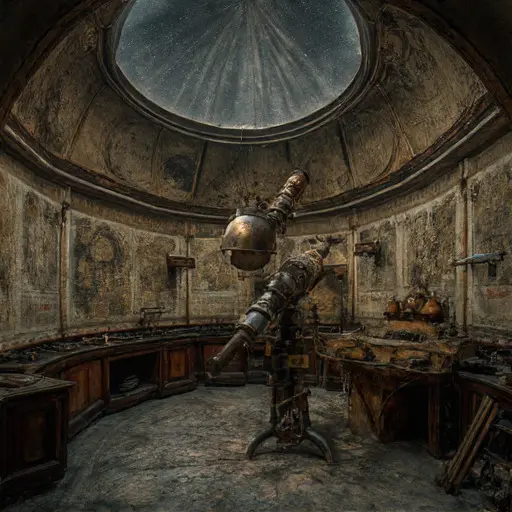
Tempus-Glyph Hall was an architectural statement of celestial ambition: a massive, dark-stone mansion built around a single, towering observation spire. Its name suggested a blend of passing time and engraved symbols. The house stood on a prominent, isolated plateau, giving it an unparalleled view of the night sky, yet making it perpetually exposed to harsh winds. Upon entering the main observation deck, the air was immediately cold, thin, and carried a potent, mineral scent of oxidized brass, ozone, and a subtle, metallic aroma. The floors were covered in rough, stone flagstones, amplifying every faint sound into an unsettling echo. The silence here was not merely quiet; it was an intense, cosmic stillness, the profound hush that enforces the memory of immense, distant, and ceaseless motion. This abandoned Victorian house was a giant, sealed clock, designed to achieve and hold a state of absolute, unchangeable, universal time.
The Chronographer’s Perfect Moment
Tempus-Glyph Hall was the fortified residence and elaborate observatory of Dr. Elias Alcott, a brilliant but pathologically obsessive chronographer and theoretical astronomer of the late 19th century. His professional life demanded the relentless charting of stellar positions, the flawless calculation of universal constants, and the pursuit of absolute temporal synchronization—the finding of the single, perfect moment that unified all physical law. Personally, Dr. Alcott was tormented by a crippling fear of temporal chaos and a profound desire to make the erratic, unpredictable flow of human life conform to the rigid, perfect rhythm of the cosmos. He saw the Hall as his ultimate lens: a space where he could finally record and engrave a single, perfect, final instant of time that would never pass.
The Constant Chamber
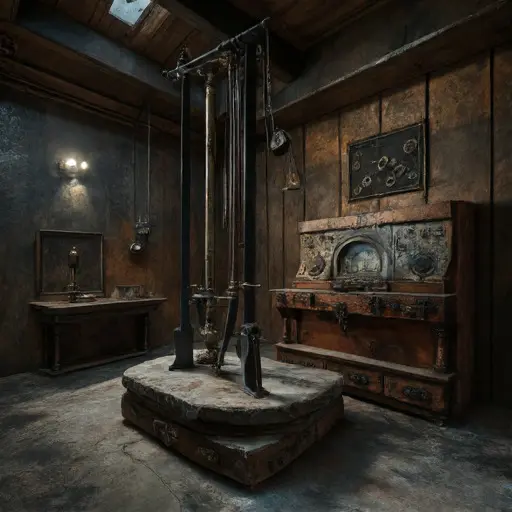
Dr. Alcott’s Constant Chamber was the engine of his obsession. Here, he worked to isolate and stabilize the passage of time. We found his final, detailed Moment Log, bound in thick, heavy brass covers. His entries chronicled his escalating desperation to find the “Zero-Deviation Instant”—the point where time’s flow was perfectly uniform across the universe. His notes revealed that he had begun to believe the only moment capable of achieving this uniformity was the moment of absolute cessation of all life and motion. His final project, detailed meticulously, was the creation of a massive, unique, internal “Time-Lock Mechanism”—a final, massive machine designed to permanently engrave the exact celestial coordinates of the Hall at the precise moment of his death onto a single metal plate, freezing that instant for eternity.
The Final Plate
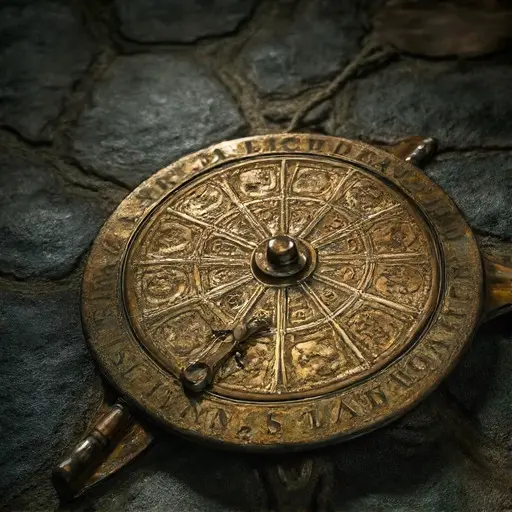
The most chilling discovery was made back in the main observation deck. Tucked directly beneath the shattered telescope was a massive, custom-machined brass plate, bolted firmly to the stone floor. The plate was covered in a dense, complex series of engraved astronomical symbols, coordinates, and complex mathematical equations. In the very center, a single, deep, permanent line had been scored, effectively acting as a final marker. Tucked beneath the plate was Dr. Alcott’s final note. It revealed the tragic climax: he had successfully engraved his final, perfect “Instant of Time,” believing that by recording the immutable position of the stars at his death, he had permanently anchored that moment into the universe. However, he realized that the engraving was still just a record—a memory—and that the universe, and time, continued to move, rendering his final glyph immediately obsolete. His final note read: “The moment is captured. The cosmos moves on. The eternal is merely a frozen script of the now.” His body was never found. The frozen script of Tempus-Glyph Hall is the enduring, cold, and massive engraved plate, a terrifying testament to an astronomer who achieved temporal perfection only to find the ultimate, fatal flaw was the unstoppable, chaotic passage of time itself, forever marching on from the fixed, silent coordinates preserved within the technical silence of the abandoned Victorian house.}