The Frosted Ziggurat House Above the Silent Civic Shore
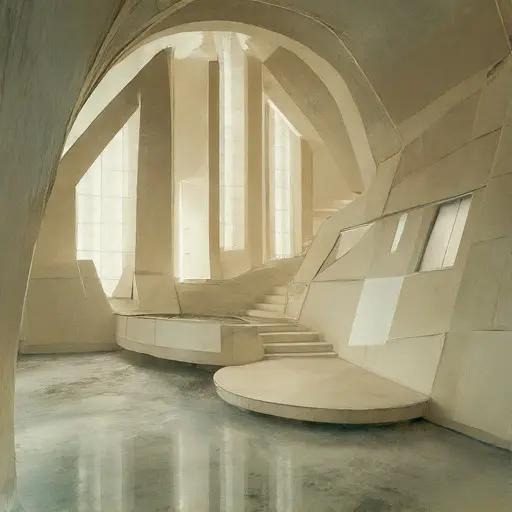
The Art Deco–Victorian hybrid residence rises from an abandoned seaside civic plaza where cracked terrazzo paving and wind-polished stone benches face a calm grey ocean. Constructed from pale sandblasted limestone and frosted glass block panels, the three-story structure forms a flowing stepped massing that resembles a softened ziggurat, its geometry intentionally relaxed as it ascends. The façade is asymmetrical, with vertical chrome-bronze fins that appear subtly warped over time, and geometric reliefs that have been partially eroded by salt air and wind exposure, reducing crisp ornamentation into softened abstraction.
Tall, narrow windows are irregularly spaced and often deeply recessed into rounded stone alcoves, creating a rhythm of shadowed voids and diffused light.
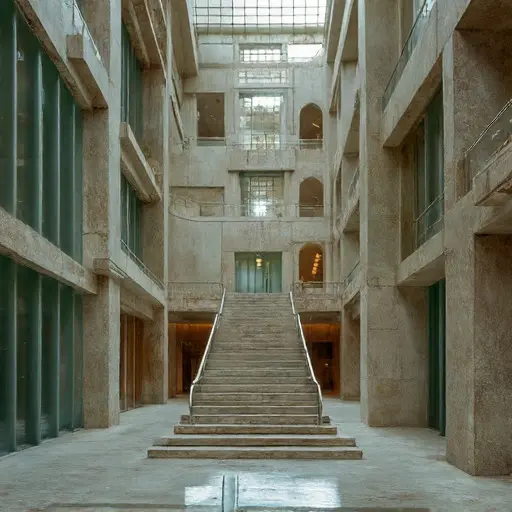
At roof level, the composition resolves into a fragmented crown of stepped forms and softened geometric edges, where limestone planes meet oxidized metal detailing. The original precision of the Art Deco influence remains legible but diminished, as salt, wind, and time have rounded sharp transitions into gentler contours. Light interacts with the frosted glass block system in layered gradients, shifting between opacity and translucence as clouds pass overhead, reinforcing the building’s dual identity as both civic monument and residential form.
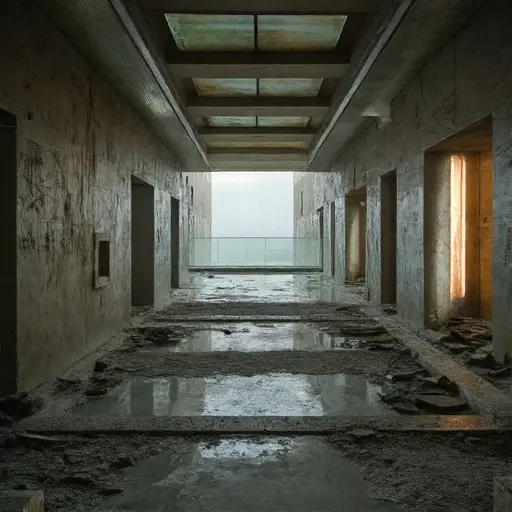
Outside, the abandoned civic plaza stretches toward the shoreline where coastal grasses encroach upon cracked stone surfaces. A rusted ornamental flagpole leans at an angle near a fallen marble clockface sculpture, its numerals worn away by exposure. The ocean remains still and heavy under overcast light, reflecting the softened silhouette of the residence. The entire scene reads as a convergence of civic ambition and environmental reclamation, where structured geometry dissolves into coastal erosion and quiet atmospheric decay.