The Forgotten Van Acker Locksmith Bench and Its Quiet Break
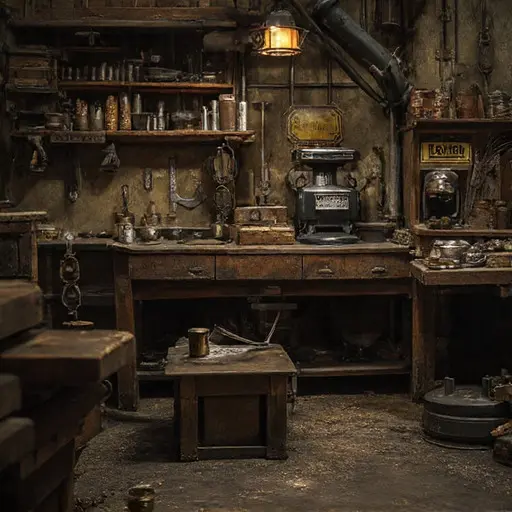
The Workroom settles into a muted stillness, touched by the faint tang of ground iron. On the locksmith bench, a half-shaped key rests beside a shallow brass ward whose groove stops abruptly. A swatch of leather once used for polishing hangs at the edge, hardened with time.
Everything seems paused in mid-intention, awaiting the next mild tap of a file. Yet something fragile inhabits the quiet—a subtle imbalance near the vise, a misaligned stack of blanks—suggesting an unspoken hesitation that drifted through these rooms and never dispersed.
Routine Imprints of Maurits Pieter Van Acker, Locksmith
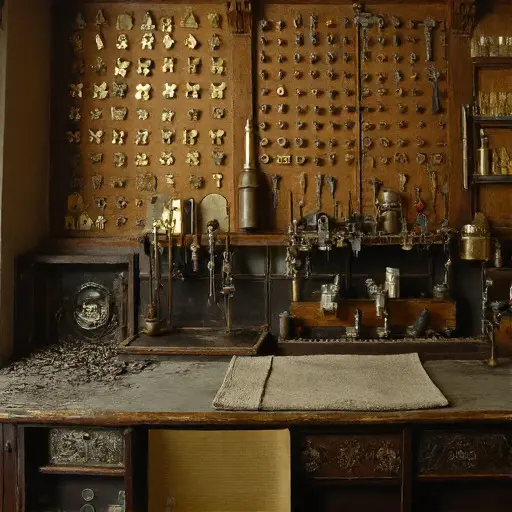
Clues across the furnished rooms reveal Maurits Pieter Van Acker, born 1874 in Ghent, apprenticed in modest Flemish workshops where precision outweighed prestige. In the Pattern Niche, key tracings annotated in Dutch line the corkboard, each contour marked for depth and angle. Brass key blanks sit sorted by silhouette in wooden trays; the smallest tray, meant for intricate cabinet locks, remains half-filled, edges immaculate. His temperament emerges in these tidy configurations—calm, observant, unwilling to force metal past what it would yield gently.
He likely began each morning aligning files on the bench, then spent midday crafting wards for household locks imported from Antwerp. Evenings brought quieter tasks: refining small safe tumblers, polishing keys until their edges brightened. In the Side Parlour, a walnut case displays locks he repaired—continental styles with ornate escutcheons—each carefully labeled. The soft orderliness suggests a man who trusted in incremental progress, shaping security from patience rather than authority.
Quiet Strains Gathering in His Trade
Unease threads itself through the upper rooms. In the Landing Closet, a broken reamer lies beside a notice from a Brussels manufacturer, edges blurred by moisture—perhaps a supply dispute, or a complaint of mismatched keys. A shallow bowl of steel pins has been overturned, leaving a delicate scatter across the shelf. In the Guest Cot Room, a travel coat lies half-folded, pockets filled only with a chipped file and a wrapped spare pick set—tools insufficient for a full departure.
On the Washstand, a tiny bottle of cologne from Bruges stands uncapped; a faint metallic scent clings to its rim, uncommon for him. The cracked porcelain dish beneath it bears a thin arc of filings, as though some part of his work followed him into rooms meant for rest. Nothing concludes these hints; instead, they gather like misaligned wards inside a lock, resisting any clean answer.
A Latch That Would Not Fall True
Returning to the Workroom, attention drifts back to the iron latch plate resting near the bench’s edge. Its screw holes show slight burrs—as if he wrestled with alignment. Beside it, the unfinished key bears a shallow flaw in its cut, a minute under-filed segment he would normally correct without pause. The grinder’s handle faces an odd angle, not parallel to the bench as was his habit. Even the bench’s leather pad curls inward at one corner, revealing a faint groove he traced involuntarily during moments of thought.
In the vise, a tiny safe tumbler sits open; its pins lean unevenly, one markedly shorter than the rest. A brass shim rests nearby, bent at a sharp kink suggesting a sudden, unwelcome slip. The air holds a hushed density—expectant, unsettled—as though these objects recall a moment when intention lost its rhythm.
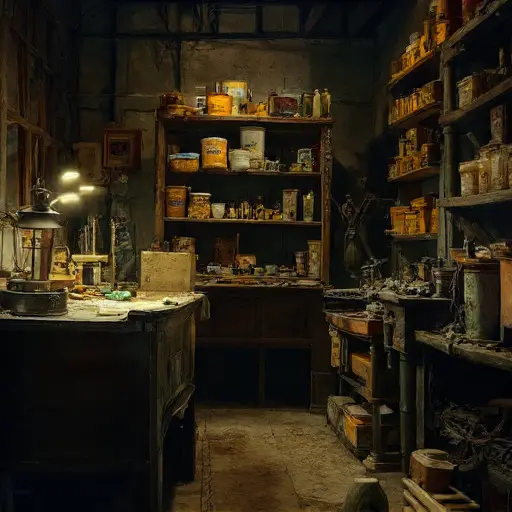
Beneath the locksmith bench, half-hidden by a crate of steel stock, lies his final attempt: a cabinet lock whose inner mechanism shows a single misaligned pin, too short for its chamber. The marking on its case ends in a wavering line, as though Maurits’s hand hovered between correction and retreat. No note accompanies the piece; no explanation edges forward from the quiet grain of the bench.
The house refuses to clarify the moment he stepped away, and it remains abandoned still.
