The Forgotten Script of the Vellum-Rood
The Vellum-Rood, a vast, utilitarian structure of dark brick and heavy, carved timber, was completed in 1860, intended to project an image of sober intellectual rigor. Its name suggests a fragile writing surface (vellum) marked by a cross or rood, a symbol of permanent suffering. Its high gables and deeply shadowed cornices give it a look of unrelenting gravity.
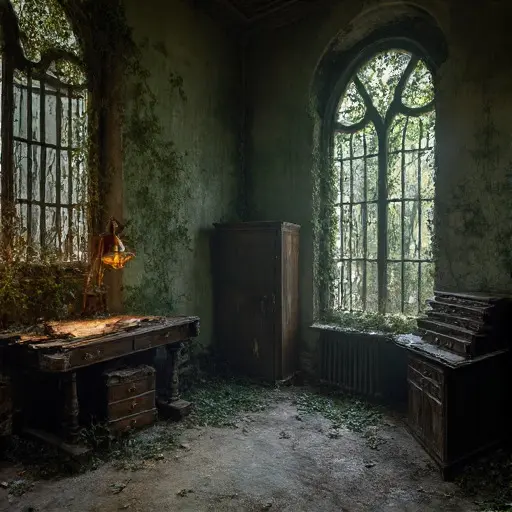
To step into its service wing is to encounter an immediate, profound coldness and a silence so deep it seems to actively absorb any sound. The immense Writing Room, the intellectual heart of the home, is now a stage for magnificent, cold decay, its immense desk a monument to a life that ended in final silence and a forgotten script.
The Obsessive Author, Elias Thorne
The mansion was built by Elias Thorne (1825–1880), a man whose entire existence was dedicated to writing a single, definitive, but profoundly secretive, historical biography. His profession was that of a privately funded scholar and author. His life was defined by the relentless pursuit of historical detail, demanding absolute privacy and freedom from interruption. Socially, he was a recluse, viewing every human interaction as a drain on his intellectual focus.
Elias married Clara Vance in 1850, a quiet woman whose chief role was to ensure the house ran with clockwork efficiency. They had one child, a son named Henry. Elias’s personality was defined by his crippling emotional distance and his rigid demand for order; his daily routine revolved around the strict scheduling of his writing time in the Writing Room. His ambition was to publish his massive biography to achieve historical immortality; his greatest fear was the destruction of his unpublished manuscript and the subsequent loss of his life’s work, condemning his story to be a forgotten script.
The house was his intellectual fortress. He installed a small, dedicated Crematorium-Hearth—a heavy, steel-lined fireplace built into the wall of his Study—where he systematically burned all his research notes, ensuring that only the final, approved manuscript would survive.
The Burning in the Study
The tragedy that destroyed the Thorne family was a final, terrible act of self-censorship and emotional despair. Henry, the son, was utterly crushed by his father’s emotional indifference and rigid demands, preferring the company of actors and playwrights to history. He planned to run away and pursue a career on the stage, a path Elias had expressly forbidden.
In 1880, Henry was caught by Elias while secretly packing a small bag in the Study. The confrontation was volatile. Henry, in a final act of desperation to wound his father, grabbed the manuscript of the biography—the single most important object in Elias’s life—and threw it into the roaring Crematorium-Hearth.
The shock of seeing his life’s work, his immortality, being consumed by fire triggered a massive, fatal stroke. Elias collapsed instantly on the Study floor, dying as the last of his forgotten script turned to ash.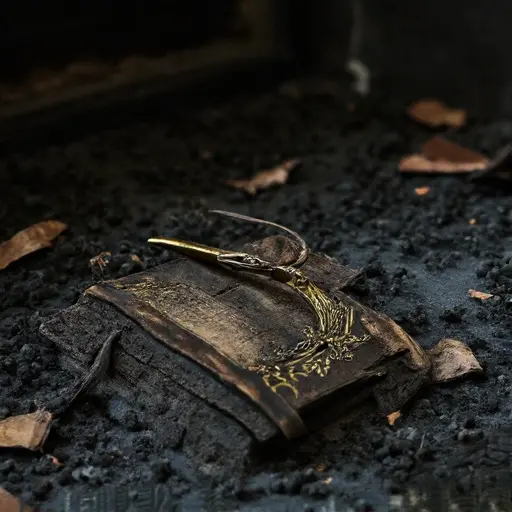
The Abandoned Quill in the Writing Room
Clara Vance, the wife, was left with a dead husband, a disgraced son, and a house entirely saturated with the smell of smoke and despair. She felt no grief, only overwhelming numbness at the total failure of their life together. Henry, overwhelmed by guilt over his father’s death, immediately severed all ties with the house and left the country, never to return.
Clara’s final act was one of final, cold indifference. She took only her most personal jewelry and walked out of the Vellum-Rood a week later. She refused to liquidate or sell any of the heavy, immovable objects, ensuring the house would stand as a monument to her husband’s destroyed dream. She allowed the taxes to lapse immediately, ensuring the house’s abandonment was absolute.
In Elias’s formal Writing Room, one final, poignant object remains on the immense desk. It is a long, intricately carved ivory quill pen, the instrument Elias used to compose his final words, now resting on a dusty, bare blotter.
The Vellum-Rood was eventually seized by the state but remained perpetually vacant, its immense, cold Writing Room and smoky Study standing as a desolate, practical monument. Its ultimate silence is the cold, physical fact of the forgotten script—the total, absolute destruction of a life’s ambition by the very son it was meant to immortalize.
