The Forgotten Petrov Metal-Engraving Forge Where the Silence Cut a Crooked Line
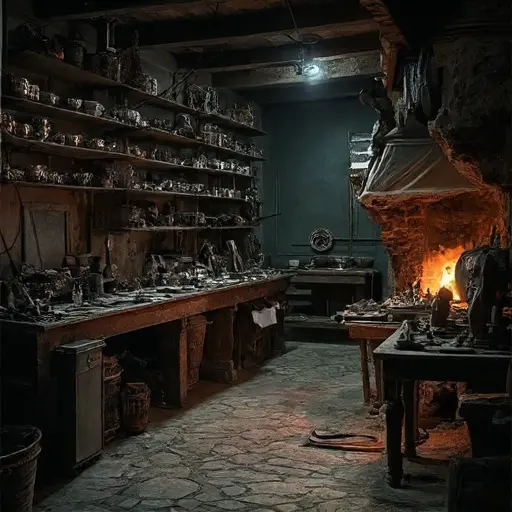
A muted density settles over the forge, warm in tone yet strangely hollow. On the central table, a silver plate displays crisp detailing along its left border; the right dissolves into shallow, uneven strokes, as though the engraver’s resolve thinned without warning. A chasing hammer leans against a block of pitch, its handle smudged.
A burin sits half-buried in wax, angled like a gesture abandoned mid-motion. Nothing shouts of disaster—only the quiet impression of a craft interrupted at the brink of certainty.
A Craftsman Who Read Metal by Pulse and Crease
This metal-engraving forge once belonged to Mikhail Artyom Petrov, chaser and pattern engraver, born 1872 in Nizhny Novgorod. Raised among modest ironworkers, he trained under a traveling master who taught him to coax relief from thin silver, to steady his wrist through vibrations of the pitch block, and to breathe in cadence with the burin’s bite. A frayed red string from his sister, Katerina Petrov, wraps around a tin of soot used for mapping lines.
Mikhail moved by careful rhythm: dawn heating the pitch to cradle metal, midday incising scrolls and icon borders, dusk polishing reliefs until they caught modest glimmer. His tools remain laid in methodical ranks—files sorted by grain, burins sharpened along linen, bowls of wax warmed then abandoned. Patrons once praised his metalwork for its elegance, restraint, and calm symmetry.
When Relief and Line Began to Waver
In fuller seasons, the forge echoed with soft tapping. Sheets of silver from Smolensk suppliers hung stacked by weight. Pitch blocks cooled in regular patterns, their surfaces bearing firm impressions of recent commissions. Completed pieces gleamed in shadowy corners, reliefs crisp as morning frost.
Yet faults linger at the edges. A border groove widens unexpectedly. An icon’s halo dips from its intended arc. A shallow dent mars a nearly completed tray. His commission ledger bears a merchant’s name written, crossed out, rewritten, then smeared by soot. A terse Russian note reads: “Он говорит, что я исказил святой образ”—he says I distorted the holy image.
Word seeped through the guilds: during presentation, a relief of a revered figure looked subtly warped—lines misaligned, expression soured. The merchant claimed insult. Others whispered Mikhail refused to exaggerate the icon’s features to suit the donor’s vanity, prompting quiet reprisal.
The TURNING POINT Pressed into Silver and Doubt
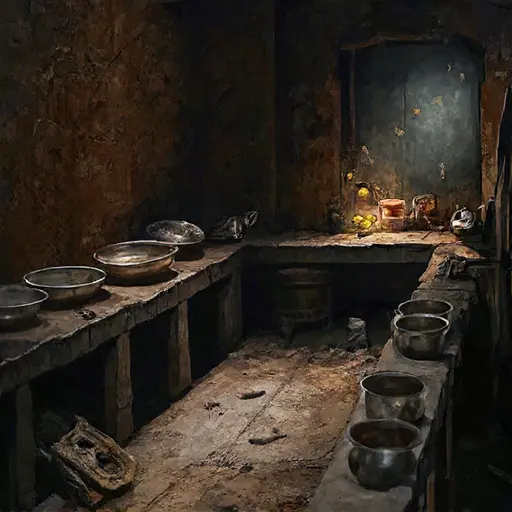
One late evening left its imprint. A major commission lies across the pitch block—its upper relief shaped with unwavering delicacy, its lower corner blurred under shallow, trembling cuts. A chasing hammer is dented at the crown. A bowl of wax has cooled into fractured waves.
Pinned beneath a crumpled pattern sheet is a torn slip: “Требуют возмещения за позор.” They demand recompense for shame. Another fragment, stained by soot, reads: “Я следовал форме… они отвергают её.” I followed the form… they reject it. His handwriting falters, lines thinning as though carried by a weary wrist. Even the silver blanks—normally arranged by size—sit skewed, some leaning as if disturbed in haste.
Near the wall, a scored plate lies abandoned, its central motif abandoned mid-spiral.
A Hidden Hollow Behind the Pitch Cabinet
Behind stacked tins of wax and trays of soot, a wooden panel loosens from its frame. Inside rests a small engraved spoon Mikhail began for Katerina: its handle carved with tranquil precision, its bowl only faintly outlined in graphite. A folded note in his wavering script reads: “Для Катерины—когда моя рука станет твёрдой вновь.” For Katerina—when my hand steadies again. The final word sinks into pale graphite.
Beside it lies a spotless silver blank, untouched, awaiting the first decisive stroke he never gave.
The Last Slackened Line
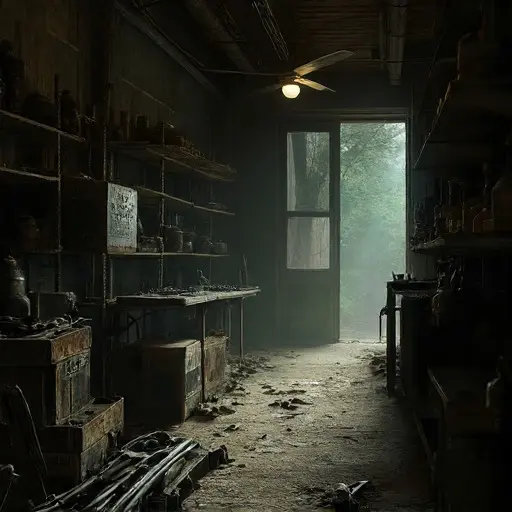
Inside a shallow drawer beneath the chasing stand rests a test engraving: its opening scroll cut with radiant clarity, its final curve wavering into pallid, uncertain etching. Beneath it Mikhail wrote: “Even devotion thins when resolve creases.”
The metal-engraving forge exhales into warm, ashen quiet, reliefs resting in half-realized intent.
And the house, holding its abandoned engraver’s chamber, remains abandoned.
