The Forgotten Mikkelsen Reed-Voicing Loft Where the Harmonies Slipped from Their Thread
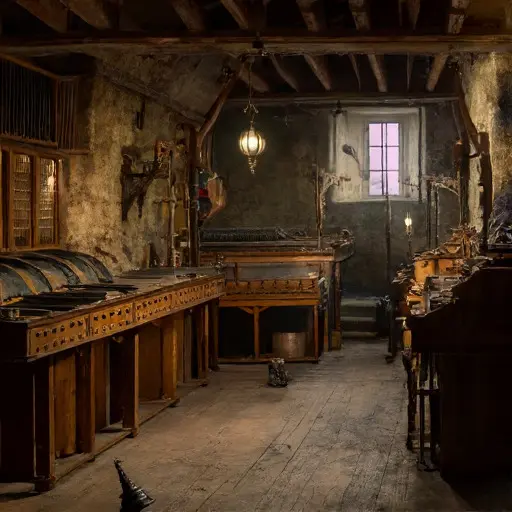
A faint hum, not of sound but of memory, lingers in the loft. On the central bench, a reed block lies open—left side aligned in calm symmetry, right side wavering as though the maker paused before certainty deserted him. A sliver of brass curls inward on itself, catching the lantern’s flicker.
A tuning scraper rests on a felt pad beside a pipe whose upper lip shows a hesitant final stroke. Nothing shattered—only work arrested mid-breath.
A Craftsman Bound by Patience, Pitch, and Thread-Fine Balance
This reed-voicing loft once belonged to Lars Henrik Mikkelsen, organ reed tuner and voicer, born 1871 near Aarhus. Raised in a modest family of joiners, he apprenticed under a traveling organ builder who taught him the discipline of airflow, the tempering of brass tongues, and the fragile steadiness required to coax harmonics from thin strips of metal. A small ribbon left by his sister, Sigrid Mikkelsen, hangs from a drawer of felt shims.
Lars lived by methodical cycles: dawn filing of reed tongues, midday seating of wedges and springs, dusk testing intonation under subdued lampglow. His tools remain arranged with austere care—scrapers wrapped in cloth, cones stacked by taper, pipes grouped by speaking height. Patrons once praised his voicing for its clarity and measured warmth.
When Sound Began to Drift from Its Center
In earlier seasons, the loft vibrated with quiet purpose. Brass from Copenhagen traders gleamed on the benches. Leather valves dried in perfect squares. Completed ranks of reeds stood ready for transport, each pipe singing true under a firm bellows test.
But flaws crept in. A reed’s tongue bends too loosely. A tuning wire sits fractionally off its mark. A pipe’s speech breaks into uneven overtones. Lars’s commission ledger bears a church patron’s name written, crossed out, rewritten, then blurred by a smudge of paraffin. A curt Danish note beside it reads: “They say my work disgraced their service.”
Market murmurs followed: the patron accused him of preparing reeds that faltered during a ceremony—tones wavering, harmonies thinning. Others whispered he refused to force brilliance into a register he believed should sound subdued, provoking quiet resentment.
The TURNING POINT Etched in Brass and Paused Breath
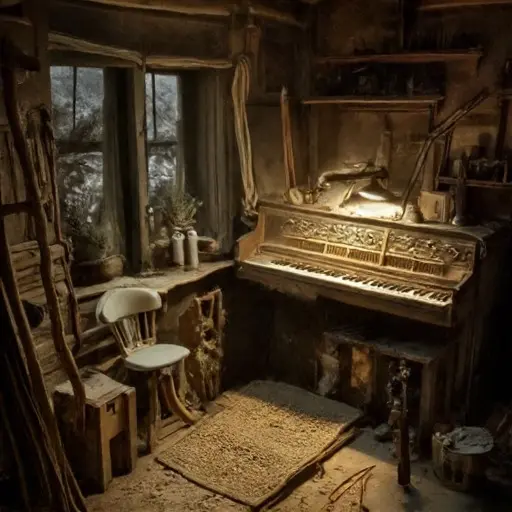
One evening left its imprint. A critical reed block for the disputed commission lies askew—lower notes tuned with flawless restraint, upper tongues twisted slightly from their seats. A paraffin lamp sits half-tilted, wick burned low. A tuning cone bears a dent as though struck in a moment of impatience.
Pinned beneath a warped airflow chart is a torn note: “They demand repayment for humiliation.” Another scrap, blurred where oil stained the paper, reads: “I tuned them true… they deny it.” His handwriting shrinks as though he braced the quill too tightly. Even the reed groupings—normally arranged by pitch—are shuffled, some lying at odd angles.
On the floor near the tool chest, a length of pipe lead slumps, edges cooling into softened curves.
A Small Hidden Space Behind the Pipe Rack
Behind the long row of unfinished pipes, a narrow panel shifts inward. Inside rests a half-voiced reed block meant for Sigrid’s modest parlor organ: the bass reeds seated with tranquility, the upper voices only faintly scraped. A folded note in Lars’s wavering script reads: “For Sigrid—when steadiness returns.” The last word dissolves into pale dust.
Beside it lies a clean strip of brass, uncut, waiting for the first measured stroke he could not bring himself to make.
The Last Unsteady Tone
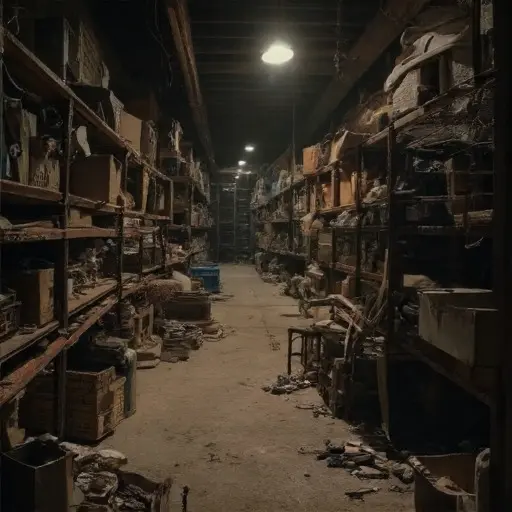
Inside a shallow drawer beneath the voicing stand rests a test reed: its lower notes firm and shimmering, its upper pitch breaking into a faint, quivering flutter. Beneath it Lars wrote: “Even harmony fails when resolve ripples from its thread.”
The reed-voicing loft exhales into brass-scented quiet, tones suspended in half-formed promise.
And the house, holding its abandoned organ-builder’s chamber, remains abandoned.
