The Forgotten Meier Clockmaker’s Workshop Where the Gears Slipped Out of Balance
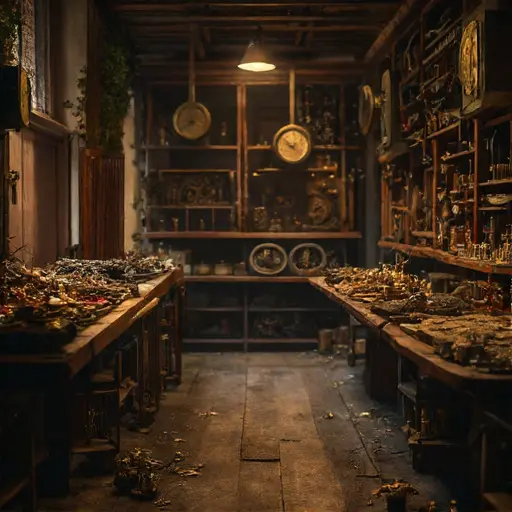
A quiet tension inhabits the room, as if each pendulum here once measured more than time. On the central bench rests a clock movement: one half fitted in crisp formation, the other muddled by teeth cut at uneasy angles. A jeweler’s loupe lies face-down beside a brass wheel showing a hesitant final filing.
A mainspring clamp sits half-closed, edges dulled by doubt. Nothing sudden reveals itself—only the soft retreat of mastery once sure of every fraction.
A Maker Who Lived by Measure, Pulse, and Balance
This clockmaker’s workshop belonged to Ulrich Johannes Meier, horologist and regulator of fine timepieces, born 1872 in Lucerne. Raised in a modest metalworker’s family, he apprenticed under a wandering regulator who taught him the equilibrium of pendulum swing, the poise of escapement teeth, and the way silence could magnify the slightest mechanical error. A faded ribbon from his sister, Sofia Meier, knots a pouch of precision screws near the rear shelf.
Ulrich built his days around quiet routines: dawn filing of wheel teeth, midday adjusting of verge angles, dusk testing of pendulum beats under lamplit stillness. His tools remain arranged with disciplined calm—gears sorted by pitch, screwdrivers lined by thickness, oils capped in tiny glass bottles. Patrons once trusted him with delicate restorations known for their measured steadiness.
When Accuracy Faltered at the Edges
For years the workshop throbbed with soft metallic rhythm: tick-tests of pendulums, faint rasp of files, the warm hum of balanced gears. Brass stock from Jura suppliers rested in careful stacks; precision wheels dried on cloth squares after ultrasonic cleaning.
Yet unsettling deviations crept in. A pivot hole widens by a hair. A tooth’s profile grows shallow. A pendulum arc dips out of symmetry. His commission ledger records a magistrate’s order written, crossed out, rewritten, then smudged by oil. A clipped German note reads: “Sie behaupten, ich hätte die Zeit manipuliert”—they claim I manipulated the time.
Rumor moved quietly through guild halls: a courthouse regulator Ulrich restored began losing minutes irregularly, casting doubt on recorded testimonies. The magistrate accused him either of incompetence or covert tampering. Others whispered he refused the magistrate’s request to adjust the clock in a way that favored a particular hearing—breeding quiet suspicion.

The TURNING POINT Etched in Brass and Strain
One dim evening left its traces. A special commission—a tower clock’s miniature regulator—lies half-assembled on the bench. Its upper gear train meshes with quiet perfection; its lower gearing shows erratic spacing, a single wheel shaved too thin along one quadrant. A fine file lies broken near the handle. A flask of machine oil has pooled into uneven rings on the cloth.
Pinned beneath a warped movement sketch is a torn scrap: “Sie verlangen Entschädigung für die Schande.” They demand compensation for the disgrace. Another fragment, blurred where oil seeped through, reads: “Ich hielt mich an die Norm… sie verweigern sie.” I followed the standard… they deny it. His handwriting loosens, strokes drifting as though each letter misjudged its own center. Even the gear trays—once perfectly aligned—sit disordered, a few wheels rolling against their companions in faint discord.
A discarded pendulum bob rests nearby, its engraving started cleanly before tapering into a wavering line.
A Quiet Pocket Behind the Regulator Rack
Behind the tall rack of pendulums and balance wheels, a narrow board shifts aside. Inside rests a petite mantel clock Ulrich meant for Sofia: its case shaped from smooth walnut, its dial delicately painted—yet the movement inside remains skeletal, only a few gears seated with tentative care. A folded note in his wavering script reads: “Für Sofia—wenn mein Gleichgewicht zurückkehrt.” For Sofia—when my balance returns. The last word dissolves into faint graphite.
Beside it lies a flawless escape wheel, sharp and ready, awaiting the calibration he never resumed.

The Last Miscounted Beat
In a shallow drawer beneath the timing stand rests a test escapement: its first rotations smooth and measured before the beat falters into a hesitant stutter. Beneath it Ulrich wrote: “Even truth drifts when resolve loses its balance.”
The clockmaker’s workshop settles into brass-scented quiet, unfinished movements resting in uncertain poise.
And the house, holding its abandoned horologist’s chamber, remains abandoned.
