The Forgotten Ledger of Dubois’ Hidden Perfumer Chamber
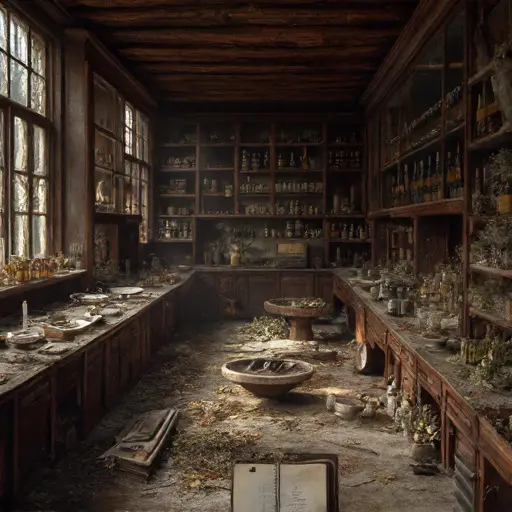
The perfumer chamber hangs in delicate stillness. On a central worktable, half-filled glass vials rest, their blend combinations incomplete. Droppers and stir rods lie neatly beside tinctures, the room echoing the absent rhythm of measured hands at work.
Crafting Scents with Precision
The chamber belonged to Émile Dubois, professional perfumer (b. 1875, Grasse, France), trained in classical olfactory schools and commissioned for noble households and luxury boutiques. His handwriting appears on recipe notebooks and client labels, exact and restrained. A note references his apprentice, Clémence Dubois, who organized oils and cleaned glassware. His daily routine involved planning blend formulas, measuring ingredients with care, and combining scents with precise timing. Temperament meticulous, ambition refined, and devotion to olfactory artistry defined his life.
Fragrances Left Half-Made
Glass vials and half-prepared perfumes lie untouched. A ledger beneath the main table lists client orders and blend instructions but stops abruptly. Dust coats bottles, droppers remain in racks, and stirring rods rest idle, poised for mixtures never completed. Residual oils have dried on the benches, the delicate work of scent creation paused indefinitely.
When Craft Could Not Compete
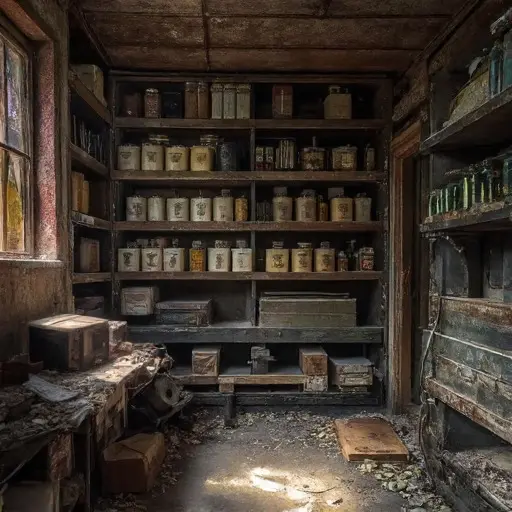
Later ledger entries are sparse. Correspondence from clients remains unopened. Dubois’ decline was caused by mass-produced synthetic fragrances; handcrafted blend formulas could not compete with chemical substitutes. Daily work slowed, then ceased entirely, leaving each fragrance suspended mid-creation.
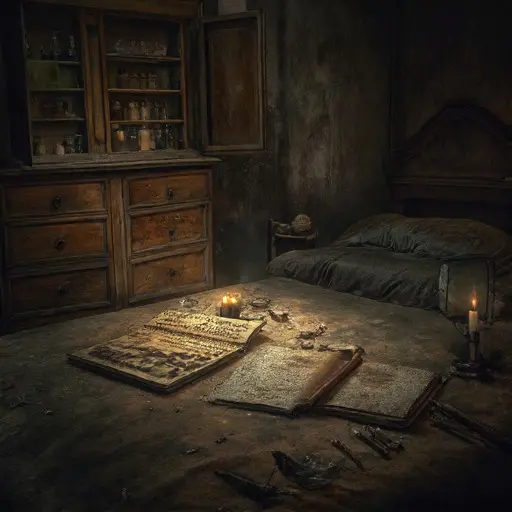
The final ledgers and perfumer tools remain untouched. No note explains Dubois’ departure; Clémence never returned to retrieve the materials. The house remains abandoned, tables stacked, vials aligned, each blend frozen mid-process, a testament to delicate labor halted permanently, the silent weight of unfinished artistry lingering in every corner.