The Forgotten Král Glass Nook Where the Last Shape Faltered
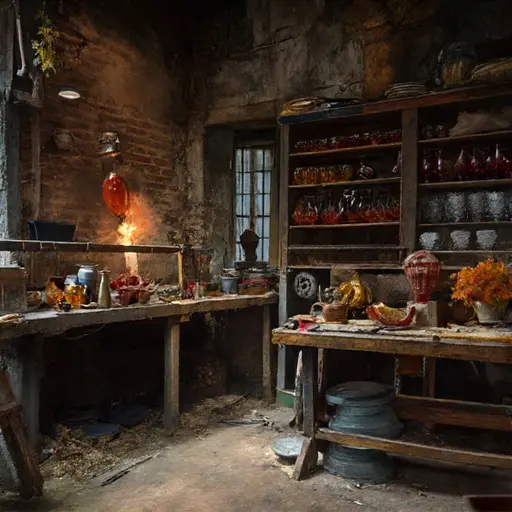
The Glass Furnace Nook feels unmoored, its brickwork cool as porcelain. Atop a charred board, a lone rod lies beside a half-shaped ornament, its curve wilted in the air’s long silence. A faint whirl of dust drifts across the marver, stirring as if guided by a memory rather than wind.
Near the kiln’s lip, the pale ring of a missing hearthstone leaves a slight indentation in the soot, its absence asking questions the house refuses to answer. Nothing confirms alarm or haste—only a poised stillness awaiting a hand that never returned.
Impressions of Václav Antonín Král, Glassblower
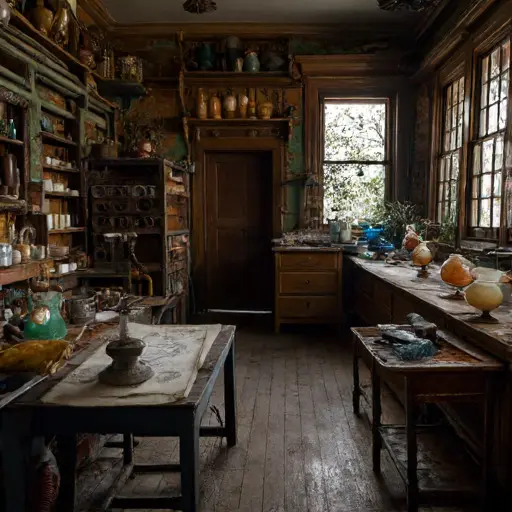
The house offers a quiet portrait of Václav Antonín Král, born 1871 in Jablonec, a Bohemian glassblower of modest means but practiced skill. In the Side Workroom, wooden molds etched with floral scrolls lean neatly against a trestle table; beside them, rods tipped with faint residue of cobalt suggest his preference for deep hues. A dog-eared sketchbook reveals measured outlines of vases and baubles, margins dotted with phonetic notes in Czech, implying self-taught English.
Routine shadows his presence: tong marks in the marver’s grain indicate his favored angle for shaping thin stems; scorched gloves near a towel rack show where he stretched between furnace and cooling bench. His temperament appears patient, exacting. Even the Dining Alcove, where bowls he crafted sit on a sideboard, reflects a craftsman who prized delicate symmetry over flourish.
Hints of Pressure Gathering Quietly
Amid the Upper Corridor, a cracked crate contains rejected ornaments—warped necks, collapsed bubbles, thin fractures wandering through once-lustrous surfaces. A letter slipped between splints carries a blurred seal from a mercantile importer, possibly indicating unmet quotas or damages denied for refund. A tally slate beside the crate shows hastily altered numbers, as if he had refigured costs too many times in one night.
In the Guest Dressing Room, a traveling coat is laid over a low-back chair, its pockets padded with cloth swatches and a small pouch of frit. Yet nothing else is packed. A subtle tremor appears in the handwriting on a shipping tag he left behind—uncharacteristic for a man so diligent. Perhaps failing eyesight, or debt looming through uncertain contracts, pressed against his composure.
Following the Hearthstone’s Shadow
Back in the Glass Furnace Nook, the missing hearthstone commands the quiet. Its original place shows a discoloration in the soot, a circle of cleaner brick beneath. Someone lifted it, briefly or purposefully. Behind the kiln, a faint scrape along the floorboards implies it was placed—or replaced—at an angle. The marver bears a single smear of cooled glass trailing off its edge, thin as thread, evoking a gesture arrested mid-flow.
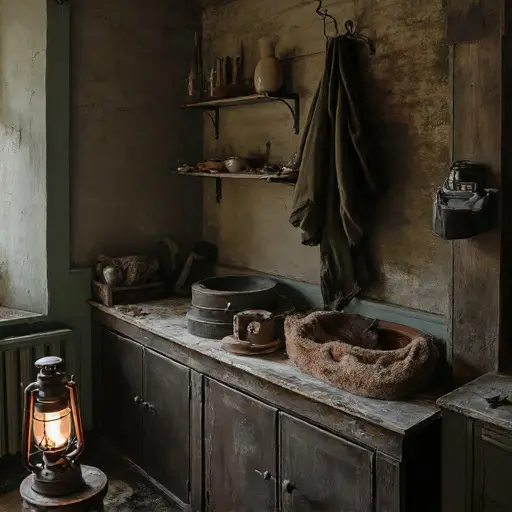
Tucked beneath a heat-scored plank is his final attempt: a delicate ornament begun in pale amber, its form slightly buckled, as though his vision bent the curve before he realized it. No message accompanies the piece—only a shallow indentation where a tool pressed too long, too hard. Whatever burden converged upon him, it stilled his careful craft at the instant it demanded his full steadiness.
The house will not elaborate, and it remains abandoned still.
