The Forgotten Hwang Tea-Fermentation Room Where the Leaves Lost Their Warmth
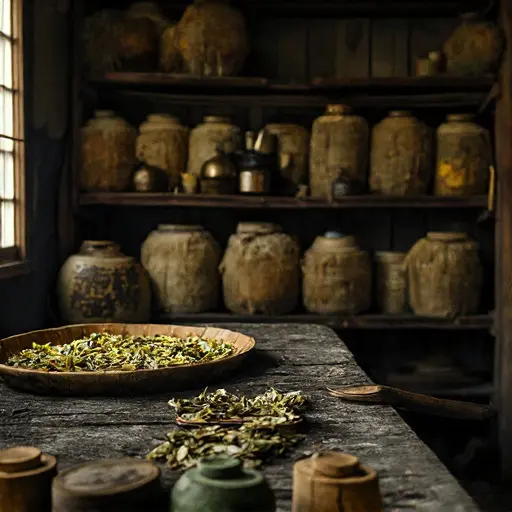
The air feels tight with memory—fermented sweetness, faint smoke from a long-extinguished brazier, the earthy whisper of leaves that once breathed moisture. Light shivers across the snapped corner of a bamboo tray. An overturned cloth pouch lies near a wooden thermometer whose mercury line froze at some unrecorded hour.
Nothing here suggests violence, only hesitation—an unfinished tasting, a choice deferred, a routine unthreaded from its warmth.
A Life Poured Through Leaves and Patience
This tea-fermentation room preserves the rituals of Hwang Seong-min, tea master and small-batch processor, born 1874 in a village outside Jeonju. Raised among modest farmers, he apprenticed with traveling blenders who taught him the quiet geometry of oxidation, temperature, and timing. His temperament remains etched across these shelves: tasting bowls arranged by season, carved tea paddles oiled to a mellow sheen, and a sachet of roasted barley kept for his younger sister, Hwang So-yeon.
Seong-min’s days once flowed in gentle sequence—sunrise leaf sorting, midday turning of trays, dusk tastings that filled the room with slow warmth. Clients in regional ports prized his balanced brews. A ledger tucked beneath a jar shows careful notations of batches, weather, and leaf condition, each written in a crisp, deliberate hand.
A House of Subtle Aromas, Then Shadows in the Brew
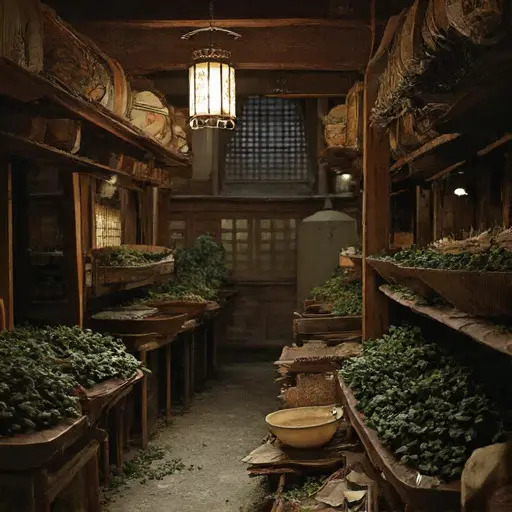
In earlier years, the room thrived with quiet purpose. Onggi jars bore chalk marks of fermentation progress. A rice-paper packet of Ceylon tea—an extravagance—rests in a crate from a merchant’s ship. Handmade fans, used to cool leaves rapidly, lie fanned across a bench. The brazier’s soot stains form soft crescents at the hearth’s edge.
But the order wavered. A batch of partially oxidized leaves shows blotches where moisture spread unevenly. A tasting bowl bears a faint crack, its glaze crazed like dried riverbeds. A note pinned above the trays reads, “Adjust timing?” with the question unanswered. His ledger’s once-steady entries begin stumbling—temperatures overwritten, batch notes crossed out, then rewritten in smaller, anxious script. Something in his practice lost balance: perhaps the pressure of a large order, or disagreement with a patron seeking a flavor outside his philosophy.
The TURNING POINT That Unsettled the Brew
One late afternoon left the deepest mark. A kettle lies dented where it struck the stone floor. The central onggi jar’s clay stopper is cracked cleanly, as if pressed too hard or dropped. A batch log, normally immaculate, ends mid-sentence: “Batch 41—oxidation questionable; patron demands—” followed by a torn corner.
Rumors insinuated that a client accused him of adulterating tea with cheaper leaves, claiming a muddied flavor profile unworthy of commission. Others whispered that a rival merchant questioned the authenticity of his methods, threatening to expose him unless he adjusted to commercial preference. Nearby, a folded slip of Hangul notes reads, “Not dilution—just weather shift,” the ink smudged by a drop of cooling tea.
A tuning of trays remains incomplete—several turned, others untouched. A spoon of tasting salt sits overturned. A stack of wrapped batches shows one packet ripped open, leaves spilling like a quiet outcry. Even the thermometer is chipped at the base, its wooden frame splintered.
A Secret Near the Warmest Corner
Behind the hearth’s brick flank, a thin panel dislodges with a faint scrape. Within the cavity, a single linen-wrapped bundle waits. It contains one small basket of leaves—neither fully oxidized nor green, their color wavering between states. Tucked alongside is a slip of paper: “For So-yeon—when the flavor settles.” The final word drifts off, the brushstroke lighter than the rest.
Beside the bundle rests a wooden tea paddle, perfectly carved yet unused, its surface still pale. A single leaf is pinned beneath its edge, half-turned, as though Seong-min could not decide which path of fermentation it deserved.
The Last Pale Sip of Evidence
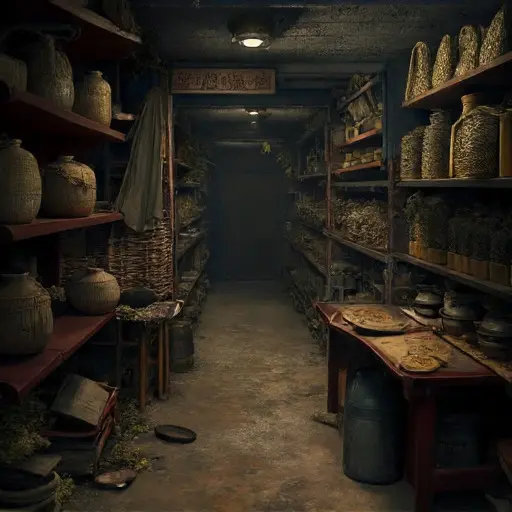
Near the tasting table, slipped inside a folded cloth, sits one final fragment: a tasting note in his careful hand. “Flavor unresolved. Waiting for clarity.” Nothing more—no date, no batch number.
The room exhales its quiet, steeped in choices never completed.
And the house, holding its abandoned tea-fermentation room, remains abandoned.
