The Forgotten Hargreaves Millinery Loft Where the Feathers Fell Out of Line
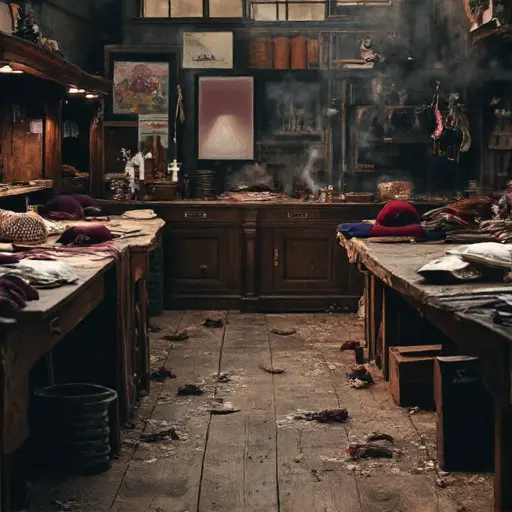
Stillness lies over every block and spool. On the central table, an unfinished hat crown sits stitched on one side, but its opposite seam pulls crookedly, revealing a faint gap. A feather fan rests beside it, two quills bent as if pressed too hard.
A ribbon iron cools mid-angle, abandoned before it could shape the final flourish. Nothing dramatic—only the faint ache of a craft interrupted at the moment it needed the steadiest hands.
A Milliner’s Routine Built on Shape and Restraint
This millinery loft holds the legacy of Eleanor Anne Hargreaves, milliner and decorative hatmaker, born 1879 just outside Manchester. Raised among modest textile workers, she trained under a traveling hatmaker who taught contour, gentle steaming, and the balance between ornament and structure. A tiny button charm from her sister, Beatrice Hargreaves, dangles from a ribbon spool near the windowless eaves.
Eleanor lived by cycles of shaping and refinement: dawn blocking of felt, midday trimming of brims, dusk stitching of linings under warm lamplight. Her tools remain neatly aligned—curved needles sorted by gauge, ribbons swirled in color order, feather trays arranged with patient care. Patrons once admired the quiet harmony of her hats, each adorned without excess.
A Once-Sure Craft Slipping into Uneven Edges
At her best, the loft fluttered with soft color. Crates of felt cones from Leeds stood in tidy rows. Feathers dyed in jewel shades dried along string lines. Finished hats circled the room atop wooden forms, balanced and effortless.
But subtle faults emerged. A brim edge waves where it should curve smoothly. A feather arrangement leans too far to one side. A ribbon frays along an uncharacteristically rough cut. Her commission ledger records a wealthy socialite’s name penned, erased, rewritten, then crossed out. A brief English note reads: “They say the fit lies.”
Whispers unfurled: the socialite accused Eleanor of crafting a hat whose structure failed at a public event—complaining that the brim sagged, that the mountings were weak. Others added she resisted a gaudy style requested by a patron known for sudden temper.
The TURNING POINT Marked in Felt and Strain
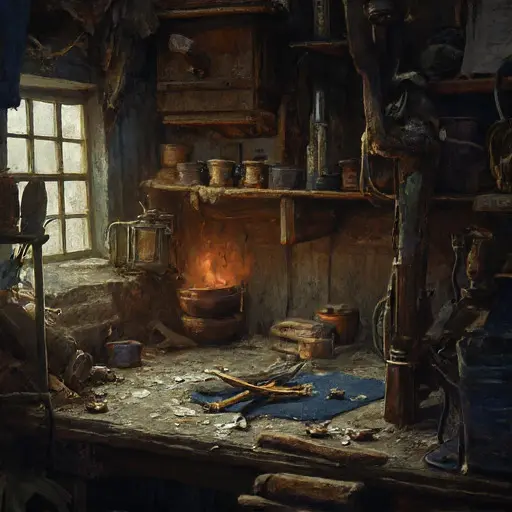
One evening left soft but certain signs. A nearly finished hat, intended for an exclusive event, sits misshapen in its block—one side pulled too tight, the other drooping. A needle lies bent at the tip. A bowl of stiffening agent has dried around the rim, crusted as if left untouched during a critical step.
Pinned beneath a torn length of ribbon is a scrap reading: “She blames me for the collapse.” Another fragment, ink uneven from a hastily dipped nib, adds: “Recompense demanded—beyond my means.” The sentence tails thinly into the paper. Even the feather shears, usually well-sharpened, bear a notch that misaligned their cut.
Across the table, a delicate veil meant for the hat’s crown remains folded, untrimmed, its lace disturbed by a single, unintended tear.
A Hidden Cubby Behind the Ribbon Cabinet
Behind the tall ribbon cabinet, a narrow board shifts back. Inside lies a half-formed fascinator: its felt base shaped impeccably, but its feather arc incomplete—only the central quill correctly set, the rest absent. A folded note in Eleanor’s even yet wavering script reads: “For Beatrice—when my shaping returns.” The last word tapers into faint graphite.
Beside it lies a perfectly dyed set of feathers, never mounted, their colors glowing softly in the dim loft light.
The Last Slipped Stitch
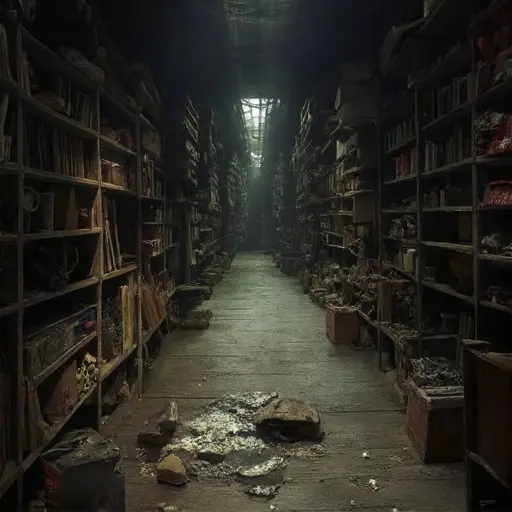
In a shallow drawer beneath the blocking stand rests a test swatch: a line of stitches even and proud until the final one, which veers sharply, pulling the fabric askew. Beneath it Eleanor wrote: “Even form falters when resolve thins.”
The millinery loft folds back into its felt-scented quiet, plumes stirring only in memory.
And the house, holding its abandoned hatmaker’s chamber, remains abandoned.
