The Forgotten Draft Folios of the Amsel Dollmaker’s Loft
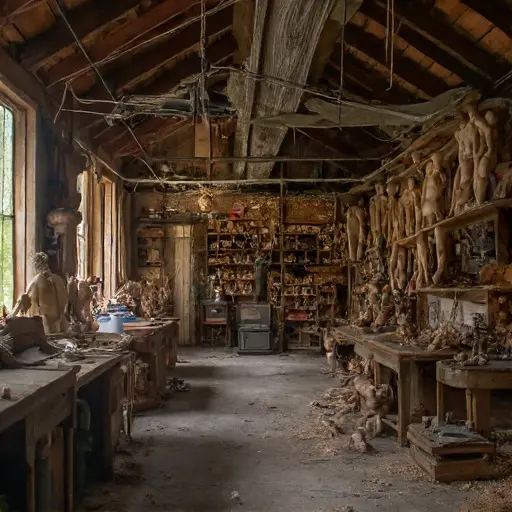
A brittle hush settles over the Dollmaker’s Loft, where a thin scatter of sketches surrounds a block of linden wood. One sheet bears a penciled pattern, abruptly broken off as if a final contour proved too difficult to settle.
Maker’s Ground
These scattered tools trace the habits of Friedrich Amsel, dollmaker (b.
1866, Erfurt), trained in modest guild practice. His script—German abbreviations spare and neat—lists repairs for village families. A note referencing his sister, Katja Amsel, “collect muslin on Thursday,” hints at steady routines, temperate and unhurried, moving between carving, sanding, and sewing.
Working the Grain
On a side bench, gouges rest wrapped in linen. Carved limbs, lightly articulated, show balanced joints. A brass caliper and folded stencil cards record proportions he reused with measured patience. Beneath a pressboard lid lies a ledger of commissions, each noted with restrained precision.
A Subtle Disturbance
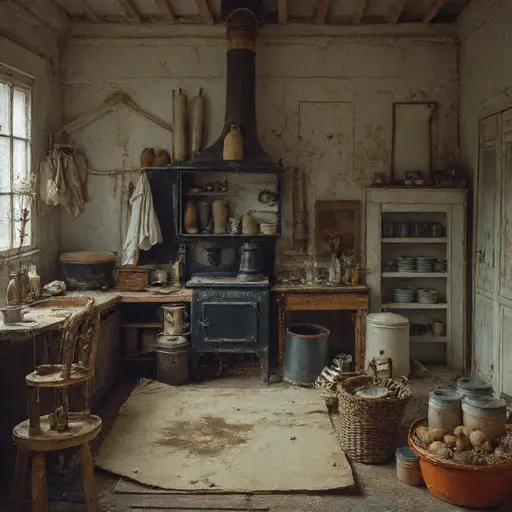
Later pages of Friedrich’s ledger waver: commissions redrafted, measurements crossed through. Doll heads of uneven symmetry accumulate near the lathe, some over-sanded, others barely shaped. One margin note—“delivery contested”—is smudged nearly blank. A drying rack of painted faces bears mismatched tones, suggesting faltering concentration rather than experimentation.
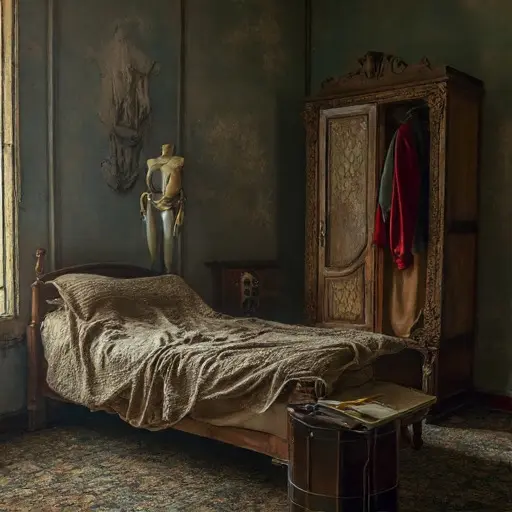
In the Loft’s final drawer, Friedrich’s draft folio reveals figures sketched to hesitant outlines, limbs barely articulated. A final note—“finish tomorrow, speak with Katja”—ends mid-stroke.
No trace resolves what pressed upon him, nor why Katja never retrieved the muslin.
The house receives its abandonment quietly, patterns left unfinished, tools awaiting hands that will not return.
